
Choosing a supplier near Paris involves more than finding a food-grade belt in stock. You need to compare the complete hygienic conveyor, its food-contact documentation, cleaning compatibility, operating limits, installation support and response time across Île-de-France.
Key takeaways
- Define whether you need a belt, complete conveyor, or integrated handling system.
- Match belt width, incline, speed and surface to the product and route.
- Request EU food-contact declarations and cleaning-chemical compatibility documents.
- Agree measurable throughput, hygiene and acceptance criteria before installation.
How to compare food conveyor belt suppliers near Paris
A food conveyor belt near Paris search covers three different supply scopes, so define yours before requesting prices.
| Scope | Supplier type | What to expect |
|---|---|---|
| Replacement belt | Distributor | Specified belt stock, emergency splice or replacement, and belt-only advice |
| Hygienic conveyor | Fabricator | Frame, drive, guards, installation and commissioning |
| Interconnected process line | Turnkey integrator | Conveying, dosing, mixing, controls, risk assessment and acceptance testing |
Ask whether the supplier covers Île-de-France, stocks your belt specification, sends installation technicians, commissions equipment and publishes after-sales response times. A nearby office does not prove rapid intervention; compare distance with actual technician coverage and documented response. Request processing-plant references with comparable hygiene, washdown and allergen changeover routines.
A sanitary food conveyor supplier must explain belt removal, product-contact access, drainage and cleaning time.
For a complete conveyor, require the legal manufacturer or integrator to provide the machinery risk assessment, guarding, technical file, operating instructions and EU Declaration of Conformity under the machinery rules applicable in France. A food conveyor belt France quotation is incomplete without these documents.
- State whether you need a belt, conveyor or complete line, then require an acceptance test with your product or validated surrogate.
- Record throughput, accumulation, transfer losses, belt tracking, incline performance, cleanability, changeover time, noise and guarding.
- Reject an unloaded dry-run-only test; compare the supplier’s service scope and evidence, not its Paris postcode.
Match the conveyor format to the product and route
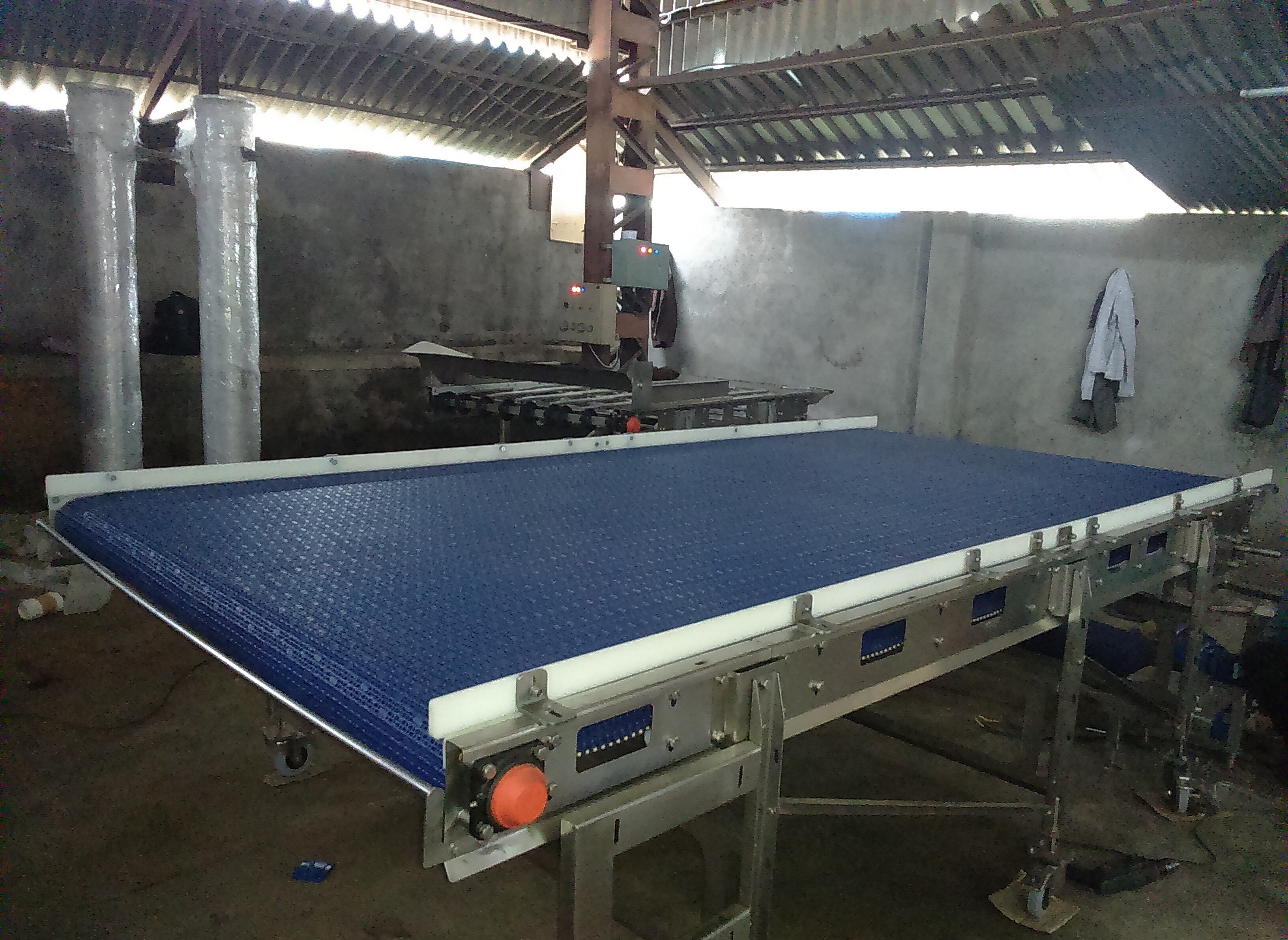
Use a straight belt for level transfers, inspection and packing lines. Choose an incline belt when the route changes elevation, then test product slip and set the required angle. Add cleats for loose or inclined products, but inspect the cleat-to-belt joint for retention points.
| Format | Best suited to | Check before approval |
|---|---|---|
| Straight belt | Level transfers, inspection, packing | Transfer gaps and tracking |
| Incline or cleated belt | Elevation changes, loose product | Slip behaviour, angle and cleanable cleat joints |
| Modular plastic belt | Washing, drainage, repeated transfers | Belt polymer and sprocket resistance to sanitation chemicals |
| Wire-mesh belt | Airflow, cooling, frying, baking and low-friction drainage | Exposed wires, edges and cleanability |
| Trough belt | Selected powders and bulk products | Return geometry, side containment and residue traps |
Match a food processing conveyor belt to the material: powders, flour and spices need containment; dough and sticky products need release and cleaning access; frozen, wet or oily products need suitable grip; fragile products need gentle transfers. Record allergen changeover steps, including belt removal, access to product-contact zones, drainage and cleaning time.
A food conveyor belt France quotation should state:
- Belt width, speed, throughput in kilograms per hour and load per metre
- Incline angle, particle size, product temperature and continuous or intermittent duty
- Belt surface, splice type and changeover procedure
Inspect the belt, frame and hygienic construction
Stainless steel alone does not make a food processing conveyor belt sanitary. Inspect the complete assembly against EN 1672-2 or ISO 14159 principles: 304 or 316 stainless steel, open profiles, radiused corners, cleanable welds, hygienic feet, sealed bearings, removable guards and accessible belt-return areas.
1. Examine transfer plates, frame joints, tensioners, drive components and dead legs for residue traps outside the belt surface. Confirm that tracking hardware is reachable without creating crevices, and that wash water drains rather than pools.
Ask the sanitary food conveyor supplier whether operators can remove or open the belt without special tools and how long cleaning and reassembly take.
2. Separate the food-contact belt from the frame in the specification. Name the belt material—polyurethane, PVC, silicone, thermoplastic polyurethane or stainless-steel mesh—and request its surface profile, thickness, tensile rating, approved temperature range, minimum pulley diameter, edge treatment, coefficient of friction where relevant and splice type.
3. Prefer an endless thermoplastic-welded belt when it removes fastener crevices, but require the weld method, allowable elongation, minimum pulley diameter, weld inspection and field-repair procedure. Treat metal-detectable or X-ray-visible material as an added control, not proof of detection; validate it with the actual product, belt thickness, detector or X-ray system, aperture and line speed.
A sanitary design still fails if the belt return or frame cannot be cleaned.
Verify EU food-contact documents and cleaning compatibility
Before approving a food conveyor belt France quotation, demand European food-contact evidence for every product-contact polymer component, not a one-line claim of “FDA compliance.” A Declaration of Compliance under Regulation (EC) No 1935/2004 must identify composition, intended food types, temperature limits, contact conditions and restrictions.
1. For plastic belts, request the applicable statement under Commission Regulation (EU) No 10/2011, including supporting migration or testing information where relevant. Ask how Regulation (EC) No 2023/2006 good manufacturing practice controls the supplied belt and other food-contact parts.
2. Give the sanitary food conveyor supplier your exact sanitation recipe: dry cleaning or low-pressure water, foam chemistry, caustic concentration, oxidising sanitiser, exposure time, rinse temperature, pressure, cleaning frequency and drying time. Obtain written resistance confirmation for alkaline detergents, hot water, fats and hydrolysis.
3. Treat IP65, IP66 or IP69K as enclosure-ingress information, not proof of hygienic design. Ask which principles from EN 1672-2 or ISO 14159 the supplier applies to welds, underside surfaces, fasteners, drainage and tracking components.
4. Require a cleaning-cycle demonstration covering tool-free belt removal, access to all product-contact zones, drainage, drying and reassembly time. A quotation from Metasis Equipments Pvt Ltd should be reviewed against these same sanitation-changeover records when it forms part of an integrated conveying or process line.
A belt that survives chemicals but traps residue still fails the process.
Related product
 | Belt Conveyor Metasis Equipment Pvt. Ltd. is a leading belt conveyor manufacturer in India, providing high-performance conveyor systems for efficient and reliable... View product → |
Set operating limits and acceptance criteria before installation
Reject any quotation that gives one nominal capacity: an acceptable food processing conveyor belt must state operating limits, test conditions and pass/fail values before fabrication.
1. Require confirmed values for product temperature, belt speed, throughput in kilograms per hour, belt width, incline angle, load per metre, particle size, minimum pulley diameter and continuous or intermittent duty. Describe the product as abrasive, oily, sticky, fragile, frozen, allergenic or prone to bridging.
2. State accumulation, transfer and sanitation changeover requirements, including allowable cleaning and reassembly time. Ask for an operating range, not a single capacity, and test belt tracking under full load, start-up torque, noise, transfer losses and throughput at the highest planned speed.
3. For a food conveyor belt near Paris, put commissioning dates, technician responsibilities, operator training, spare-parts provision, emergency response and after-sales contacts in the order. Name the response time and the person responsible; a Paris-region address alone proves nothing.
4. Use your actual product, or a validated surrogate, for the factory or site acceptance test. Record throughput, incline performance, full-load tracking, transfer losses, cleanability, sanitation changeover time, noise, guarding and documentation before final acceptance. An unloaded dry run cannot prove production performance.
Frequently asked questions
How should you compare food conveyor belt suppliers near Paris?
Define your supply scope first, then compare conveyor design, hygienic construction, documentation, cleaning compatibility and acceptance testing.
Which conveyor format suits a food processing line?
Choose the belt layout, width, incline, speed and transfer arrangement according to the product, route and handling risks.
What should you inspect on a sanitary food conveyor?
Inspect the belt material, frame, welds, fasteners, guarding, product-contact surfaces, access points and areas where residue can collect.
Which EU documents should a food conveyor supplier provide?
Request food-contact declarations for product-contact materials, material identification and cleaning-chemical compatibility information for the belt and relevant components.
What acceptance criteria belong in a conveyor installation contract?
Specify measurable limits for throughput, belt speed, tracking, product handling, cleanability, safety and performance during commissioning.