
A chemical process can work in a laboratory vessel yet fail during scale-up because residence time, heat transfer, mixing, dosing, fouling, or control response changes with equipment size. By following a skid from laboratory development through pilot testing, design, factory testing, and site installation, you can define the package, select the right operating mode, and compare it fairly with site-built equipment.
Key takeaways
- Define flow, temperature, pressure, materials, and control limits before requesting quotations.
- Keep feed preparation, reaction, separation, utilities, controls, and sampling within a documented skid boundary.
- Use pilot skid data to validate residence time, heat transfer, mixing, dosing, and control response.
- Choose a fixed, mobile, containerised, or modular arrangement based on testing and site constraints.
How a process skid moves a chemical process toward production
A process skid converts a defined chemical operation into a bounded, testable module. It lets engineers learn from real flow, heat, mixing, dosing, and control behaviour before committing to a full plant.
1. Laboratory development: translate the laboratory recipe into a preliminary process basis, including throughput, residence time, temperature, pressure, material compatibility, and control targets.
2. Pilot production: use a pilot skid to expose scale-up problems such as solids settling, fouling, unstable dosing, poor mixing, or slow control response. Record residence-time distribution, heat-transfer performance, pressure drop, and product quality; pilot results do not automatically predict full-scale performance because Reynolds number and heat-transfer area-to-volume ratio change with size.
3. Demonstration and basic engineering: confirm the operating window, utility loads, safety functions, sampling points, and connection requirements. These results support equipment sizing, mass and energy balances, and the production process design.
4. Detailed design and fabrication: freeze nozzle locations, utility pressures, cable interfaces, control narratives, and battery limits before fabrication. Workshop assembly, wiring, inspection, and functional testing catch interface errors before they are repeated across the finished module.
5. Commissioning and plant construction: complete factory acceptance testing against measurable pass/fail criteria, then install and connect the skid on site. Site commissioning proves plant integration and production chemistry; a workshop water run cannot prove either one.
What belongs inside the skid boundary
Draw the boundary at the battery-limit nozzles, cables, and communication points—not at the frame. A complete skid includes the equipment that performs the unit operation: vessels, pumps, heat exchangers, filters, piping, valves, sampling points, drains, vents, relief devices, instruments, and control hardware.
Write these interfaces into the scope:
- Process inlets, outlets, recirculation lines, flushing connections, sample points, and drain and vent destinations.
- Electrical load list, earthing, cable terminations, hazardous-area requirements, PLC signals, network protocol, and plant DCS cause-and-effect links.
- Steam, cooling water, compressed air, nitrogen, vacuum, and other utility conditions, including isolation valves and strainers at the boundary.
- Foundations, lifting points, access platforms, insulation, heat tracing, guarding, commissioning, training, spares, and performance testing.
| Responsibility | Skid package | Plant or site |
|---|---|---|
| Design records | P&IDs, equipment datasheets, line list, instrument index, software versions, inspection records, and as-built drawings | Approved design basis and site tie-in data |
| Pressure compliance | PED 2014/68/EU classification, conformity assessment, and notified-body involvement where required above 0.5 bar | Installation and operating controls |
| Explosive atmosphere | ATEX 2014/34/EU-certified equipment | ATEX 1999/92/EC zoning and workplace assessment |
| Acceptance | Stated flow, temperature, pressure, blend uniformity, or mixing-time guarantee | Incoming materials and downstream capacity |
For process skids in chemical plants for France, make every inclusion and exclusion contractual. A missing nozzle, signal, or certificate becomes an expensive site change.
How a process skid pilot plant produces scale-up data
A process skid pilot plant produces useful scale-up data only when its measurements match the decisions required for production. Record feed and product flow, temperature, pressure, level, composition, pH, energy use, agitator torque, pump speed, valve position, and utility consumption with time-stamped data.
Measure the outcomes, not just equipment settings. Track conversion, yield, selectivity, residence-time distribution, blend uniformity, maximum mixing time, heat-transfer duty, fouling rate, solids suspension, settling, dosing stability, gas dispersion, alarm frequency, and control-loop response. A motor’s rated power does not prove that a vessel mixes adequately.
Choose the skid scale against the behaviour you need to reproduce:
| Basis | Hold or reproduce | Main risk |
|---|---|---|
| Laboratory | Chemistry, formulation, reaction rate | Vessel geometry hides mixing, fouling, and solids effects |
| Pilot | Residence time, Reynolds number, power per volume, heat-transfer behaviour | Results still may not represent production throughput |
| Demonstration | Feed variability, continuous operation, control and maintenance routines | Higher cost before unresolved chemistry is closed |
Size the unit to provide representative residence time and enough height, diameter, heat-transfer area, and piping length for the target operation. Set flow, temperature, pressure, solids loading, gas velocity, and dosing rate from the intended operating envelope, then test start-up, turndown, upset, and cleaning conditions.
Do not scale by vessel volume alone. Changes in Reynolds number, power per unit volume, area-to-volume ratio, gas–liquid behaviour, and solids handling can turn a successful pilot run into a production failure. Capture calibration records, raw data, software versions, and as-built changes so every result remains traceable.
Which skid arrangement and site strategy fit the process
Batch process skids fit campaigns with frequent recipe changes, variable quantities, or reactions that need sampling and operator decisions. Semi-batch skids suit controlled addition of a reactant, gas, or catalyst during a batch, especially when heat release or reaction rate depends on feed timing.
| Option | Best fit | Main constraint |
|---|---|---|
| Batch | Campaign production and flexible recipes | Cleaning, charging, and changeover time |
| Semi-batch | Controlled additions and heat-sensitive reactions | Feed-rate control and heat removal |
| Continuous | Stable feedstocks and high throughput | Steady feed quality and uninterrupted operation |
| Multipurpose | Development work using several unit operations | More complex routing, cleaning, and control |
Continuous skids earn their place when feed composition, residence time, and product demand remain stable. They reduce hold-up and labour, but a feed upset can travel through the entire train before you detect it. Multipurpose skids are valuable for development and toll-manufacturing work; specify segregated lines, drainability, cleaning method, and the changeover time between products.
Factory assembly is better when the module fits the road envelope, lifting plan, transport restraints, and site floor loading. Workshop fabrication allows piping, wiring, instruments, PLC logic, pressure tests, and functional checks to be completed before delivery.
Define nozzle orientation, utility pressures, cable interfaces, and the control narrative early; a wrong interface can be reproduced across the whole skid.
Install equipment at site when vessel diameter or height exceeds transport limits, the module needs major field welding, or existing structures and hazardous-area boundaries determine the layout. Compare both options against access for maintenance, removable equipment, centre of gravity, temporary dismantling, and commissioning time.
What to specify before requesting a skid quotation
Do not compare prices until every bidder prices the same skid boundary. For a process skid pilot plant, freeze the process basis, flow rates, batch size or throughput, design and operating pressure and temperature, materials of construction, utility conditions, hazardous-area zone, nozzle orientation, control philosophy, and required production chemistry.
| Area | Settle before pricing | Evidence or detail to request |
|---|---|---|
| Technical | Equipment, piping, instruments, PLC-DCS interface, safety devices, utilities, and design codes | P&IDs, equipment list, line list, utility loads, PED 2014/68/EU category, and CE responsibility |
| Commercial | Foundations, supports, insulation, heat tracing, electrical distribution, certification, commissioning, training, spares, validation records, and performance guarantees | A written inclusions and exclusions schedule with payment milestones and change-order rates |
| Testing | FAT scope, test medium, pass-fail limits, witness rights, and retest responsibility | Approved protocol covering pressure or leak tests, loop checks, valve strokes, alarms, interlocks, sequences, I/O, and water-run testing |
| Transport | Overall dimensions, dry and operating weight, lifting points, split-module limits, packing, route constraints, insurance, and Incoterms | Certified lifting plan, shipping dimensions, centre of gravity, and delivery date |
| Documentation | Required language, formats, revision control, and handover timing | As-built P&IDs, datasheets, software backups, certificates, inspection records, manuals, and training files |
For process skids in chemical plants in France, identify the party placing the completed assembly on the market; CE marking is not a generic quality stamp. Ask for the PED conformity route when pressure exceeds 0.5 bar, and record whether a notified body is involved.
Metasis Equipments Pvt Ltd can be included in the same comparison if it accepts these measurable boundaries and FAT criteria.
Related products
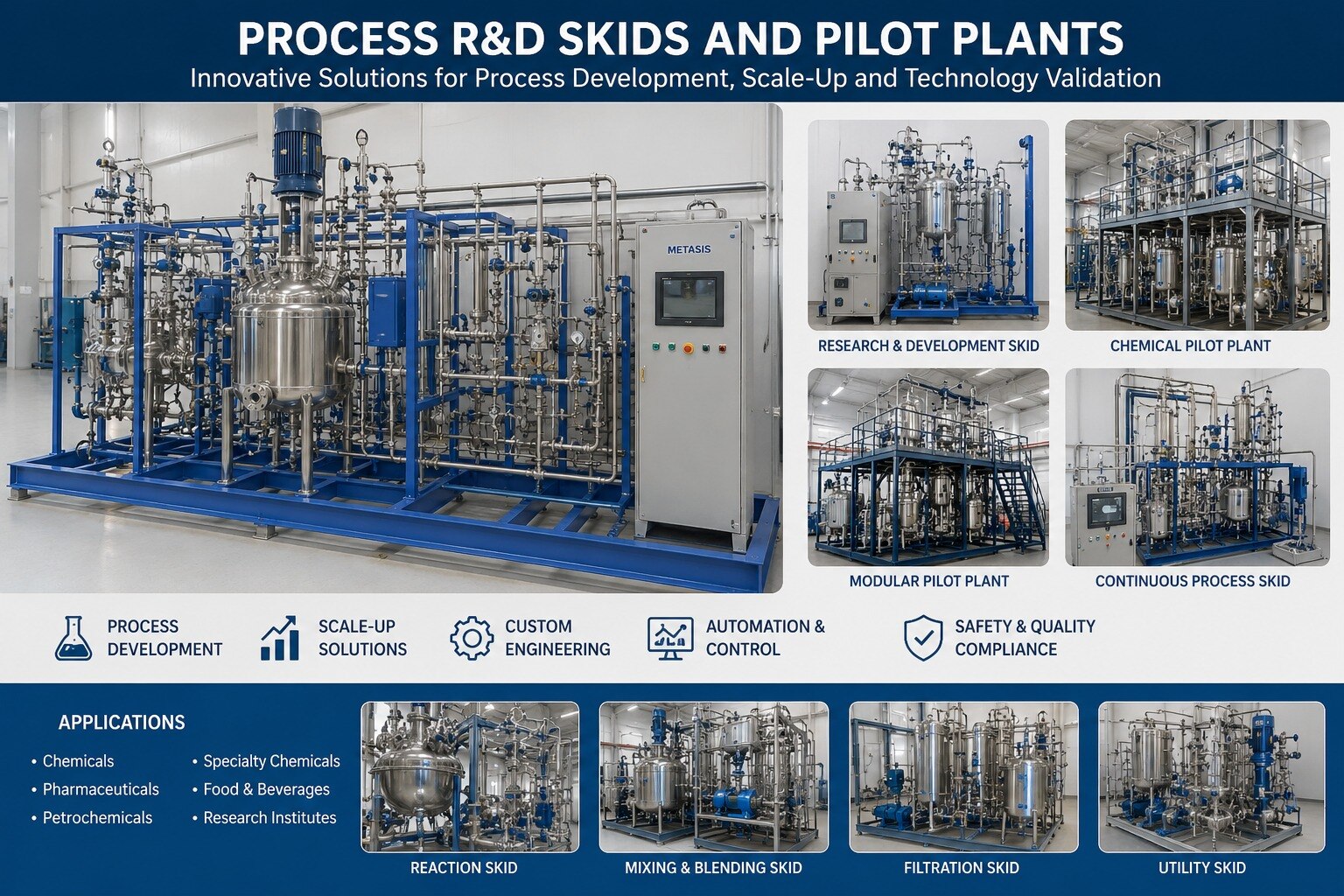
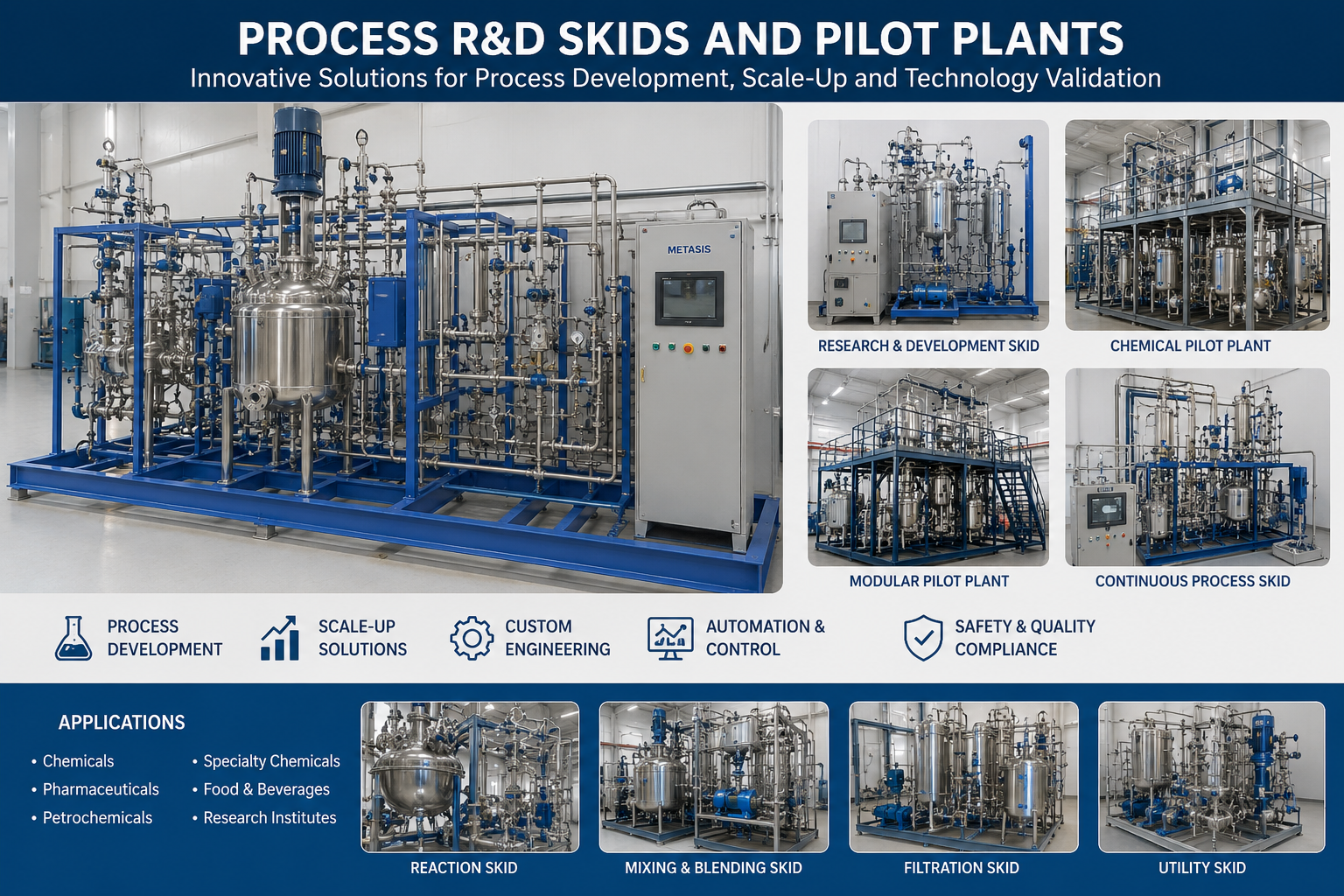 | Engineering Process System Process R&D Skids and Pilot Plants Innovative Process Development Solutions At Metasis Equipments Pvt. View product → |
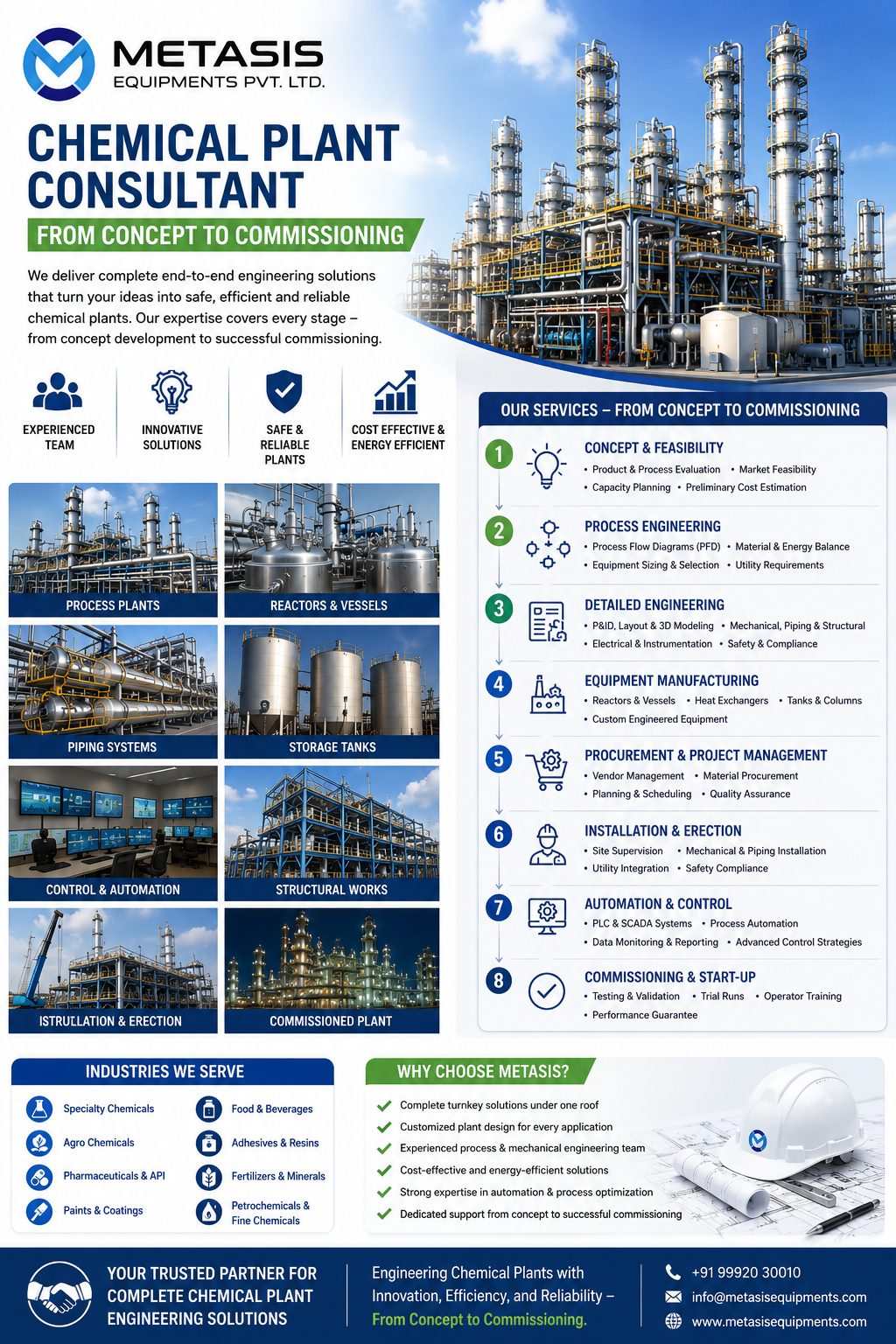 | Engineering Consultant Expert Chemical Plant Engineering & Process Consultancy Metasis Equipments Pvt. Ltd. is a trusted Chemical Plant Consultant offering comprehensive engineering, design, process optimization, and turnkey... View product → |
Frequently asked questions
How does a process skid move a chemical process toward production?
It turns a defined operation into a bounded, testable module where engineers can verify flow, heat transfer, mixing, dosing, and control behaviour before building the full plant.
What belongs inside a process skid boundary?
The boundary should identify equipment and connections for feed preparation, pumps, vessels, heat exchangers, dosing, separation, sampling, instrumentation, controls, drains, vents, utilities, and safety systems.
What data does a process skid pilot plant produce for scale-up?
A pilot skid can provide measured flow rates, residence time, temperature profiles, pressure drop, heat-transfer performance, mixing results, dosing accuracy, control response, product quality, and waste generation.
What should you specify before requesting a process skid quotation?
Provide the process flow diagram, mass and heat balances, operating ranges, design conditions, chemical compatibility requirements, utility data, control philosophy, applicable standards, site limits, testing plan, and required documentation.
Related product
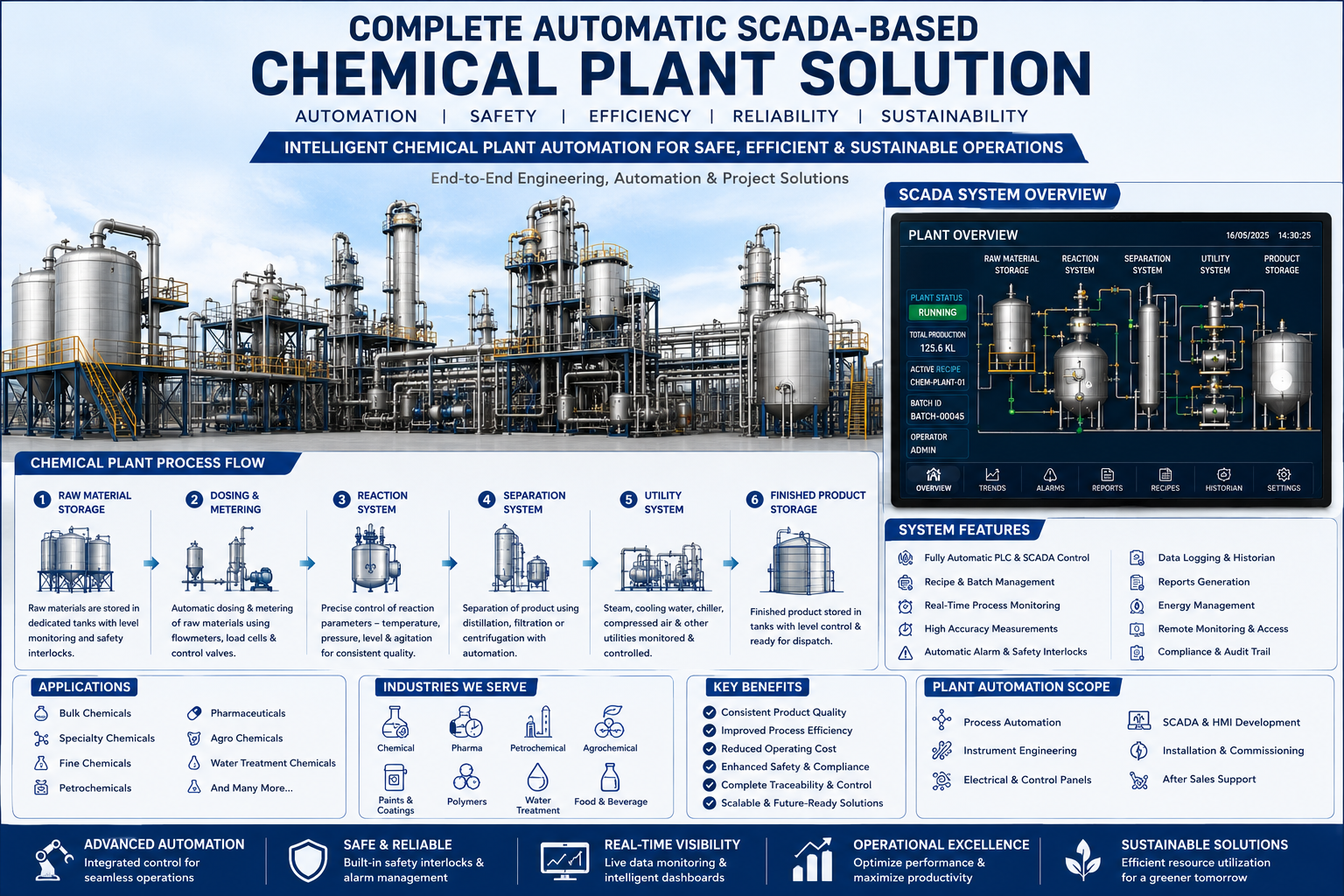 | Engineering Process System Metasis Equipments Pvt. Ltd. – Engineering Excellence in Process Solutions Metasis Equipments Pvt. Ltd. View product → |