
Choosing a ribbon blender for specialty chemicals requires more than matching a vessel volume to a batch size. You will be able to assess the mixing mechanism, compare alternative technologies, specify containment and materials, calculate capacity, and evaluate French suppliers against a practical process specification.
Key takeaways
- Select opposing inner and outer ribbons for countercurrent batch circulation.
- Size the blender from bulk density, fill volume, liquid addition and batch time.
- Specify seals, materials and containment around the chemical’s hazard profile.
- Compare French suppliers by test data, documentation, service and integration scope.
How Inner and Outer Ribbons Move a Chemical Batch
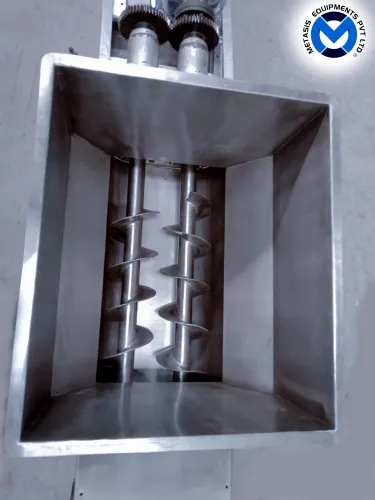
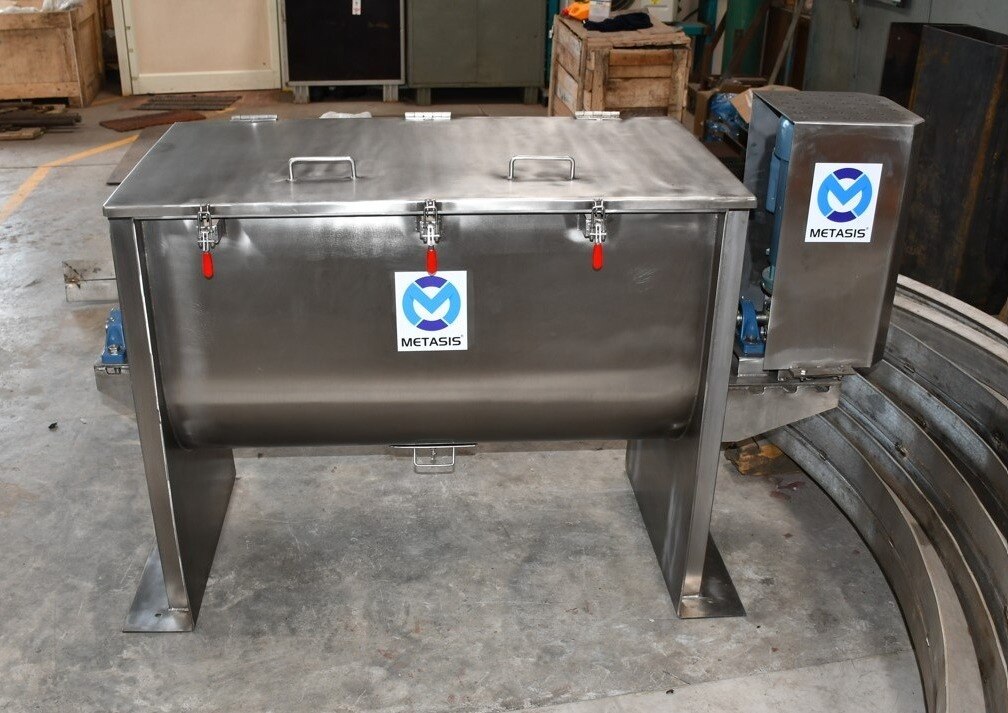
A ribbon blender for chemicals creates uniformity through countercurrent circulation. The outer helical ribbon pushes material toward one end while the inner ribbon moves it toward the other, producing opposing axial streams. As these streams cross, particles continually exchange position from the wall toward the shaft and back, creating radial movement across the vessel.
This is low- to moderate-shear mixing, so it suits a dry powder blend when the components tolerate gentle handling. It will not replace a high-shear mixer where the process demands intensive deagglomeration, emulsification or rapid wetting.
Set the mixing time and ribbon tip speed from trials; geometric similarity alone does not guarantee the same result after scale-up.
Fill level changes the circulation pattern. Underfill leaves the ribbons partly exposed, reducing turnover and allowing poorly mixed pockets near the shaft or vessel ends. Overfill restricts ribbon movement, raises torque and can leave material unmixed below the shaft.
Use the manufacturer’s validated minimum and maximum working fill, not the vessel’s quoted total capacity. Then test samples from the blender and discharge stream: differences in particle size, density, shape or electrostatic behaviour can separate a uniform batch during discharge, conveying, vibration or filling.
A good sample inside the mixer does not prove the packaged chemical remains uniform.
Choose the Mixer Around the Formulation, Not the Product Name
Select the mixer by bulk density, particle-size distribution, moisture, cohesiveness, abrasiveness, corrosiveness and shear sensitivity—not by the chemical’s product name. The right specialty chemical mixing equipment also depends on batch size, liquid addition, heat transfer, containment, discharge behaviour and whether the process must deagglomerate, coat, dissolve or dry.
| Option | Best fit | Choose it when |
|---|---|---|
| Ribbon blender | Dry powders, crystals, granules and premixes; low-to-moderate shear | You need economical axial circulation for a free-flowing or mildly cohesive batch and can control segregation after discharge. |
| Paddle mixer | Gentle, adaptable convective mixing | Particles are fragile, shear-sensitive or irregular, and you need careful liquid addition without intensive size reduction. |
| Ploughshare mixer | Intensive convective movement with optional choppers | Cohesive powders, compacted lumps or difficult liquid incorporation need stronger movement; verify that the added shear will not damage particles. |
| Conical screw mixer | Gentle three-dimensional mixing and controlled discharge | A broad fill range, fragile solids, low-shear handling or difficult vessel emptying matters more than rapid blending. |
| High-shear mixer | Deagglomeration, emulsification and rapid wetting | The formulation contains hard lumps, binders or liquid-solid reactions; a faster ribbon-blender motor is not a substitute. |
| Fluidised-bed mixer | Air-assisted mixing, coating or drying | Particles can fluidise without excessive attrition and the process requires simultaneous gas contact, drying or coating. |
Check segregation during discharge, conveying and filling, not only inside the vessel. Confirm scale-up with the actual powder using fill ratio, tip speed, mixing time, torque, temperature and bulk density; request a trial before selecting the machine.
Specify Capacity, Liquid Addition and Throughput in Measurable Terms
A 1,000 L vessel does not produce a 1,000 L batch. Obtain the manufacturer’s validated minimum and maximum working fill, then calculate capacity from the actual powder bulk-density range, not vessel geometry alone.
1. Calculate working volume as total vessel volume × target fill ratio. For example, 1,000 L × 0.60 = 600 L working volume.
2. Calculate fill ratio as working volume ÷ total vessel volume × 100. Keep the result inside the validated range; underfilling weakens circulation, while overfilling restricts ribbon movement and raises drive torque.
3. Calculate powder batch mass as working volume × measured bulk density. At 600 L and 0.55 kg/L, the batch is 330 kg. State loose and tapped densities if consolidation changes the result.
4. Specify liquid addition as kilograms or litres per batch, concentration, addition rate, nozzle location and addition time. For a 12 kg liquid addition over 6 minutes, the rate is 2 kg/min; include the liquid in final batch mass.
5. Establish mixing time from trials at the target fill, tip speed, torque or power draw and temperature. Record the time needed to meet the blend-uniformity limit, then verify samples after discharge.
6. Measure discharge time from the open-gate command to an empty, inspectable vessel. Calculate throughput as batch mass ÷ total cycle time, where total cycle time includes charging, mixing, discharge and cleaning.
Test the discharge device and conveying route with the actual formulation. Segregation can begin after an acceptable blender sample, especially during a long drop or pneumatic transfer.
Match Materials, Containment and Protection to the Chemical Hazard
Product-contact construction must match the chemical, not merely the bulk powder. Specify 316L stainless steel or another compatible alloy, the internal surface finish, weld treatment, gasket material, shaft and ribbon clearances, and seal type. Corrosive ingredients can attack welds; abrasive solids can wear a thin surface and contaminate the batch.
Write these liquid-addition details into the specification:
- State liquid viscosity, surface tension, temperature, addition mass or volume, spray rate, and acceptable moisture distribution.
- Require a spray manifold or defined multiple injection points when uniform wetting matters; one inlet can create balls, wall deposits, and wet pockets.
- Identify the nozzle material, cleanability, blockage controls, and whether the mixer must operate under dust extraction during spraying.
For toxic, sensitising, or potent powders, replace an open charging port with contained charging, a split-butterfly valve, continuous liner connection, or glovebox interface. Specify dust extraction airflow, purgeable or mechanical seals, bearing protection, and the cleaning or decontamination method.
For combustible dust, provide the product’s minimum ignition energy, Kst, maximum explosion pressure, ignition temperature, and dust-cloud test basis. Define grounding, bonding, temperature limits, and explosion venting, suppression, or isolation. ATEX equipment compliance under Directive 2014/34/EU does not replace the employer’s zoning and worker-protection assessment under Directive 1999/92/EC. State the intended zone.
A vacuum-rated vessel, pressurised jacket, or steam circuit also needs design pressure, design vacuum, test pressure, temperature range, and PED category.
How to Compare French Suppliers Before You Order
Distance is a weak buying criterion. Search results for “ribbon blenders near me,” “industrial ribbon blender france,” and “ribbon blenders for specialty chemical production france” matter less than evidence from your formulation and discharge route.
Ask each supplier for:
- A trial report using your actual powder, including fill ratio, tip speed, mixing time, torque or power draw, temperature, and samples taken after discharge.
- Results from the discharge, conveying, and filling path; a sample taken inside the vessel alone cannot reveal segregation after vibration or pneumatic transport.
- A cleaning demonstration showing residue at the shaft, end plates, seals, bottom gate, and valve.
- The risk assessment, guards, interlocks, emergency-stop design, instructions, Declaration of Conformity, CE file, and ATEX documentation where the dust hazard requires it.
- References for commissioning, operator training, spare parts, and process validation in France.
| Supplier type | Evidence to compare | Warning sign |
|---|---|---|
| Nearby fabricator | Trial access and French service response | Fabrication drawings but no powder data |
| Industrial ribbon blender France supplier | Scale-up using tip speed, fill ratio, density, torque, and heat profile | Scale selected from volume alone |
| Turnkey project supplier | Integrated dosing, containment, discharge, conveying, validation, and legal documentation | Mixer tested but downstream equipment ignored |
Ask Metasis Equipments Pvt Ltd for the same evidence; a fair comparison depends on identical test conditions, acceptance criteria, and delivery scope—not the supplier’s location.
Related product
 | Ribbon Blender Efficient Powder Mixing Solutions Since 2012, Metasis Equipments Pvt Ltd has been manufacturing high-performance Ribbon Blenders for various... View product → |
Frequently asked questions
How do inner and outer ribbons move a chemical batch?
The outer ribbon pushes material toward one end while the inner ribbon moves it toward the other, creating opposing axial streams and radial exchange between the wall and shaft.
What information should you provide when sizing a ribbon blender?
Provide formulation ingredients, bulk density range, batch mass, target fill volume, liquid addition rate, required mixing time and desired throughput.
How should you match a ribbon blender to a chemical hazard?
Specify wetted materials, shaft and seal design, dust containment, grounding, temperature control and any required explosion-protection measures from the hazard assessment.
How can you compare ribbon blender suppliers in France?
Compare documented mixing trials, equipment drawings, materials and seals, containment provisions, delivery scope, commissioning support and after-sales service.