
The fee is justified when outside expertise removes a costly process, safety, or integration risk that your plant team cannot resolve efficiently. By comparing project stages, alternative providers, expected deliverables, and total lifecycle costs, you can decide whether to hire external support or keep the work in-house.
Key takeaways
- Hire external engineers when coordination, compliance or commissioning risk exceeds their fee.
- Choose an EPC contractor for delivery; choose a consultant for independent design decisions.
- Calculate value from throughput, downtime, labour, energy and rework—not equipment price alone.
- Demand a design basis, performance tests, documentation and clear acceptance criteria.
What does an industrial process engineering company actually do?
An industrial process engineering company turns a production requirement into a coordinated plant design, then proves that the plant meets it. Its work begins with a documented design basis, not a preferred machine or copied vendor quotation.
1. The team converts the process brief into measurable conditions: production rate, batch size, material properties, operating temperature and pressure, turndown, cleanability, allowable segregation, and process limits. For conveying, dosing, and mixing, it records bulk density, particle-size distribution, moisture, abrasiveness, cohesiveness, flowability, dust explosibility, and required residence time.
2. It prepares heat and mass balances, utility loads, and process flow diagrams. These expose shortages early: a feeder that cannot reach turndown, a mixer with inadequate residence time, or a compressed-air system that cannot support conveying.
3. It compares equipment against the duty, including pneumatic versus mechanical conveying, loss-in-weight versus volumetric dosing, and batch versus continuous mixing. Material testing or pilot trials matter because moisture, temperature, degradation, and particle size can change performance.
4. It develops equipment datasheets, piping and instrumentation diagrams, controls, interfaces, and the plant layout. The team then supports procurement, checks vendor documents, resolves construction interfaces, and protects the original design basis.
5. During commissioning, it coordinates mechanical completion, instrumentation checks, dry functional tests, water or inert tests, material trials, operator training, and performance testing.
6. A validated acceptance test specifies the material condition, feed rate, test duration, accuracy interval, capacity, and pass criteria. A nameplate capacity claim proves only what the supplier printed, not what your integrated plant can achieve.
When is external process engineering support worth the fee?
If you are asking, “are process engineering for companies worth hiring?”, use one test: hire external support when it removes a decision or integration risk your team cannot manage efficiently in-house. The fee earns its place when a wrong choice could cause rework, lost production, unsafe operation, or chronic maintenance.
The case is strongest for a new plant, capacity increase without validated process data, repeated bottlenecks, unexplained yield loss, unsafe manual dosing, poor utility balance, frequent equipment failures, hazardous materials, or competing technologies and layouts.
1. Feasibility and concept design compare process options, establish cost boundaries, and expose unresolved assumptions before equipment selection.
2. Front-end engineering design fixes the design basis, process limits, utility loads, layout constraints, and acceptance criteria. It prevents a cheap quotation from becoming an expensive redesign.
3. Basic and detailed engineering reduce clashes and rework through drawings, specifications, controls, and interfaces. Procurement support then protects those specifications when vendors submit substitutions or incomplete data.
4. Construction support resolves site interfaces. Commissioning and ramp-up test capacity, dosing accuracy, and product quality with real wet, hot, abrasive, sticky, or full-rate materials; debottlenecking identifies chronic losses after startup.
The fee is harder to justify for a simple, standard machine with a defined duty, complete internal data, and one competent equipment supplier. An internal engineer or the vendor’s application team may be sufficient.
Do not pay an external firm merely to reproduce supplier quotations; pay it to make and integrate decisions your organisation cannot validate alone.
Which provider should you hire: process engineering company, EPC contractor, vendor, or internal team?
Hire the provider whose responsibility matches the risk you need removed. Decide whether you need plant-wide integration, independent technology selection, machine expertise, construction ownership, or support from people who already know your operation.
| Option | Responsibility | Best fit and limitation |
|---|---|---|
| In-house engineering department | Uses plant knowledge and operator access; coordinates quickly at low external cost | Best for familiar processes and routine changes; specialist capacity may be lacking for new technology or peak workloads |
| Equipment manufacturer | Designs and supports its own feeder, mixer, conveyor, filter, or controls package | Best when the duty is defined; recommendations remain bounded by that product range |
| Independent process consultant | Establishes the process basis and compares pneumatic with mechanical conveying, loss-in-weight with volumetric feeding, and batch with continuous mixing | Best before equipment selection; may not execute the full installation |
| EPC contractor | Provides single-point coordination and construction responsibility | Best when turnkey delivery matters; check proprietary controls, battery limits, change orders, and concentration risk |
| Process engineering company | Provides technology-neutral design, interface control, and owner’s engineering | Best before committing to equipment or an EPC route; confirm its construction and commissioning scope |
Process engineering companies add the most value when several technologies satisfy the nominal duty but differ in energy use, maintenance, segregation, contamination, or changeover performance. Use an engineering company for manufacturers when the assignment centres on developing a product or machine, not integrating a plant.
Define battery limits, guarantees, interfaces, and acceptance tests before appointing anyone; a turnkey promise without those boundaries transfers convenience, not necessarily risk.
How do you calculate the business case and prepare a good brief?
Build the case as an avoided-cost calculation: compare the engineering fee and any added capital cost with avoided design rework, procurement delays, production downtime, energy use, material loss, maintenance, labour, disposal, and the cost of an incorrect equipment specification. Quantify lost output from plugging, bridging, segregation, off-specification batches, excessive wear, dust cleanup, and manual intervention.
Include utilities, consumables, spare parts, and the cost of manual intervention over the plant’s operating life.
Before inviting a process plant consultancy, prepare:
- Process flow diagram and mass balance
- Production rate and batch size
- Raw-material properties, including bulk density, moisture, abrasiveness, cohesiveness, and particle-size distribution
- Operating temperature and pressure
- Available utilities and utility capacities
- Applicable material standards
- Site constraints and layout information
- Target commissioning date
Request an estimate with these controls:
| Check | Require | Why it matters |
|---|---|---|
| Scope boundary | Battery limits, deliverables, and interfaces | Prevents missing work and change-order disputes |
| Estimate basis | Estimate class, cost date, and contingency basis | Early low-definition estimates are not directly comparable with later detailed estimates |
| Assumptions | Unresolved process, utility, site, and material assumptions | Exposes risks before equipment is selected |
| Effort | Engineering hours, disciplines, exclusions, and planned site visits | Separates real engineering from a thin review |
| Validation | Testing assumptions and responsibility for vendor data | Defines who proves performance and checks supplier claims |
This comparison distinguishes genuine risk reduction from a low-cost proposal that merely repackages supplier quotations.
Which deliverables and guarantees prove that the fee created value?
Value is proven by documents, defined interfaces, and witnessed acceptance tests—not by a polished equipment quotation. Require these items before approving the fee:
- Process design basis, heat and mass balances, PFDs, P&IDs, equipment datasheets, plot plan, layout drawings, line lists, instrument index, control narrative, utility summary, hazard-review actions, vendor-document register, and commissioning plan.
- For hazardous or combustible-dust service, material hazard data, ignition-source controls, venting or suppression decisions, equipment isolation, housekeeping provisions, and closure tracking for every HAZOP recommendation. HAZOP, including an IEC 61882-based study, cannot repair an incomplete design.
- For integrated machinery, an interface responsibility matrix covering guards, interlocks, emergency stops, stored energy, access, cleaning, permissives, and restart behaviour.
Compare proposals using the same acceptance structure:
| Area | Require | Proof of value |
|---|---|---|
| Design | Battery limits and complete engineering register | Approved documents with revision control |
| Performance | Feed condition, capacity, dosing or blend accuracy, availability, noise, dust emissions, and energy consumption | Witnessed test using defined material and method |
| Handover | Spares, training, documentation, retesting, as-builts, and control backups | Signed handover pack and successful operator demonstration |
Commissioning must advance through mechanical completion, instrumentation checks, dry functional tests, inert or water tests where appropriate, material trials, and full-rate performance testing. Include operator training, as-built drawings, control backups, and a clear obligation to retest after design changes.
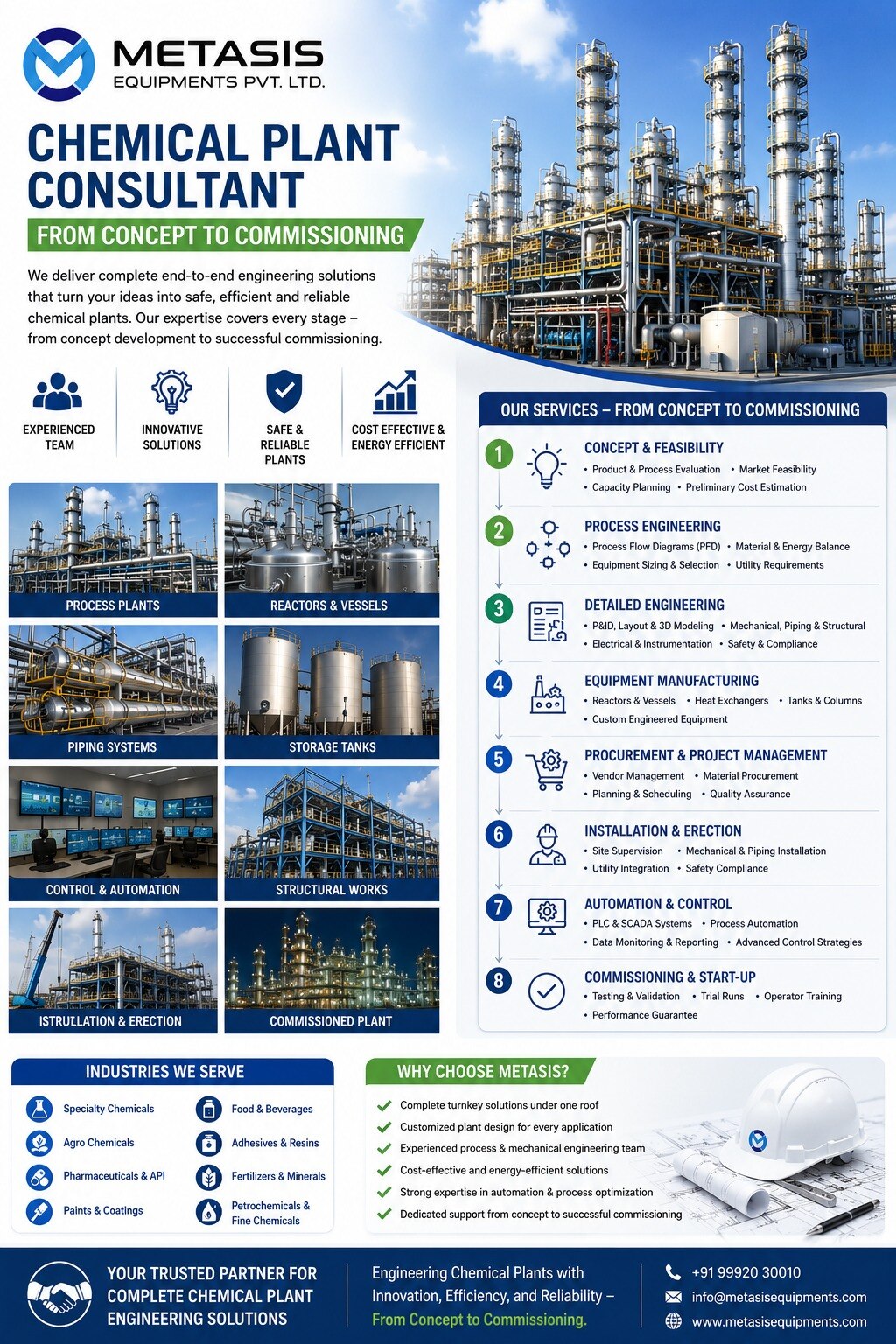
Assess Metasis Equipments Pvt Ltd against this checklist, especially its battery limits, interface ownership, exclusions, and acceptance criteria, rather than treating its quoted scope as proof of value.
Related products
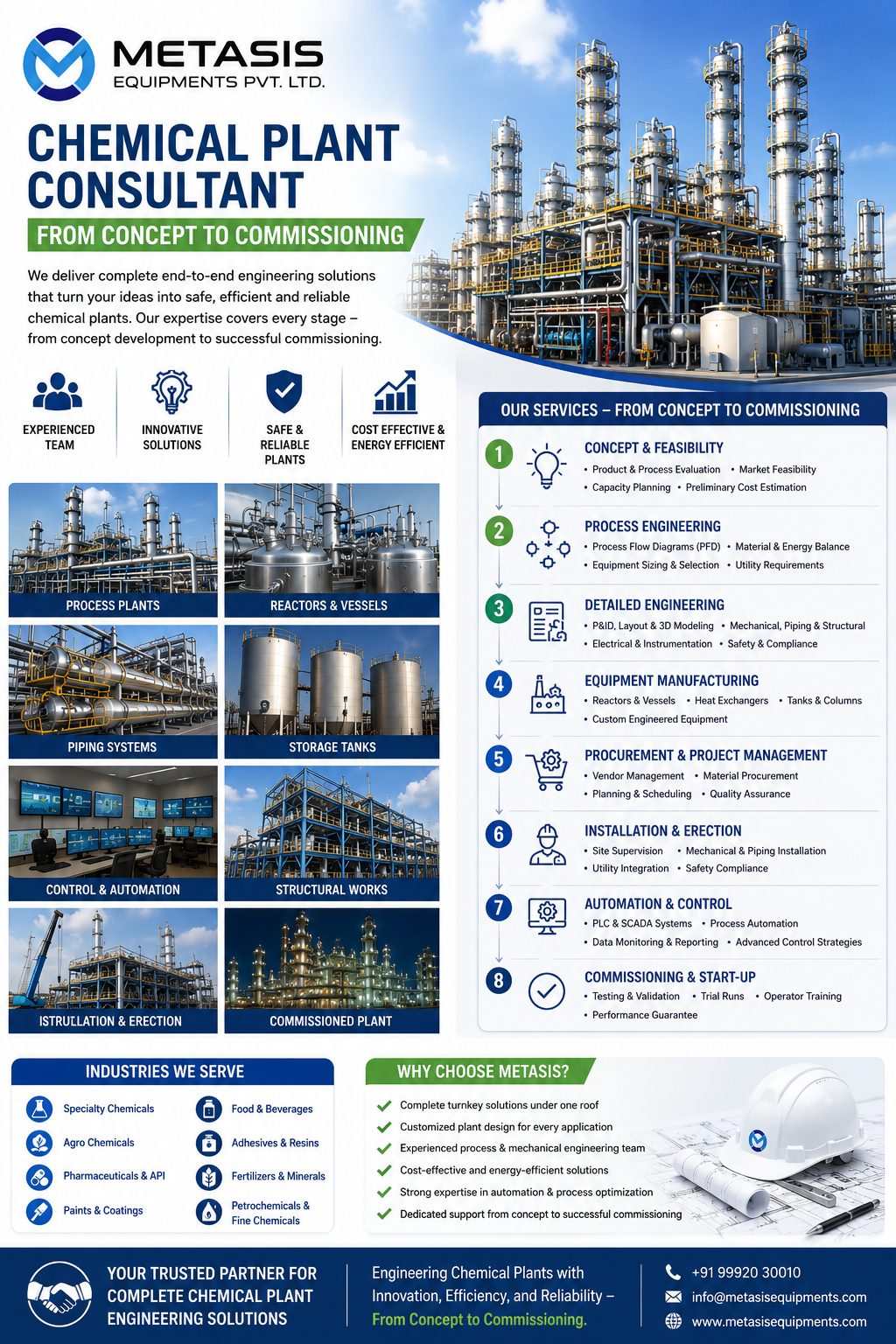 | Engineering Consultant Expert Chemical Plant Engineering & Process Consultancy Metasis Equipments Pvt. Ltd. is a trusted Chemical Plant Consultant offering comprehensive engineering, design, process optimization, and turnkey... View product → |
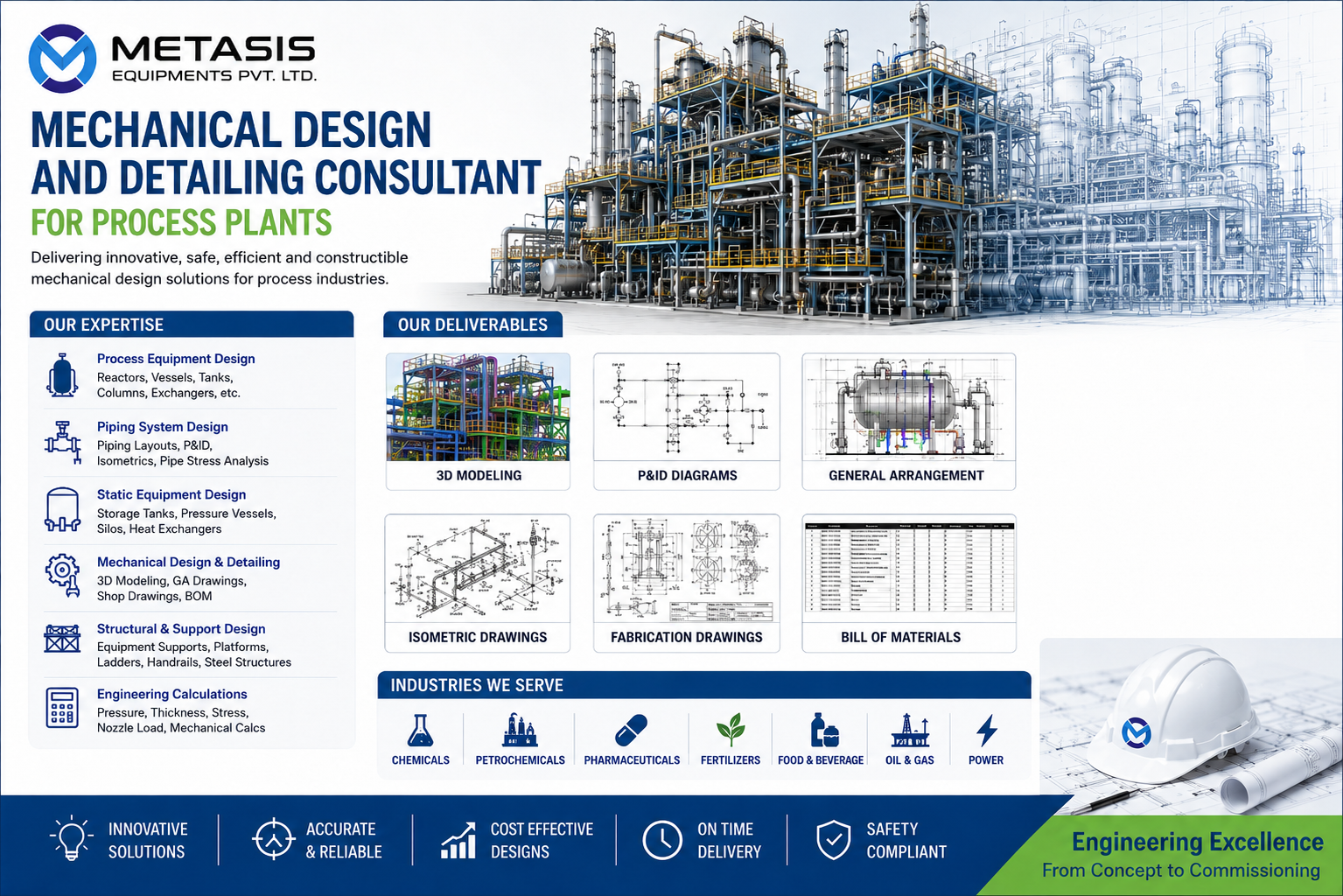 | Engineering Consultant Mechanical & Detailing Consultant for Process Industry Precision Engineering. Detailed Design. Reliable Execution. Metasis Equipments Pvt. Ltd. View product → |
Frequently asked questions
What does an industrial process engineering company actually do?
It converts a production requirement into a coordinated plant design using a documented design basis, process calculations, equipment specifications, layout, controls and commissioning checks.
When is external process engineering support worth the fee?
External support earns its fee when the project involves unfamiliar processes, multiple equipment suppliers, capacity constraints, compliance exposure or costly commissioning and downtime risks.
Should you hire a process engineering company, EPC contractor, vendor or internal team?
Use an internal team for familiar, controlled improvements; a vendor for a defined machine; a process engineering company for independent design and coordination; and an EPC contractor for single-point responsibility for plant delivery.
How do you calculate the business case for process engineering?
Compare the engineering fee with expected gains in throughput, uptime, labour, energy, yield and safety, then subtract added operating, maintenance and implementation costs.
Which deliverables prove that process engineering created value?
Request the design basis, mass and energy balances, equipment specifications, layouts, control philosophy, risk assessments, commissioning records, performance-test results and acceptance criteria.
Related products
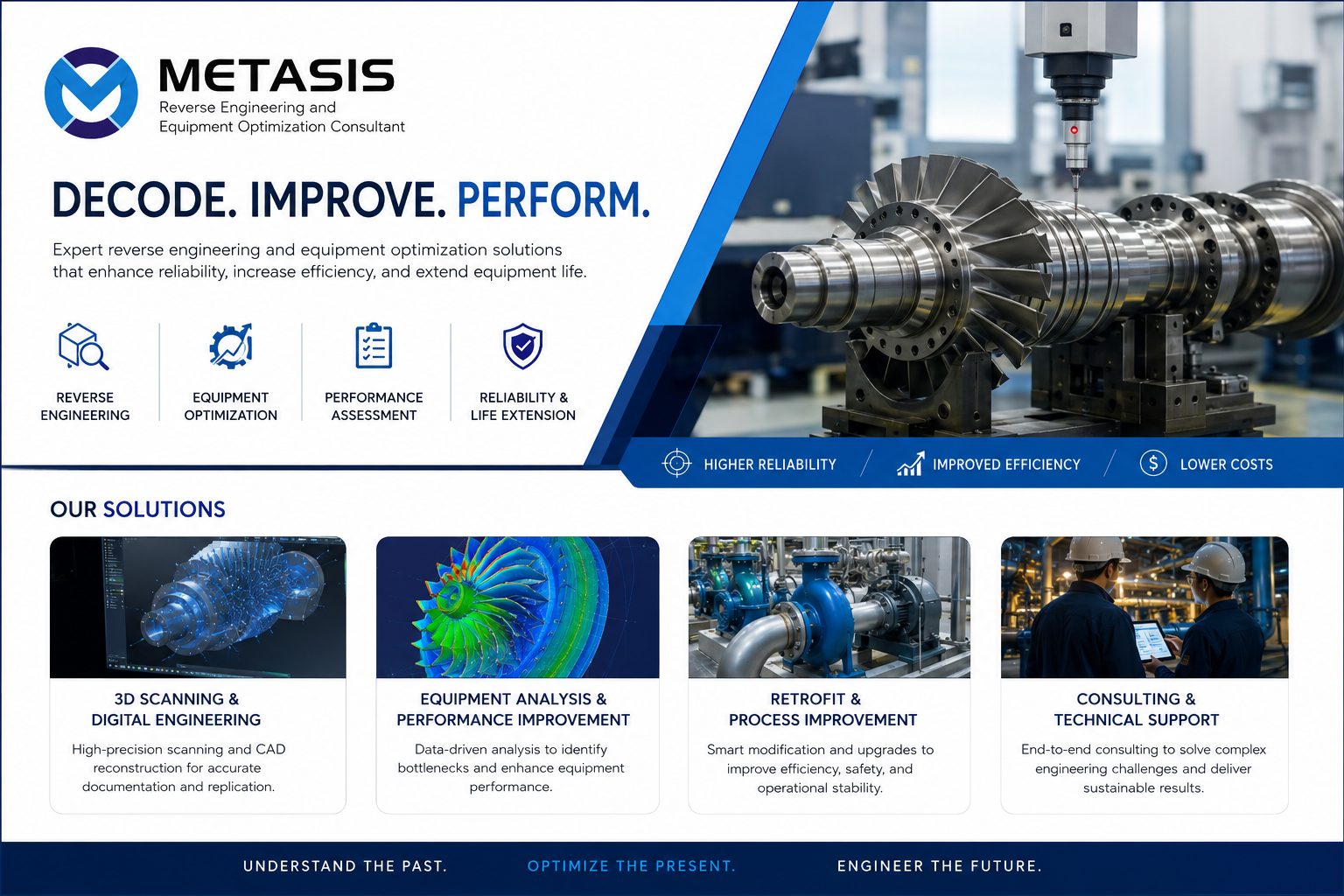 | Engineering Consultant Reverse Engineering & Process Optimization Consultant Re-Engineer. Optimize. Improve Performance. Metasis Equipments Pvt. Ltd. View product → |
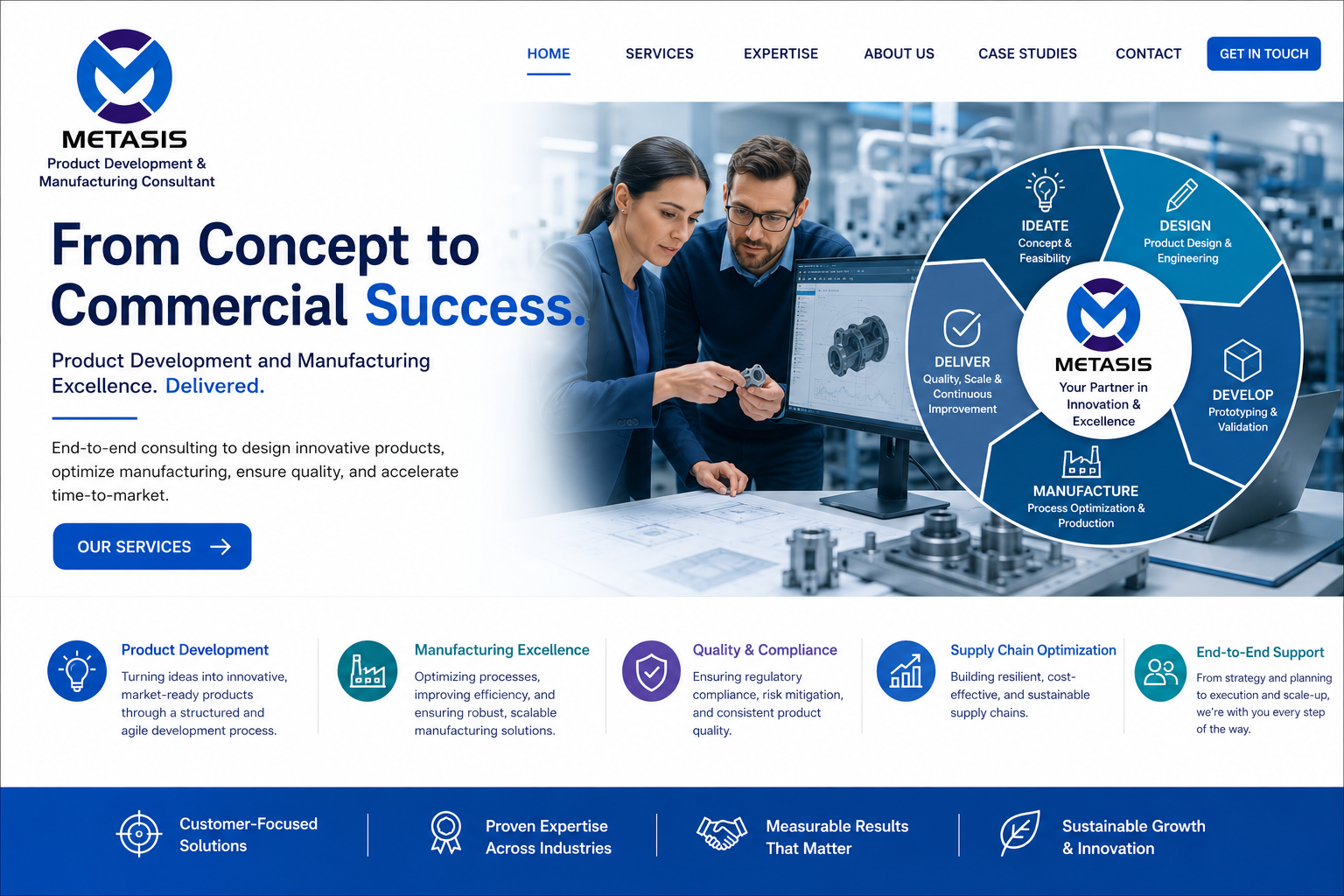 | Engineering Consultant Product Development & Procurement Consultancy for Process Industry Innovative Product Development. Strategic Procurement. Sustainable Growth. Metasis Equipments Pvt. Ltd. View product → |