
Throughput alone cannot produce a defensible elevator specification: moisture, bulk density, fibre length, dust behaviour and contamination all change the design. By the end, you will have a basis for comparing quotations, selecting the right elevator arrangement and checking whether the proposed equipment is safe and maintainable on a London site.
Key takeaways
- State feedstock type, moisture, bulk density and particle size before requesting prices.
- Size the elevator for peak mass flow, not average tonnes per hour.
- Specify magnets, dust control, fire detection and access for safe biomass handling.
- Demand drawings, test records, commissioning checks and measured capacity from suppliers.
What feedstock and duty data must go into the enquiry?
Start with the feedstock, not the machine. State whether it is wood chips, straw, shredded paddy, pellets, husks, refuse-derived fuel, digestate solids or a blended feedstock. A bucket elevator for biomass facilities in London cannot be sized from tonnes per hour alone.
- Record moisture range; bulk density at minimum and maximum moisture; particle-size distribution; maximum lump size; fibre length; angle of repose; temperature; abrasiveness; and contamination from stones, ferrous scrap or tramp metal.
- Explain the consequence of each value: long fibres bridge and wrap, wet digestate smears and blocks chutes, pellets generate combustible dust, and heavy or abrasive feedstock accelerates bucket, liner and belt or chain wear.
- Add required tonnes per hour, lift height, inlet and outlet elevations, duty hours, starts per hour, available footprint, and indoor or outdoor location.
| Conveyor option | Best fit | Main trade-off |
|---|---|---|
| Bucket elevator in London | Defined vertical lift with limited footprint | Needs controlled feed, guarding and clean-out access |
| Belt or inclined conveyor | Horizontal or modest incline; easier access and cleaning | Requires more floor space |
| Drag conveyor | Heavy, dusty or cohesive material | Higher friction and wear |
| Screw conveyor | Wet, cohesive digestate solids | Better containment, but plugging and wear need control |
| Pneumatic conveyor | Fine, dry, lightweight material | High power demand and dust-control burden |
This comparison prevents a generic quotation: select a vertical elevator only when the lift, feed behaviour and cleaning constraints justify it.
How should capacity and the mechanical arrangement be calculated?
Require every quotation to show the capacity calculation: bucket volume ÷ bucket spacing × elevator speed × stated fill factor, converted to mass flow using the specified bulk density. Ask whether the result is a nameplate rating or guaranteed capacity at your minimum bulk density, maximum moisture and effective fill.
A volumetric rating without these assumptions cannot be compared between suppliers.
Choose the discharge arrangement for the feedstock:
- Use centrifugal discharge for free-flowing, relatively dry pellets, husks or chips.
- Use continuous discharge for fragile, sluggish or cohesive material.
- Use positive discharge with shaped buckets or mechanical tipping when sticky biomass will not clear itself.
Specify belt-mounted or chain-mounted buckets by duty. A belt reduces noise and moving mass; a chain suits heavier, hotter or more abrasive service but adds sprocket, lubrication, elongation and wear requirements.
Your biomass bucket elevator specifications should state bucket profile and capacity, spacing, belt width or chain pitch, speed, bucket material, casing thickness, shaft diameter, pulley lagging, liners and drive torque. Include starting torque, gearbox ratio, motor protection, variable-speed requirements and headroom for the head pulley, inspection and drive removal.
State the allowable material temperature and what happens after a broken or stretched belt or chain.
How do you prevent wet biomass, contamination and transfer problems?
Design the boot and transfer points for the material’s worst condition, not its dry average. Wet digestate-conditioned feedstock needs sloped surfaces, minimal dead zones, generous clean-out doors, sealed inspection doors and drainage that cannot carry dust or slurry into bearings. Seal the casing against dust leakage while keeping inspection and cleaning practical.
1. Fit scraper arrangements and suitable pulley lagging to reduce smearing on the boot pulley. Control the incoming feed so it does not overload one side of the buckets. Add an anti-rollback device or backstop where reverse movement could return material into the boot.
2. Size the discharge chute for the wettest, largest feed condition and install a plugged-chute switch. Place magnets, screens, stone traps or upstream size control before the elevator where metal, stones or oversized pieces are possible. A bucket elevator is not a shredder.
3. Document every interface: shredder, hammer mill, hopper, mixer, dosing system, storage silo, extruder or bio-CNG material handling equipment control system. Confirm signals for permissives, trips, speed, blocked discharge and downstream readiness before commissioning.
Choose a screw conveyor instead when the feed remains wet, cohesive and difficult to empty cleanly. If a biomass bucket elevator is retained, specify access points that support safe cleaning without defeating dust containment. A clean, balanced feed protects capacity, bearings, buckets and the boot from avoidable transfer failures.
What London safety, fire and outdoor requirements belong in the specification?
Treat the enclosed elevator as both a dust-confining vessel and a possible ignition source. Your bucket elevator specifications must address explosion, fire, machinery safety, methane and London weather exposure as separate design questions.
- Obtain representative dust-test data for minimum ignition energy, minimum explosible concentration, maximum explosion pressure, Kst, minimum ignition temperature and layer ignition temperature.
- Complete a documented DSEAR assessment covering the elevator, boot, head, chutes, filters and adjacent enclosures. Record Zone 20, 21 or 22 classifications and require Category 1D, 2D or 3D equipment respectively; “ATEX-rated” alone is incomplete.
- Engineer vent panels or suppression with explosion isolation at connected filters, chutes and conveyors. Route vent discharge to a safe location; a vent panel alone will not stop flame or pressure propagation.
- Require independent belt-slip, belt-misalignment, overspeed or underspeed, bearing-temperature and blocked-discharge protection. Add fire-resistant belts where the risk assessment demands them, plus spark detection, hot-bearing monitoring, emergency stops, earthing and bonding.
- Check the Supply of Machinery (Safety) Regulations 2008, BS EN 618, PUWER duties, the site fire-prevention plan and any environmental permit.
- Keep methane separate: bio CNG material handling equipment beside the elevator needs its own gas-zone, ventilation and electrical assessment. Dust certification does not cover methane.
- For outdoor installation, state the IP enclosure rating, galvanised, painted-carbon-steel or stainless construction, corrosion protection, AR plate or UHMWPE liners, drainage, weatherproof access covers and temperature-variation limits.
This gives a bucket elevator in London a site-specific safety basis rather than a catalogue compliance claim.
How should you compare suppliers, installation effort and acceptance evidence?
Compare lifecycle cost, not the quoted machine price, for a bucket elevator for biomass facilities in London.
| Cost area | Include in comparison | Consequence if omitted |
|---|---|---|
| Installation | Structural steel, foundations, access platforms, electrical installation and craneage | Site costs exceed the machine quotation |
| Maintenance | Replacement-belt routing, spare buckets, cleaning labour and inspection access | Small failures create lengthy shutdowns |
| Design interfaces | Headroom for drive removal, lifting points, foundation tolerances, and head, casing and material loads | Removal, alignment or structural reinforcement becomes disruptive |
Ask a specialist such as Metasis Equipments Pvt Ltd to state every assumption, guaranteed duty and interface point in its bucket elevator specifications. Do not compare catalogue ratings.
Require a maintenance schedule covering belt tension and tracking, bucket bolts, chain elongation, sprockets, pulley lagging, bearings, seals, boot buildup and clean-out. It must give responses to belt mistracking, loose bolts, plugged discharge, boot flooding, chain wear, bearing overheating, backflow and dust leakage.
During commissioning, record no-load and loaded throughput, bulk density, belt or chain speed, motor current, vibration, bearing temperature and dust leakage. Trip-test every emergency stop, sensor interlock, blocked-chute switch and speed device; inspect vent paths and isolation devices after site integration.
Handover must include drawings, Supply of Machinery (Safety) Regulations 2008 conformity documentation, operating and maintenance instructions, spare-parts lists, and evidence that controls work with upstream and downstream plant.
Related product
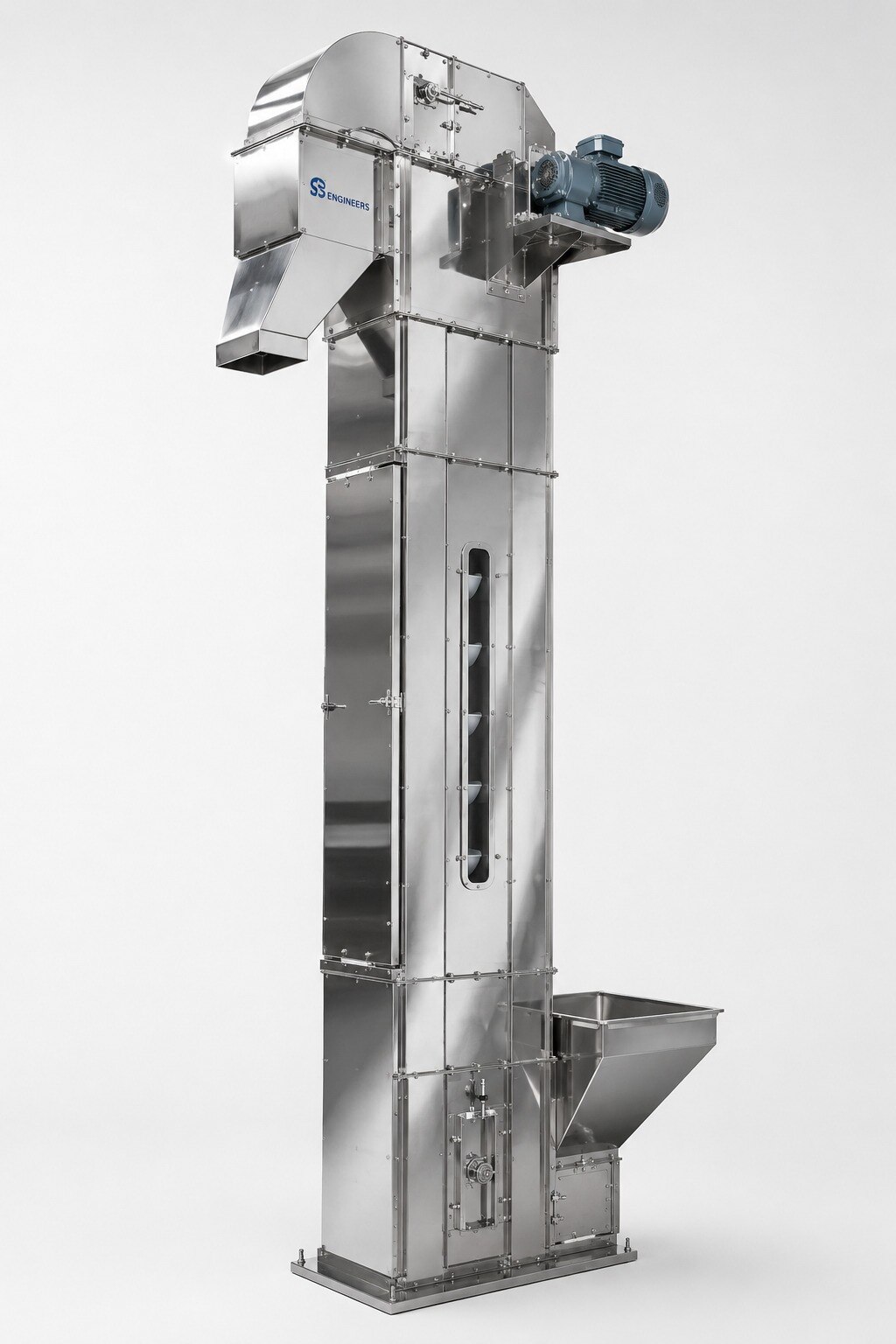
 | Bucket Elevator Efficient Vertical Material Handling Solutions A Bucket Elevator is a highly efficient conveying system designed for the vertical transportation of... View product → |
Frequently asked questions
What feedstock and duty data must go into a biomass bucket elevator enquiry?
State whether the material is wood chips, straw, shredded paddy, pellets, husks, refuse-derived fuel, digestate solids or a blend. Include moisture content, bulk density, particle-size range, abrasiveness, temperature, contamination risk, required tonnes per hour and operating hours.
How should capacity and the mechanical arrangement be calculated?
Calculate peak mass flow, bucket fill, elevator speed, lift height, discharge arrangement and duty cycle together. Allow for bulk-density changes, start-up conditions, surge loading and the space needed for inspection, cleaning and maintenance.
How do you prevent wet biomass, contamination and transfer problems?
Specify enclosed transfer points, access doors, clean-out provisions, suitable bucket spacing, controlled loading and discharge chutes. Add magnets or metal detection where tramp metal threatens the buckets, belt, chain or downstream equipment.
What London safety, fire and outdoor requirements belong in the specification?
Define dust containment, extraction interfaces, guarding, emergency stops, isolation points, fire detection, temperature monitoring and explosion-risk controls with the site risk assessment. For outdoor equipment, specify corrosion protection, weatherproof electrical enclosures, drainage and wind-driven rain protection.
How should you compare suppliers, installation effort and acceptance evidence?
Compare general-arrangement drawings, foundation loads, utility requirements, access clearances, installation scope and commissioning support. Require documented checks for capacity, speed, vibration, temperature, belt or chain tracking, interlocks and safe discharge before acceptance.