
A ribbon blender can mix a free-flowing powder efficiently, yet the wrong fill level, seal, discharge arrangement or motor rating can turn a suitable concept into a costly process problem. By the end, you will have a practical way to match the blender to your formulation, verify its performance and write a purchase specification that protects safety, cleanability and production capacity.
Key takeaways
- Size the vessel from working fill volume, not catalogue capacity.
- Define acceptable blend uniformity before comparing mixer designs.
- Specify materials, seals and discharge details for your chemical powder.
- Demand test results, drawings and written performance guarantees from suppliers.
Understand What the Ribbon Blender Will Actually Do
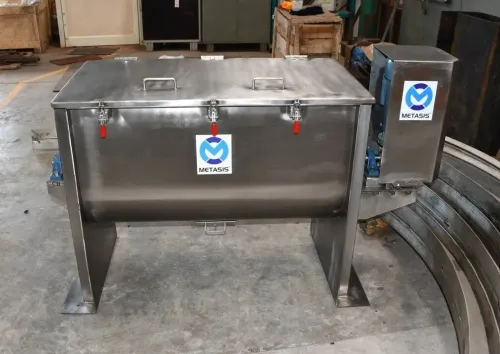
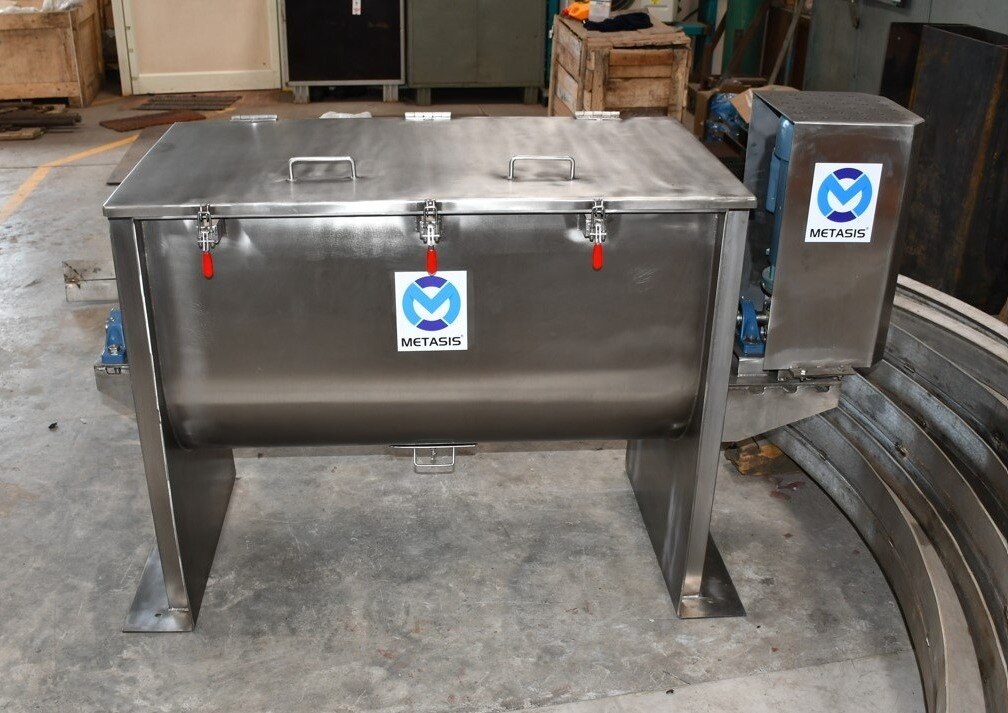
A ribbon blender moves solids by convection: its inner and outer ribbons push material in opposite axial directions while lifting and folding it radially. Mounted on a shaft inside a horizontal trough, the ribbons circulate material from end to end; end plates contain the charge, and a bottom discharge valve releases it after mixing.
This is a transport-and-fold action, not intense kneading.
| Material | Suitability | Why |
|---|---|---|
| Free-flowing powders and granules | Strong fit | Axial circulation blends particles efficiently |
| Short fibres | Suitable | The ribbons carry and fold fibrous solids |
| Cohesive, damp or agglomerated powders | Conditional | Clumps can ride with the ribbons instead of breaking apart |
| Paste-like materials | Poor fit | The ribbons may not generate enough shear for complete incorporation |
A chemical powder blender suits dry products such as pigments, mineral additives, detergents and crystalline chemicals when they flow freely. Spray nozzles can add small liquid quantities, but excess liquid can create lumps, raise torque and turn a blend into a paste.
Check the shaft seals before approving the machine: ask for seal material, purge or barrier-gas requirements, allowable leakage and a replacement method that does not require shaft removal. If the powder can form an explosive atmosphere, require a DSEAR assessment covering dust release, ignition sources, zoning, explosion protection, isolation and housekeeping.
Size the Vessel From the Batch, Not the Catalogue Capacity
Calculate vessel volume from the heaviest, least-dense batch: required powder volume equals batch mass divided by minimum bulk density. A 500 kg batch at 0.5 kg/L occupies 1,000 L; at a 60% working fill, it needs about 1,667 L of usable volume. Confirm whether the quoted figure means usable working volume or gross vessel volume.
Specify these values before requesting a quotation:
- Minimum and maximum batch mass
- Minimum and maximum bulk density
- Required fill ratio and acceptable minimum batch
- Particle-size distribution, moisture, cohesion, flowability and abrasive content
- Target mixing time and uniformity assay
- Discharge time and allowable residual heel
The supplier must state gross volume, usable working volume, minimum practical batch and maximum batch separately. A catalogue capacity can leave insufficient free space for the ribbons to circulate, causing dead zones, overload or an unmixable heel.
Size the motor and gearbox for the worst case, not the average powder. Dense, cohesive or damp material increases starting torque; abrasive solids increase wear and can alter clearance over time. Compare tip speed, power per unit volume, fill fraction, ribbon-to-wall clearance and mixing time during scale-up.
Matching laboratory rpm alone can create excessive shear or weak circulation in the production machine.
For ribbon blenders for chemical processing in London, require a duty-specific motor and gearbox rating based on the actual formulation, batch range and loaded-start condition, supported by a representative trial rather than a generic horsepower figure.
Define Uniformity and Test Whether Another Mixer Fits Better
Set uniformity as a number, not as “mixed.” Specify the assay, sample mass, number of samples, sampling locations and acceptance limit—for example, active-ingredient assay with an RSD of no more than 2% across samples taken from both ends, the centre and discharge stream.
Include the mixing endpoint and test method in the purchase specification; a visual colour check cannot prove chemical uniformity.
| Mixer option | Strength | Choose it when |
|---|---|---|
| Ribbon blender | Convective movement with moderate shear | The product is free-flowing powder, granules or short fibres and needs gentle bulk blending |
| Paddle or ploughshare mixer | More intensive circulation and shear | The powder is cohesive, agglomerated or needs liquid addition |
| High-shear mixer | Rapid dispersion and strong particle breakdown | You need wet granulation, deagglomeration or paste formation |
Do not transfer a published mixing time between ribbon blenders. Require a representative trial using your formulation, minimum and maximum fill levels, liquid addition rate, operating speed and proposed ribbon geometry. Compare samples using the agreed assay, not a supplier’s colour test. Confirm torque, discharge time and residual heel at the same trial.
Scale-up by comparing tip speed, power per unit volume, fill fraction, ribbon-to-wall clearance and mixing time—not rpm alone. Choose another mixer if the powder remains cohesive, forms dead zones, segregates after mixing or needs high shear; ribbon blenders are not automatically suitable for those duties.
Check Materials, Seals, Discharge and Hazardous-Service Design
Approve the mechanical envelope before approving the mixer. Confirm the trough, covers, sight glasses, filter housing, discharge valve, shaft seals and jacket for the specified temperature, vacuum level, vacuum cycles and credible blocked or isolated conditions. A vacuum pump does not make a standard vessel vacuum-rated.
Obtain a corrosion assessment covering every ingredient, impurity, cleaning chemical, concentration, temperature and residence time. 316 or 316L stainless steel is not universal: chlorides, strong acids, caustics and wet deposits can attack it.
Resolve these purchase details in writing:
- Seal arrangement, purge or barrier-gas requirements, allowable leakage, seal-material compatibility and replacement method. State whether technicians can change the seal without removing the shaft or opening the vessel.
- Discharge type, residual heel, discharge time and cleanability. A dead pocket can contaminate the next batch.
- Motor, gearbox, earthing and bonding details, including surface-temperature limits and enclosure protection.
- Dust-tightness and vacuum-leakage acceptance tests, not vague claims of sealed operation.
| Service condition | Specify before approval | Failure if missed |
|---|---|---|
| Standard powder duty | Material compatibility, wear allowance and discharge performance | Corrosion, ribbon wear or retained product |
| Vacuum or heated duty | Ratings for every pressure boundary and component | Collapse, leakage or unsafe isolation |
| Combustible dust | DSEAR assessment, zoning, dust group, EPL or equipment category, maximum surface temperature, explosion protection and isolation | Ignition, explosion propagation or non-compliant installation |
For an industrial ribbon blender in london, require conformity documentation for the complete hazardous-service package. A flameproof motor alone does not make the blender ATEX-compliant. DSEAR must address dust release, ignition sources, housekeeping and maintenance; an SDS warning alone cannot set the protection level.
Turn the Purchase Into Verifiable Supplier Guarantees
A catalogue mixing time is not a process guarantee. Require the ribbon blender supplier to commit to results for your formulation, because fill level, ribbon geometry, speed, powder properties, liquid addition, sampling location and assay method all change the result.
1. Demand a representative trial or factory performance test using your powder. Record batch mass, fill level, speed, liquid addition, sampling locations, number of samples, assay method, acceptance limit and mixing time.
2. Put the duty data on the purchase order: minimum and maximum bulk density, particle-size distribution, moisture, cohesion, abrasiveness, batch mass and target uniformity. Require guaranteed usable volume, batch range, motor and gearbox rating, and torque at the stated conditions.
3. Require measured commitments for discharge time, residual heel, dust-tightness or vacuum leakage, sound level, external surface temperature, and expected wear-life of ribbons and liners. Generic vessel capacity does not cover these outcomes.
4. For vacuum service, specify filter area, filtration rating, cleaning method, allowable pressure drop and blockage detection. Specify shaft-seal arrangement, purge or barrier gas, allowable leakage, compatible materials and replacement without shaft removal.
5. For hazardous areas, require the equipment category or EPL, gas or dust group, temperature class or maximum surface temperature, motor and enclosure protection, earthing and bonding details, and conformity documents. A flameproof motor alone does not make a package ATEX-compliant.
Metasis Equipments Pvt Ltd can be assessed on the same evidence: signed guarantees tied to your formulation, not catalogue claims.
Related product
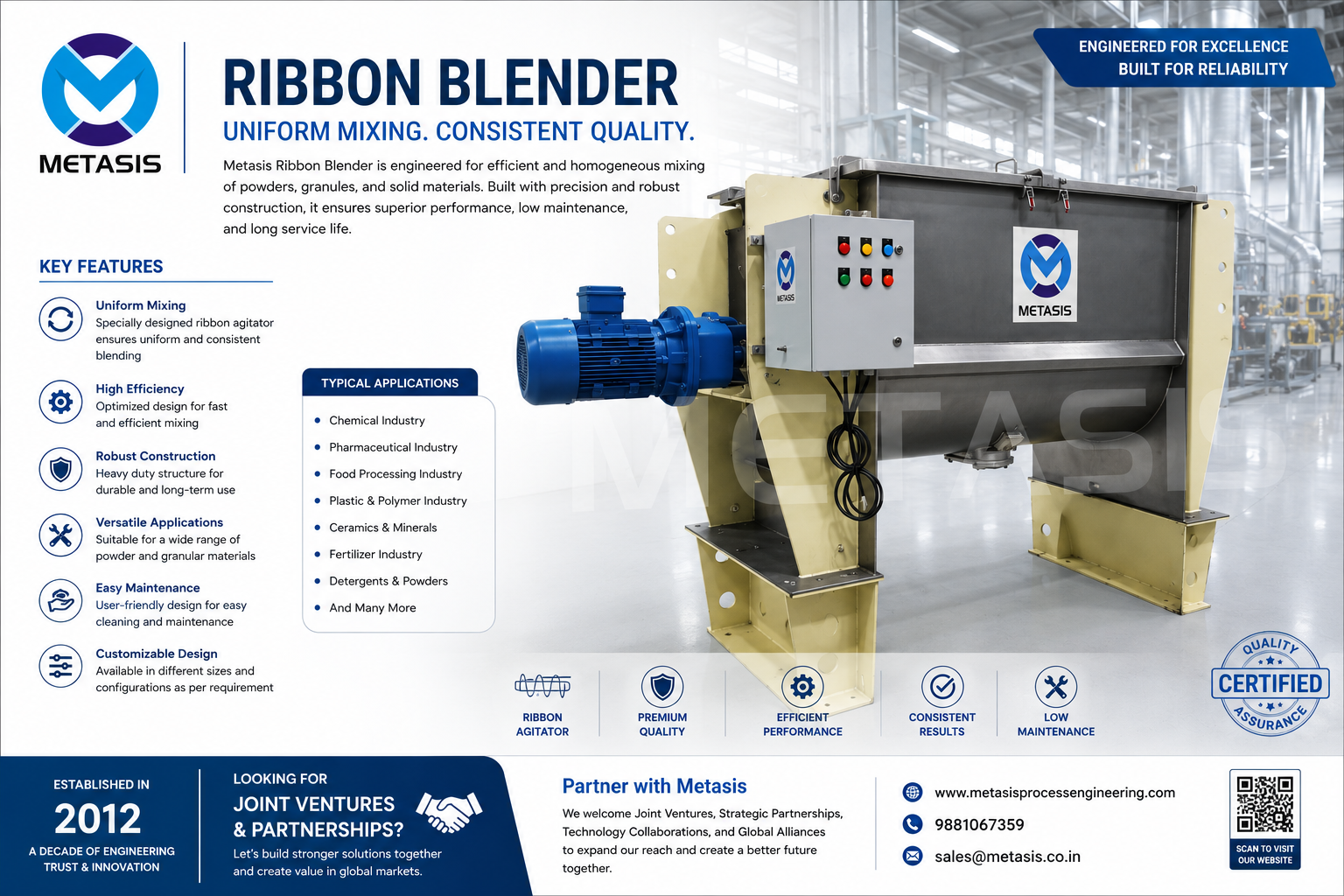 | Ribbon Blender Efficient Powder Mixing Solutions Since 2012, Metasis Equipments Pvt Ltd has been manufacturing high-performance Ribbon Blenders for various... View product → |
Frequently asked questions
What should you define before buying a ribbon blender?
Define the solids, batch size, bulk density, moisture, particle size, additives, required blend uniformity, cycle time and discharge method.
How do you size a ribbon blender for chemical processing?
Start with the batch mass and bulk density, convert them to volume, then allow the operating fill level required for effective ribbon movement rather than using the catalogue maximum.
When is a ribbon blender the wrong mixer?
Choose another mixer when the product needs high-shear deagglomeration, liquid dispersion, controlled temperature, very short residence time or a uniformity target the ribbon design cannot demonstrate.
What should a ribbon blender supplier guarantee?
Request written commitments covering blend uniformity, batch capacity, cycle time, discharge performance, materials, seal arrangement, motor duty and factory or site acceptance testing.