
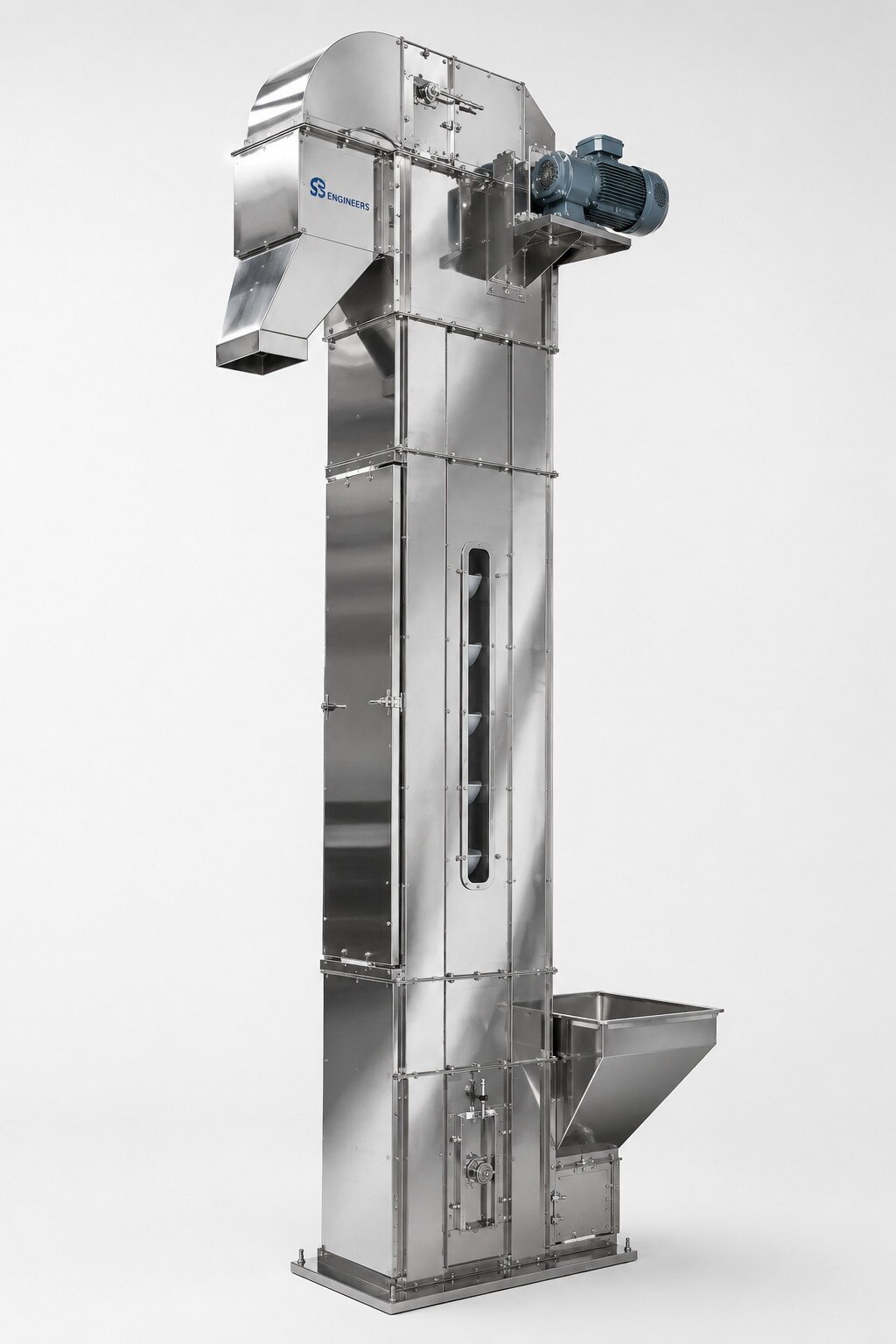
The right elevator type depends on whether your material flows freely, clings to surfaces, breaks under impact, absorbs moisture, or creates combustible dust. By the end, you will be able to compare discharge arrangements, belt and chain construction, sizing inputs, powder controls, granule protection, and chemical hygiene requirements.
Key takeaways
- Use centrifugal discharge for free-flowing, impact-tolerant materials.
- Choose continuous discharge for fragile granules and cohesive powders.
- Size from bulk density, bucket fill, speed, and guaranteed capacity.
- Specify dust extraction, cleanability, and explosion protection before purchase.
Choose the discharge arrangement by material behaviour
Select the discharge arrangement from flowability, impact tolerance, and required capacity—not from throughput alone. Bucket elevator types for chemical plants differ mainly in how they release material at the head.
| Option | Construction and discharge | Best fit | Main limitation |
|---|---|---|---|
| Centrifugal-discharge | Spaced buckets travel at relatively high belt or chain speed and throw material into the head chute | Free-flowing granules that tolerate impact; compact, high-throughput duties | Poor choice for sticky, cohesive, damp, highly aerated, or fragile products |
| Continuous-discharge | Closely spaced buckets release material by gravity over the bucket front or into the adjacent bucket | Sluggish powders and products requiring gentle handling | Lower capacity per casing size |
| Positive-discharge | A mechanism tips or inverts each bucket to force material out | Material that will not leave a conventional bucket, including cohesive or damp product | Extra moving parts, cleaning points, and maintenance burden |
| Bucket-on-belt | Buckets attach to a belt; the term describes construction, not a separate discharge class | Applications where belt construction suits the duty | Still requires a centrifugal, continuous, or positive discharge arrangement |
Centrifugal discharge suits robust, free-flowing granules but its loading and discharge velocity can create fines, breakage, segregation, or electrostatic charging. Choose continuous discharge for gentle handling, or positive discharge when reliable emptying matters more than mechanical simplicity. The right bucket elevator depends on flow behaviour, allowable impact, and the capacity you must deliver.
Compare belt and chain elevators before specifying speed and capacity
Choose the belt or chain before you specify speed and capacity: an industrial bucket elevator that suits the mass flow can still fail through heat, contamination, tracking, or inaccessible maintenance points.
| Option | Advantages | Constraints and contamination risks |
|---|---|---|
| Belt | Quieter running, fewer articulation points, lower noise, and a simpler product-contact arrangement | Polymer temperature rating, chemical compatibility, static dissipation, belt tension, slip, and tracking limit the design |
| Chain | Higher load capability and higher-temperature service when suitable metallurgy is selected | Lubrication, wear particles, noise, sprocket wear, and extra contamination points require control |
Compare these operating factors before choosing from a catalogue capacity:
- Operating speed and target throughput
- Material temperature and abrasive loading
- Maintenance access and the consequence of a belt or chain failure
- Product-contact materials, cleaning method, and contamination tolerance
Require access to the boot, head, take-up, bearings, belt or chain inspection points, and replaceable wear components. A concealed boot can retain chemically incompatible powder, while an inaccessible chain can turn minor wear into a shutdown.
Ask the vendor to state temperature limits for the complete bucket elevator assembly, including buckets, fasteners, bearings, seals, casing, and discharge components—not only the belt or chain. A belt elevator is often the cleaner choice for moderate-temperature service; a chain elevator earns consideration when load or temperature exceeds the belt system’s documented limits.
Size the elevator from the material and the guaranteed duty
A defensible specification starts with the material, not the catalogue capacity. Record particle-size distribution, minimum and maximum bulk density, moisture, flowability, cohesion, abrasiveness, corrosiveness, temperature, friability, dust explosibility, required lift height, and allowable residence time for the chemical powder elevator or granule handling elevator.
- Establish the required mass flow in tonnes per hour.
- Convert mass flow to volumetric flow at both bulk-density extremes.
- Select bucket volume and spacing for the material’s flow behaviour.
- Choose belt or chain speed, then apply the specified bucket fill percentage.
- Reduce the theoretical result for discharge efficiency, back-leg carryback, buildup, and air entrainment.
- Check the result against inlet loading, outlet restrictions, and residence time.
Require the supplier to show every calculation and guarantee usable discharge rate at minimum and maximum design bulk density. Do not accept one undifferentiated capacity figure.
| Rate | Meaning | Specify or verify |
|---|---|---|
| Feed rate | Material entering the boot | Prevent surging and flooding |
| Elevator discharge rate | Material leaving the head | Include fill and discharge losses |
| Usable process throughput | Rate reaching the next process step | Deduct carryback, buildup, and restrictions |
Include boot and head geometry, inlet and outlet dimensions, take-up travel, inspection access, and the required vertical lift. Identical tonnes-per-hour demands can require different bucket sizes, spacing, and speeds when density, cohesion, or residence-time limits change.
Control dust, flooding, bridging, and aeration in fine powders
A fine-powder chemical powder elevator needs a controlled inlet, not a free-falling feed. Meter the flow to prevent surging, provide enough boot volume for reliable bucket filling without creating stagnant inventory, and fit a level or plugged-chute detector. Bridging, flooding, aeration, dust leakage, and inconsistent filling each require a defined response.
1. Control induced air movement: fine powder can travel up the casing, reducing net discharge and increasing leakage. Use sealed inspection doors, aspiration at the head and boot, balanced venting, and an enclosed transfer to the next machine.
2. Provide internal cleanout access at the boot, buckets, pulley, and casing. Specify dry vacuuming, inert-gas purging, or another validated method; do not assume water washdown is acceptable.
3. Treat carryback, bucket buildup, boot-pulley deposits, and poor filling as capacity losses. Add inspection points, removable liners, and replaceable wear components.
4. Base protection on a dust hazard analysis when measured Kst, Pmax, minimum explosible concentration, minimum ignition energy, layer ignition temperature, or cloud ignition temperature exists. Across bucket elevator types for chemical plants, use the results to define containment, ignition control, venting, and isolation.
Protect granules from impact, breakage, and segregation
A centrifugal bucket elevator suits free-flowing, robust granules when high throughput and a compact casing matter. Its loading and discharge velocities can generate fines, fracture friable particles, separate size fractions, and increase electrostatic charging. If those risks govern, choose gentler handling.
1. Use lower-speed continuous discharge when impact and drop height dominate the risk; closely spaced buckets release granules by gravity instead of throwing them.
2. Use positive discharge when reliable emptying matters without throwing the product; its tipping or inverting mechanism adds moving parts and cleaning points.
3. Reduce inlet drop height, use controlled feeding, install a close-coupled outlet chute, line impact areas where chemically compatible, and avoid abrupt direction changes.
4. Run a product-quality acceptance test on the granule handling elevator. Check fines generation, particle-size distribution before and after conveying, segregation at discharge, and residual hold-up.
A gentler bucket elevator usually delivers less capacity per casing size or requires greater mechanical complexity. Specify both the required throughput and the maximum allowable degradation.
Specify chemical hygiene, explosion protection, and supplier deliverables
Specify the chemical environment before selecting stainless steel for a chemical powder elevator. Check chloride stress-corrosion, strong acids or alkalis, wet deposits, and galvanic couples across every dust-exposed part, not just buckets.
1. State material grades and surface finish for casing, buckets, belt or chain, fasteners, shaft seals, bearings, liners, gaskets, coatings, and inspection-door hardware. Specify seal design, allowable leakage, drainability, residual hold-up, and the validated product-changeover procedure.
2. Define cleaning limits: dry vacuuming, inert-gas purge, wet washdown, or no liquid cleaning. Unplanned washdown can create caking, corrosion, microbial growth, or combustible dust while deposits dry. Require access doors that are sealed, cleanable, and fitted with compatible hardware.
3. For combustible dust, require the hazard analysis, including Kst, Pmax, minimum explosible concentration, minimum ignition energy, layer ignition temperature, and cloud ignition temperature. Specify bonding and grounding, bearing-temperature monitoring, speed and belt-alignment or slip detection, boot and head relief, explosion isolation, and casing containment.
4. Where ATEX applies, request the dust group, maximum surface-temperature marking, equipment category or EPL, and conformity documentation. Use EN 618 as a machinery-safety reference, not as the complete dust assessment.
Metasis Equipments Pvt Ltd can add value by coordinating an industrial bucket elevator with unloading, dosing, mixing, storage, or packing, provided you judge the documented process duty and hygiene specification rather than a catalogue rating.
Related product
 | Bucket Elevator Efficient Vertical Material Handling Solutions A Bucket Elevator is a highly efficient conveying system designed for the vertical transportation of... View product → |
Frequently asked questions
How do you choose a bucket elevator discharge arrangement?
Match the discharge method to material flowability, impact tolerance, and required capacity. Centrifugal discharge suits free-flowing, impact-tolerant materials; continuous discharge suits fragile granules and cohesive powders.
Should a chemical plant use a belt or chain bucket elevator?
Compare belt and chain elevators against temperature, chemical compatibility, speed, maintenance access, allowable stretch, and the required duty cycle before setting capacity.
What information is needed to size a bucket elevator?
Provide material bulk density, particle size, moisture, flowability, temperature, abrasiveness, bucket fill target, lift height, and guaranteed mass flow.
How can you control dust and flooding in a chemical powder elevator?
Use sealed casings, controlled feed, dust extraction at transfer points, suitable venting, level detection, and a boot design that prevents material accumulation and aeration.
How do you protect granules from breakage and segregation?
Use low-impact loading, controlled speed, continuous discharge where appropriate, gentle transfer chutes, and a layout that limits drop height and particle separation.