
Choosing a mixer depends on more than vessel size or motor power: particle size, density, moisture, oil content, friability and the required uniformity all change the result. By the end, you will be able to compare mixer types, specify operating tests and identify where segregation, cleanout or continuous-feed problems could undermine an otherwise good blend.
Key takeaways
- Use ribbon blenders for efficient horizontal circulation of free-flowing powders.
- Choose paddle, ploughshare or tumble mixers based on cohesion, fragility and recipe demands.
- Test samples from multiple vessel locations to confirm blend uniformity.
- Specify batch or continuous operation before selecting mixer capacity and controls.
How a ribbon blender moves food and spice powders
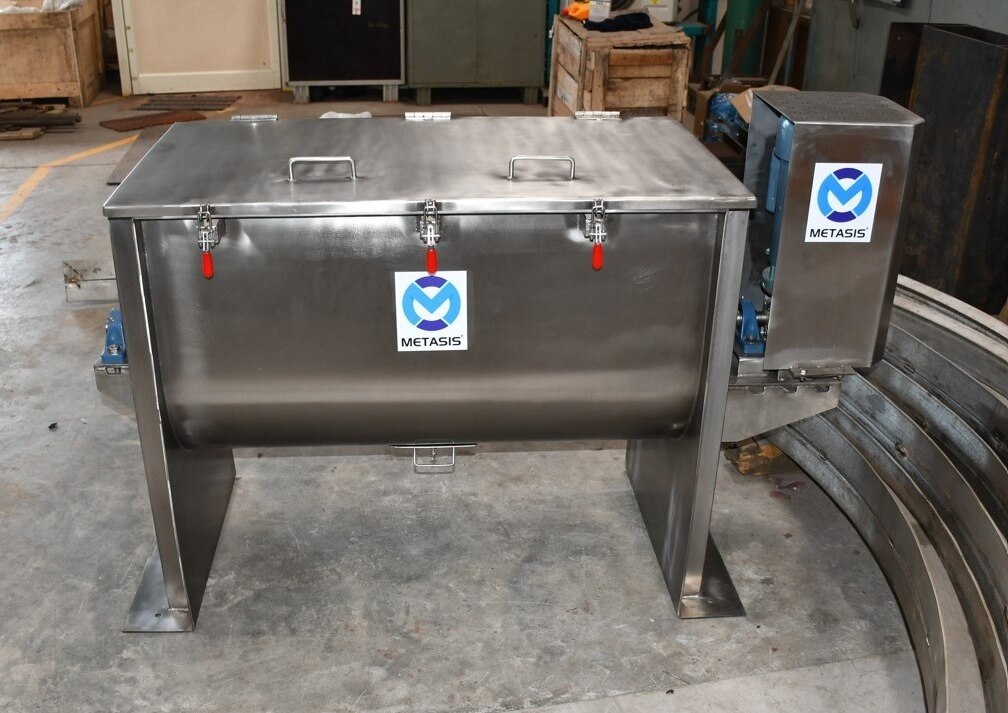
A ribbon blender works by circulating powder along a horizontal trough. Inner and outer helical ribbon flights move material in opposite axial directions, while the rotating assembly lifts and turns powder across the vessel’s width.
This convective action creates repeated axial circulation and radial turnover, producing a uniform blend without relying on intense impact or grinding.
It suits a food powder mixer duty when the formulation flows freely and its ingredients have reasonably compatible particle size and bulk density. Flour, salt, dried herbs, seasoning powders and short-fibre ingredients fit this operating pattern.
The mixer is less suitable for compacted lumps, fat-coated powders, sticky sugar, highly cohesive or hygroscopic material, and fragile particles that degrade under repeated movement.
| Powder property | Why ribbon blenders fit | What can go wrong |
|---|---|---|
| Free-flowing, dry powder | Moves readily through the ribbon circulation pattern | Segregation can occur after discharge |
| Similar particle size and density | Reduces settling of heavy or coarse ingredients | Large differences can produce concentration bands |
| Short fibres or flakes | Handles them with moderate shear | Excessive speed can break delicate pieces |
| Small-dose spice or additive | Blends well after pre-dilution into carrier powder | Direct dumping creates local concentration pockets |
| Hard lumps or compacted powder | Conventional ribbons provide limited breakup | Add a chopper, intensive mixer or deagglomeration step |
| Substantial liquid, oil or binder | Not rapidly dispersed by ordinary ribbon action | Use a high-shear stage or a different mixer |
Stainless steel alone does not make ribbon blenders sanitary. Specify smooth product-contact surfaces, ground welds, accessible interiors, suitable seals, corrosion resistance and compatibility with the cleaning method.
Ribbon, paddle, ploughshare or tumble: which mixer fits?
Choose the mixer by the hardest ingredient and the required movement, not by motor power or vessel diameter alone. Ribbon blenders suit free-flowing powders, but each alternative solves a different problem.
| Option | What it does | When it fits |
|---|---|---|
| Ribbon blender | Moves powder axially in opposing directions with radial turnover | Free-flowing spices, flour premixes and short fibres |
| Paddle mixer | Lifts and drops material with gentler agitation | Fragile botanicals, low-density powders and delicate inclusions |
| Ploughshare mixer | Creates stronger three-dimensional circulation; add a chopper for lumps | Cohesive powders, sticky seasoning and uneven bulk density |
| Double-cone or V-blender | Tumbles material through repeated splitting and recombination | Free-flowing, fragile powders needing low-impact blending |
| Tumble mixer | Offers gentle movement with fewer internal obstacles | Friable products where easy draining matters more than positive transport |
| High-shear mixer | Uses rapid rotor or chopper action to break agglomerates and disperse liquids | Compacted lumps, fat-coated powders, binders and substantial liquid additions |
| Continuous mixer | Blends metered ingredient streams as they pass through | Stable, high-volume production with controlled feed rates |
Ribbon blenders normally need a fuller working volume than tumble mixers, but no universal fill percentage exists. Obtain validated minimum and maximum working loads for the actual powder, plus blend-time data against your uniformity limit; running longer can increase segregation or damage fragile particles.
For spice mixing equipment, specify whether the process needs gentle handling, deagglomeration, liquid dispersion or continuous dosing. A faster ribbon is not a substitute for a chopper or high-shear stage when hard lumps must be destroyed.
Match the mixer to the recipe and operating method
A 500 kg vessel is not automatically suitable for a 500 kg batch. Select an industrial ribbon blender against validated working loads, powder behaviour and the recipe’s most difficult addition, not vessel volume alone.
1. Set batch size from the supplier’s minimum and maximum working loads. An underfilled ribbon leaves dead zones; an overfilled one restricts circulation and increases unmixed pockets. Confirm loads in kilograms for your bulk density, not only as a percentage of vessel volume.
2. Match fill level to the mixing mechanism. Ribbon blenders need a fuller working volume than tumble mixers, while aerated, low-density powders may require more headspace. Obtain test data at the proposed load before specifying the food powder mixer.
3. Choose speed from the required blend time and particle strength. Higher tip speed can shorten blending, but it can break fragile botanicals, heat fat-containing powders or increase segregation after the blend is discharged. A time study should identify the uniformity endpoint, not simply the fastest setting.
4. Control ingredient order. Pre-dilute a potent spice, colour or flavour into part of the carrier powder before adding it to the main batch. Directly tipping a small dose into a large charge creates concentration pockets that end-of-batch samples can miss.
5. Treat liquid addition as a process design. Specify spray location, droplet size, viscosity, addition rate, atomising air and agitator speed; otherwise liquid forms wet balls or wall buildup instead of coating particles.
6. For allergen or colour changeovers, select accessible welds, removable shafts and seals, and a documented dry-cleaning or wet-wash method. If water enters the mixer, confirm drainage and drying time before the next batch.
Prove uniformity after mixing, not only inside the vessel
A uniform sample from the vessel does not guarantee uniform bags. Differences in particle size, density, shape and electrostatic charge can make fines percolate downward while coarse particles roll away during discharge, conveying or hopper storage.
For ribbon blenders for food and spice processing, discharge through a short, controlled path. Avoid long drops, high-velocity pneumatic conveying and repeated transfers; use a steady feeder and keep the receiving hopper from developing stagnant zones. Do not overfill a hopper, top up partly emptied bins or leave a blend vibrating for long periods.
At the bagger, maintain consistent feed rate and minimise drop height, vibration and hold-up between bags.
Prove the finished blend with a written sampling plan. Collect separate increments across the discharge rather than one scoop from the first material produced:
- Sample the beginning, middle and end of discharge at defined mass or time intervals.
- Include samples after conveying and from selected bags when segregation can occur in the transfer or filling system.
- Specify sample mass, location, interval, assay method, acceptance limit and how sampling and analytical variance are handled.
- Test minor ingredients with a validated assay, not only colour or visual appearance.
- Investigate a passing composite if individual increments show a sequence trend.
Keep increments separate until the plan defines a composite; compositing can hide a high or low portion. Repeat the study after changing fill level, discharge rate, conveyor route or bagging settings.
Choose batch or continuous production and specify the equipment
A batch ribbon blender outperforms continuous mixing when recipes change, minor ingredients need controlled addition, or each lot requires traceability and release testing. It also suits plants making several seasoning formulas on one line, where continuous changeover would waste material or risk carryover.
| Option | Strength | Choose it when |
|---|---|---|
| Batch ribbon blender | Controlled recipe, sampling and changeover | Products vary or low-dose ingredients need pre-dilution |
| Continuous mixer | Steady throughput with fewer stops | One stable formula runs for long periods with consistent feed rates |
Before selecting spice mixing equipment, request evidence that the proposed machine works with your process:
- A trial report using your powders, including blend time, tip speed, fill level, ingredient order, minor-to-major ratio and assay results.
- Validated minimum and maximum working loads, not just vessel volume; ribbon blenders need a fuller working volume than tumble mixers, but the usable range depends on powder behaviour.
- Discharge samples taken across locations and time intervals, with sample mass, assay method, acceptance limits and sampling-variance treatment.
- A liquid-addition test covering viscosity, spray location, droplet size, addition rate and atomising air. A spray bar alone does not prevent wet balls or wall buildup.
- Drawings specifying product-contact finish, weld quality, seals, access, cleanability, corrosion resistance and compatibility with your cleaning method.
If you are reviewing a proposal from Metasis Equipments Pvt Ltd, ask for these records against your recipe rather than accepting stainless steel or motor horsepower as proof of suitability. For low-dose spices, require a demonstrated carrier premix method; direct dumping can create concentration pockets that end-of-batch sampling misses.
Related product
 | Ribbon Blender Efficient Powder Mixing Solutions Since 2012, Metasis Equipments Pvt Ltd has been manufacturing high-performance Ribbon Blenders for various... View product → |
Frequently asked questions
How does a ribbon blender move food and spice powders?
Inner and outer helical ribbon flights move powder in opposite axial directions, lifting and turning it across a horizontal trough.
Which mixer suits food and spice powders: ribbon, paddle, ploughshare or tumble?
Choose by powder flow, cohesion, particle fragility, liquid addition, required shear and the level of segregation risk.
How do you prove uniformity after mixing?
Take samples from defined locations and mixing times, then compare laboratory results against the recipe’s acceptance limits.
Should a food powder process use batch or continuous mixing?
Use batch mixing for recipe changes and controlled lots; use continuous mixing when feed rates, formulation and quality control remain stable.