
A pilot skid is useful only when its equipment, controls, utilities, data capture, and site-support plan match the experiments you need to run. You will be able to define the right skid boundary, compare alternatives, test scale-up assumptions, and screen suppliers for delivery and commissioning at a Maryland, Virginia, or District site.
Key takeaways
- Define the skid boundary by inlet, outlet, utilities, controls, and safety interfaces.
- Choose batch, continuous, recirculating, or modular architecture for the experiment.
- Record flow, temperature, pressure, residence time, and mixing data for scale-up.
- Compare suppliers on commissioning, documentation, service response, and integration support.
Define the skid boundary before you search near Washington DC
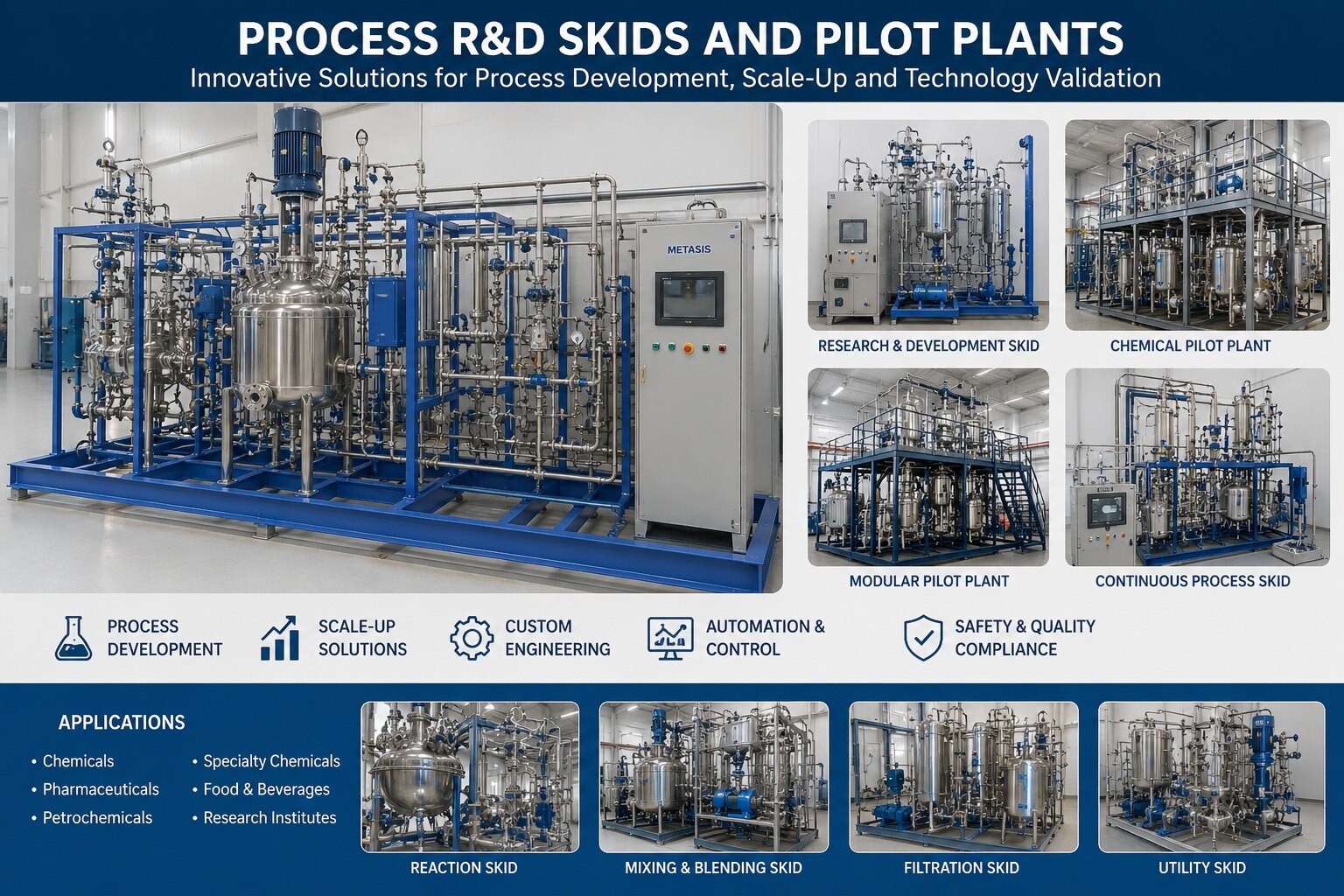
A process R&D skid is a factory-assembled unit that performs defined operations—such as dosing, mixing, heating, filtration, or conveying—within a documented process boundary. Pilot plant skids use the same idea at experimental scale, while a modular process system combines several skids or modules into a relocatable plant.
Use this boundary-setting procedure before searching for process skids near Washington, DC:
1. Mark the battery limits on a process flow diagram. Include equipment, pumps, valves, instruments, control panels, software, sampling points, and interconnecting pipework that the supplier will fabricate and test.
2. List the site-installed items separately. These commonly include incoming power, compressed air, steam, cooling water, exhaust, drainage, foundations, structural supports, insulation, hazardous-area wiring, plant tie-ins, rigging, and permanent utility headers.
3. Request a battery-limit drawing and an inclusion/exclusion matrix. “Turnkey” does not guarantee installation, commissioning, validation documents, or corrective field work.
4. Confirm transport constraints before approving the layout: maximum shipping envelope, weight, lifting points, centre of gravity, removable guards, doorway and elevator dimensions, and whether the module ships whole or in sections.
5. Treat data equipment as part of the skid boundary. Require engineering units, timestamps, alarm history, experiment identifiers, exportable raw data, and calibration status—not only a touchscreen.
A supplier is genuinely near your Maryland, Virginia, or District site when it can support FAT, shipment, field installation, commissioning, and corrective work. A low quote becomes expensive when access changes force repeated travel or site modifications.
Pilot scale also does not remove OSHA Process Safety Management duties; a covered process can trigger thresholds such as 10,000 pounds of flammable liquids or gases in one location.
Match the pilot architecture to the experiment
Choose a skid when the experiment must reproduce connected unit operations, collect scale-up data, and operate across a defined range rather than prove one reaction in a vessel.
| Option | Choose it when | Main limitation |
|---|---|---|
| Laboratory glassware | You are screening chemistry, formulation, or equilibrium with gram-to-litre quantities. | It rarely reproduces residence time, mixing, heat transfer, pressure, or continuous flow. |
| Bench rig | You are testing one unit operation, such as filtration, dosing, separation, or heat exchange, with limited integration. | Interactions between upstream and downstream steps remain uncertain. |
| Pilot plant skids | You need repeatable batches or continuous runs, representative materials, sampling points, wider turndown, and exportable process data. | They require more engineering, controls, utilities, and operator training than a bench rig. |
| Containerized plant | The process is proven enough to run near production conditions, and relocation or rapid deployment matters. | Shipping constraints and container utilities can force compromises in access, layout, and hazardous-area design. |
| Fixed pilot plant | You expect long campaigns, heavy services, large inventories, or frequent modifications at one site. | Civil work and permanent installation slow the first experiment. |
| Direct commercial scale-up | The process envelope, scale-dependent behaviour, materials, and economics are already validated. | Unknown mixing, heat removal, fouling, or solids handling can turn a full-scale mistake into an expensive shutdown. |
Process R&D skids earn their cost when uncertainty lies in integration or scale-dependent behaviour. Pilot plant skids should preserve raw data, timestamps, engineering units, alarm history, experiment IDs, and sample links; a touchscreen without exportable data cannot support scale-up.
For batch work, use an ISA-88-style equipment and recipe model so operators repeat phases and record deviations consistently. Choose a wider-range skid when the experiment must discover limits, not merely run at a nominal production point.
Build a scale-up path from process envelope to pilot data
Start with the operating envelope, not a vessel size. Record minimum and maximum flow, batch size, residence time, pressure, temperature, viscosity, solids loading, allowable shear, turndown, cleaning method, utility quality, and the measurements needed for scale-up.
- Define the laboratory success criteria and identify each unit operation: feed preparation, dosing, mixing, heating or cooling, reaction, separation, conveying, and discharge.
- Draw a process flow diagram with material balances, energy duties, stream compositions, hold-up volumes, sampling points, relief paths, and waste connections.
- Convert the diagram into equipment specifications. Size pumps, vessels, heat exchangers, mixers, filters, and instruments against the full envelope, not nominal throughput.
- Test wetted materials, seals, elastomers, cleanability, fouling, corrosion, and solids handling before releasing the design. A material failure can invalidate otherwise useful pilot data.
- Review the design for access, lifting points, shipping weight, center of gravity, doorway dimensions, utilities, and maintenance clearances before fabrication.
- Commission the process R&D skids with water or an approved surrogate, then run planned trials across flow, temperature, residence time, and load conditions.
- For batch work, define recipes, equipment states, phases, alarms, and operator actions using an ISA-88 structure. Export raw readings with engineering units, timestamps, experiment IDs, alarm history, and calibration status.
The pilot represents the commercial process when the governing scale-up variables match: residence-time distribution, Reynolds number, heat-transfer duty, mixing or mass-transfer performance, solids concentration, shear, and pressure drop. Compare those results with commercial design targets; a smaller skid that only proves product output is not enough.
Pilot plant skids exist to expose the limits and variability that production equipment must survive.
Specify materials, utilities, controls, and safe operation
Specify the full operating envelope, not just nominal flow. Process R&D skids must state minimum and maximum flow, batch size, residence time, pressure, temperature, viscosity, solids loading, turndown, allowable shear, cleaning method, and measurements needed for scale-up.
- Name every wetted material, gasket, hose, seal, and surface finish, then check compatibility with feedstocks, solvents, cleaning chemicals, temperature, and pressure. State corrosion allowance and whether parts require sanitary access or passivation.
- List available utilities: voltage and phase, compressed-air pressure and dew point, cooling-water temperature and pressure, steam quality or hot-water temperature, nitrogen purity, drain capacity, ventilation, and waste connections. A skid that meets its design point can still fail if the host supply cannot support it.
- Size pumps and mixers for the minimum case. Record minimum stable flow, control range, solids-suspension criterion, allowable shear, mixer speed, heat generation, and motor load; horsepower alone hides poor low-flow performance.
- Require controls that retain raw data, engineering units, timestamps, alarm history, experiment or batch identifiers, and calibration status. Use ISA-88 concepts—equipment models, phases, operations, and recipes—for repeatable batch work and easier automation transfer.
- Define guarding, relief devices, shutdown logic, lockout points, hazardous-area classification, emergency stops, sampling access, lifting points, spare parts, calibration intervals, and cleanout access. Attach a battery-limit drawing and inclusion/exclusion matrix.
| Area | Specify | Failure avoided |
|---|---|---|
| Materials | Wetted metallurgy, seals, finish | Leaks, corrosion, contamination |
| Utilities | Pressure, quality, capacity, connections | Commissioning delays |
| Controls | I/O list, alarms, historian export | Unusable pilot data |
| Maintenance | Access, isolation, spares | Extended downtime |
Evaluate a process skid supplier by regional support, not distance alone
A search for process skids near Washington DC should measure service coverage, not driving distance. Ask whether the process skid supplier can attend FAT, deliver to your Maryland, Virginia, or District site, supervise installation and commissioning, and perform corrective work without repeated long-distance mobilisations.
Make the quotation boundary contractual. Require a battery-limit drawing and an inclusion/exclusion matrix covering pumps, valves, instruments, control panels, programming, utilities, structural supports, insulation, hazardous-area wiring, installation, commissioning, validation documents, and operator training. “Turnkey” has no universal meaning.
| Supplier comparison | Evidence to request | Risk reduced |
|---|---|---|
| Regional support | Named service territory, response time, local subcontractors, travel terms | Delayed corrective work |
| FAT scope | Signed test procedure covering wiring, I/O, sequences, alarms, interlocks, instrument ranges, documents, and wet operation where practical | Controls faults after shipment |
| Transport plan | Shipping envelope, weight, lifting points, centre of gravity, rigging path, doorway and elevator checks, module split | Damage or impossible placement |
| SAT scope | Utility checks, tie-ins, communications, rotation, site conditions, and post-installation performance test | Unassigned commissioning risk |
Confirm site utilities before fabrication: voltage and phase, compressed-air pressure and dew point, cooling-water pressure and temperature, steam or hot-water duty, drain capacity, ventilation, nitrogen purity, and waste handling. Also identify the governing code; ASME B31.3 addresses process piping, while pressure vessels may require an ASME Section VIII basis.
Metasis Equipments Pvt Ltd belongs on a comparison list only after it documents these boundaries and acceptance tests in the quotation. That evidence matters more than its workshop’s mileage from Washington DC.
Related product
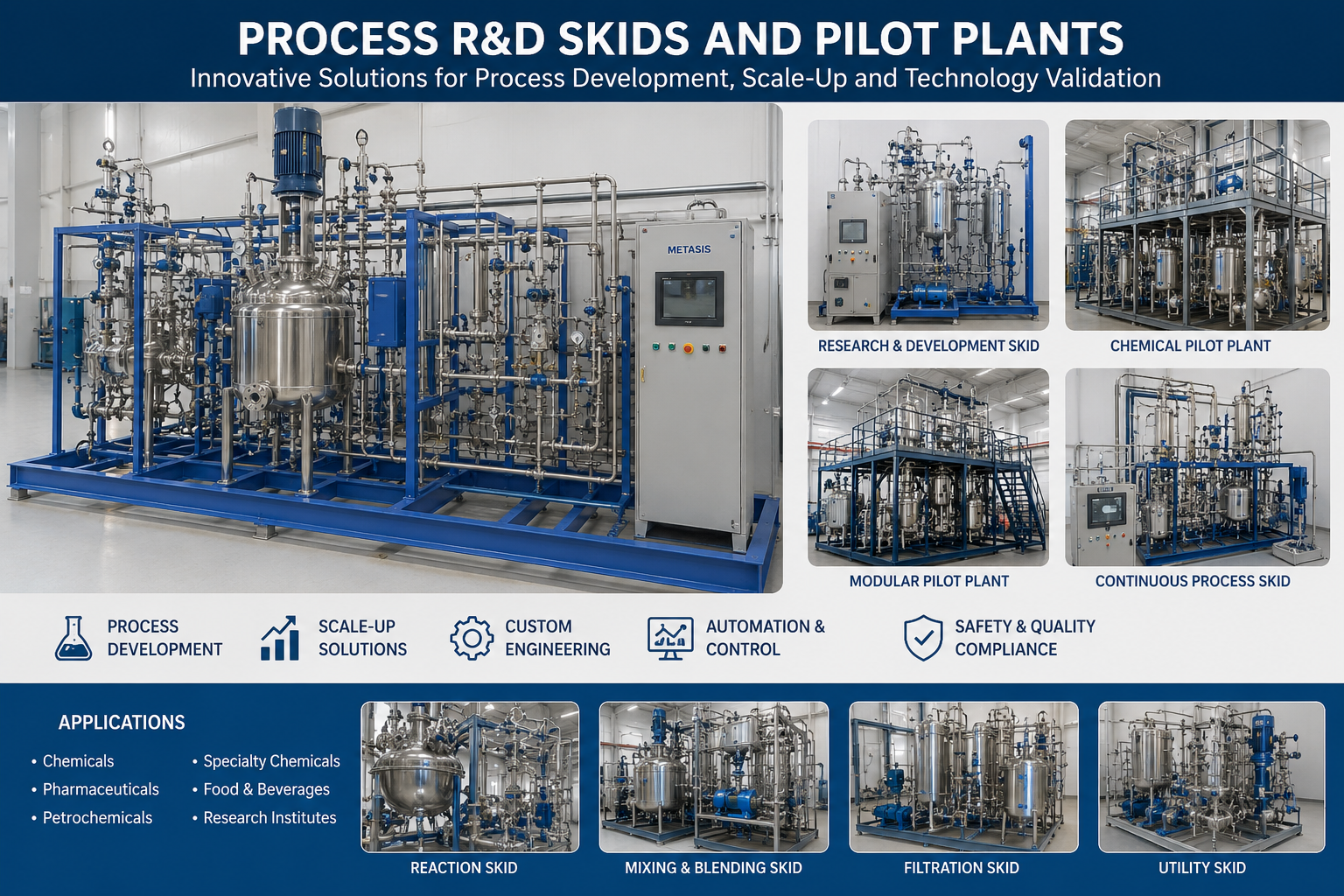 | Engineering Process System Process R&D Skids and Pilot Plants Innovative Process Development Solutions At Metasis Equipments Pvt. View product → |
Frequently asked questions
What should you define before searching for process skids near Washington DC?
Define the process boundary by listing feed and product connections, utility tie-ins, instrumentation, controls, safety systems, and the equipment included in the skid.
How do you match a pilot plant skid to an experiment?
Choose the architecture according to the experiment: batch systems suit recipe and residence-time studies, while continuous systems suit steady-state throughput and long-run testing.
What pilot data supports process scale-up?
Capture flow rate, temperature, pressure, residence time, mixing performance, power demand, material balance, and operating limits across the process envelope.
How should you evaluate a process skid supplier?
Compare design documentation, factory testing, commissioning, operator training, controls integration, spare parts, service response, and experience supporting your region—not distance alone.