
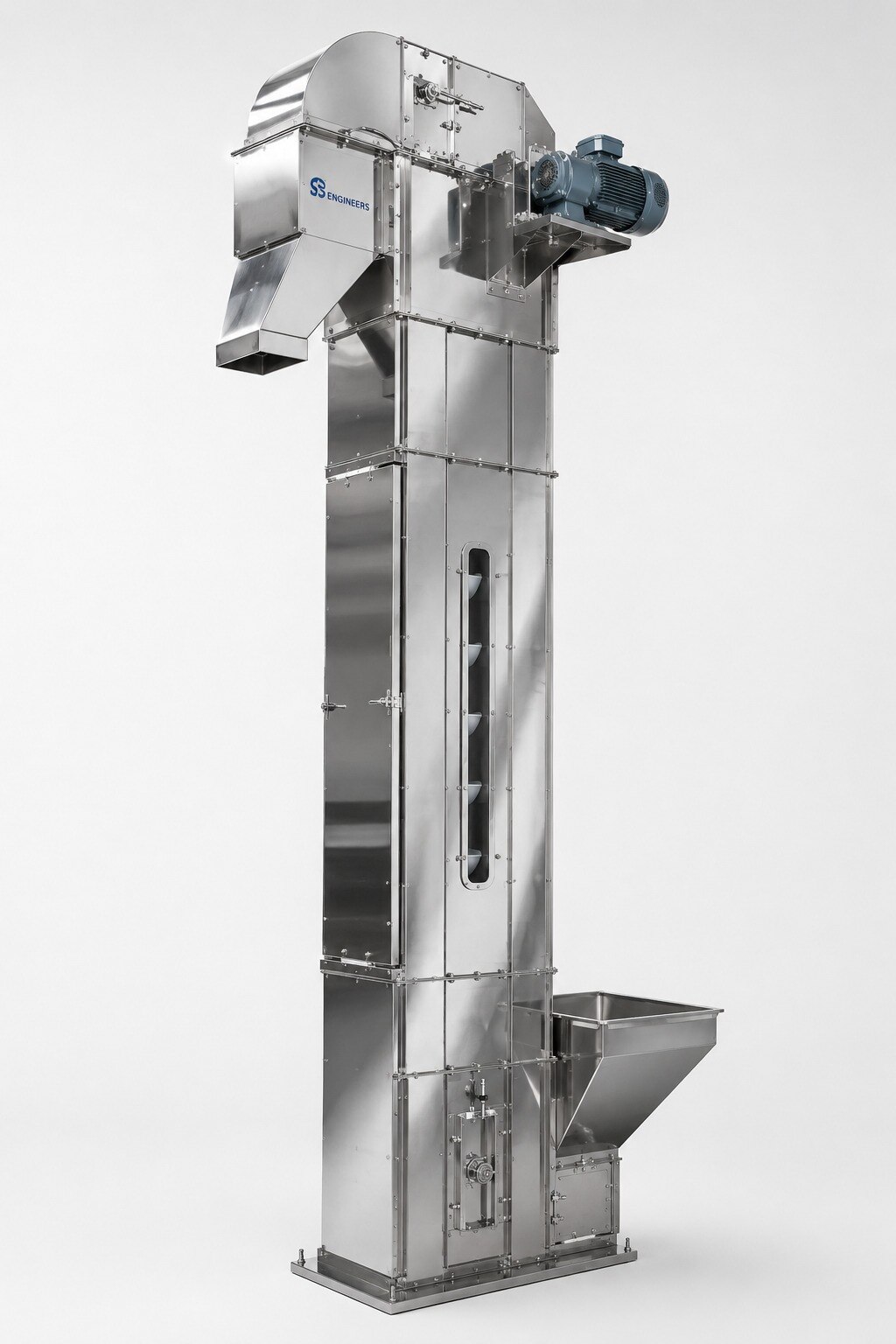
A bucket for elevator systems is the individual vessel that carries bulk material, while the bucket elevator is the complete machine that loads, lifts, and discharges it. By the end, you will be able to identify the machine’s main parts, match bucket and elevator designs to your material, estimate required capacity, and decide whether vertical bucket handling fits your plant.
Key takeaways
- Match bucket shape to the required discharge path and material flow.
- Choose belt construction for lighter loads and chain construction for demanding service.
- Calculate capacity from bucket volume, spacing, speed, and fill percentage.
- Specify material properties, temperature, abrasiveness, throughput, lift height, and discharge point.
What a Bucket for Elevator Systems Is Made to Do
A bucket for elevator systems is the individual vessel that carries bulk material upward. Fixed at intervals to a belt or one or more chains, it receives solids at the bottom, holds them during the lift, and releases them at the top.
The elevator bucket purpose is vertical transport, not storage: the buckets keep a measured stream moving through the machine.
The complete elevator includes these working sections:
- The boot receives material through the inlet. The buckets scoop or accept the flow, while a cleanout provides access if spilled material accumulates.
- The belt or chain pulls the buckets around the lower pulley or sprocket and up through the enclosed casing. A drive supplies motion, and a take-up maintains suitable tension.
- The head turns the buckets over the upper pulley or sprocket and directs material through the discharge. Inspection doors, guards, bearings, and safety devices support operation and maintenance.
Bucket performance depends on the entire arrangement. Belt or chain speed, bucket spacing, boot loading, casing clearance, and the discharge path determine whether material enters cleanly and leaves without falling back. A larger bucket alone does not guarantee more capacity; poor loading, inadequate drive power, belt tension, buildup, or plugging can restrict the elevator first.
Loose fasteners or misalignment can also let a bucket strike the casing or pulley.
How Bucket Design Changes the Way Material Is Discharged
Centrifugal, continuous, and positive-discharge buckets produce different results at the head. Understanding bucket elevator basics starts with matching belt speed, bucket spacing, and geometry to the material’s flow and the required discharge path.
| Design | Discharge behaviour | Best fit |
|---|---|---|
| Centrifugal | High-speed buckets throw material from the head pulley into the outlet | Free-flowing grain, pellets, fertilizer, and dry powders |
| Continuous | Closely spaced buckets let material slide over the preceding bucket | Fragile products, flour, seed, and materials where reduced breakage matters |
| Positive-discharge | A secondary pulley or mechanism tips each bucket and clears sluggish contents | Sticky, cohesive, or difficult-to-release solids |
The elevator bucket purpose is to carry a full load without trapping material between buckets or against the casing. Deep buckets suit light, free-flowing powders; shallow or vented buckets reduce air resistance and help control powdery discharge.
Wider, reinforced buckets suit coarse or abrasive solids, while stainless steel resists corrosive products and polyurethane or nylon reduces impact on fragile material.
Space buckets widely for centrifugal discharge and closely for continuous discharge. Bolt buckets to a belt when you need straightforward replacement; attach them to chain strands or chain-mounted panels when load, heat, or abrasion would damage a belt. Specify the attachment pattern, bolt grade, bucket thickness, and access for replacement.
A larger bucket alone will not increase usable capacity if boot loading or head clearance limits the elevator.
Belt or Chain: Which Elevator Construction Fits the Load?
Choose a belt construction for higher speeds and quieter operation; choose chain when shock loads, abrasive feed, or heavy buckets will dominate. Belt elevators suit many bucket elevator applications because they move product quickly with less mechanical noise. Chain designs trade speed and quiet running for load-path strength.
| Construction | Speed and noise | Abrasion resistance | Maintenance | Heavy-load suitability |
|---|---|---|---|---|
| Belt | Higher operating speeds; quietest option | Requires a belt selected for abrasion, heat, and oil exposure; cuts and edge damage can disable it | Inspect tracking, splice, fasteners, belt tension, and pulley alignment; avoid material buildup that causes slip | Best for moderate loads and products that do not impose severe shock or impact |
| Chain | Lower speed in many heavy-duty designs; louder because of sprockets, rollers, and chain engagement | Steel chains tolerate impact and abrasive service better, but pins, bushings, sprockets, and buckets still wear | Check chain elongation, lubrication, sprocket wear, alignment, and loose attachments | Strong choice for dense, hot, coarse, or highly abrasive material and high-torque service |
Do not treat chain as maintenance-free. Chain stretch changes bucket spacing and tracking, while a damaged belt splice can cause sudden failure. Both constructions need inspections for bucket contact, boot buildup, abnormal vibration, and overloaded drives.
For vertical material handling equipment, compare the complete load path rather than the bucket alone. A chain elevator is often the safer choice for severe duty; a belt elevator usually wins when throughput, low noise, and lower routine mechanical maintenance matter more.
How to Size Capacity From Material and Operating Data
Lift height affects power, belt or chain tension, and discharge timing—not the amount each hour can be delivered. Size the elevator from required mass flow, bucket geometry, spacing, speed, and the material’s bulk density.
Use this calculation:
Mass flow = bucket volume × buckets per metre × belt or chain speed × fill factor × bulk density
Use consistent units: cubic metres, metres per second, kilograms per cubic metre, and buckets per metre produce kilograms per second. For example, 0.008 m³ buckets at 3 buckets per metre, 0.8 m/s, a 75% fill factor, and 650 kg/m³ bulk density yield about 28.1 tonnes per hour.
That is a working estimate, not the catalogue maximum.
Measure the material and operating conditions that change the result:
- Bulk density range, including the lowest density you must handle
- Particle-size distribution, moisture, temperature, abrasiveness, and cohesiveness
- Target flow, peak flow, operating hours, and required vertical lift
- Bucket volume, spacing, speed, inlet loading, and discharge arrangement
| Material condition | Capacity risk | Sizing response |
|---|---|---|
| Free-flowing grain | Lower loading loss | Use a measured fill factor |
| Fine powder | Dust, aeration, and back-legging | Reduce fill factor and verify venting |
| Sticky or wet solids | Buildup and boot plugging | Allow cleanout access and compare another conveyor |
| Fragile pellets | Breakage at high speed | Lower speed and check discharge trajectory |
These bucket elevator basics apply across bucket elevator applications, but usable capacity remains limited by boot loading, casing clearance, drive power, and plugging risk. A larger bucket cannot correct poor inlet flow or an overloaded boot.
When You Need a Bucket Elevator—and What to Put in the Specification
Choose a bucket elevator when you need a substantial vertical rise, limited floor space, enclosed transfer, and steady flow of free-flowing bulk solids. It suits many bucket elevator applications, but a bucket for elevator systems does not determine capacity by itself; the belt or chain, boot, casing, drive, discharge, and feed arrangement do.
| Option | Best fit | Compare another option when |
|---|---|---|
| Bucket elevator | High lift, compact footprint, controlled dust, continuous flow | Sticky material, difficult boot cleanout, or severe degradation risk |
| Inclined belt conveyor | Long, accessible routes and gentle handling | The required rise consumes too much floor space |
| Screw, drag, or vertical screw conveyor | Short lifts, metering, enclosed movement, or cohesive material | High lift and high throughput make power and wear excessive |
| Pneumatic conveyor | Fine powders, flexible routing, and hygienic enclosed transfer | Product degradation, high air demand, or dense-phase conveying is unsuitable |
Give the supplier operating data, not just the required height:
- Bulk-density range, target and peak capacity, particle-size distribution, moisture, temperature, abrasiveness, corrosiveness, and flowability
- Lift height, centreline distances, inlet and outlet locations, chute geometry, and available footprint
- Product breakage limit, acceptable fines generation, bucket material, attachment method, belt or chain preference, and design speed
- Dust classification, explosion-protection basis, washdown needs, inspection points, boot cleanout, guarding, interlocks, emergency stops, and lockout/tagout access
Metasis Equipments Pvt Ltd can use this information to distinguish a genuine elevator requirement from a screw conveyor or another vertical material handling equipment choice. A nominal tonnes-per-hour figure without these details produces a machine that passes the calculation and fails in service.
Related product
 | Bucket Elevator Efficient Vertical Material Handling Solutions A Bucket Elevator is a highly efficient conveying system designed for the vertical transportation of... View product → |
Frequently asked questions
What is a bucket for elevator systems used for?
A bucket carries bulk solids vertically by receiving material at the elevator boot, lifting it, and discharging it at the head.
How does bucket design affect material discharge?
Bucket shape, depth, spacing, and elevator speed determine whether material leaves by centrifugal force, gravity, or a controlled discharge path.
Should you choose a belt or chain bucket elevator?
Use a belt elevator for lighter, less abrasive service; choose a chain elevator when the load, temperature, impact, or abrasion demands stronger construction.
How do you size a bucket elevator?
Use bucket volume, spacing, operating speed, fill percentage, material bulk density, and required mass throughput to calculate capacity.
What information belongs in a bucket elevator specification?
State the material, bulk density, particle size, moisture, temperature, abrasiveness, throughput, lift height, discharge arrangement, and operating schedule.