
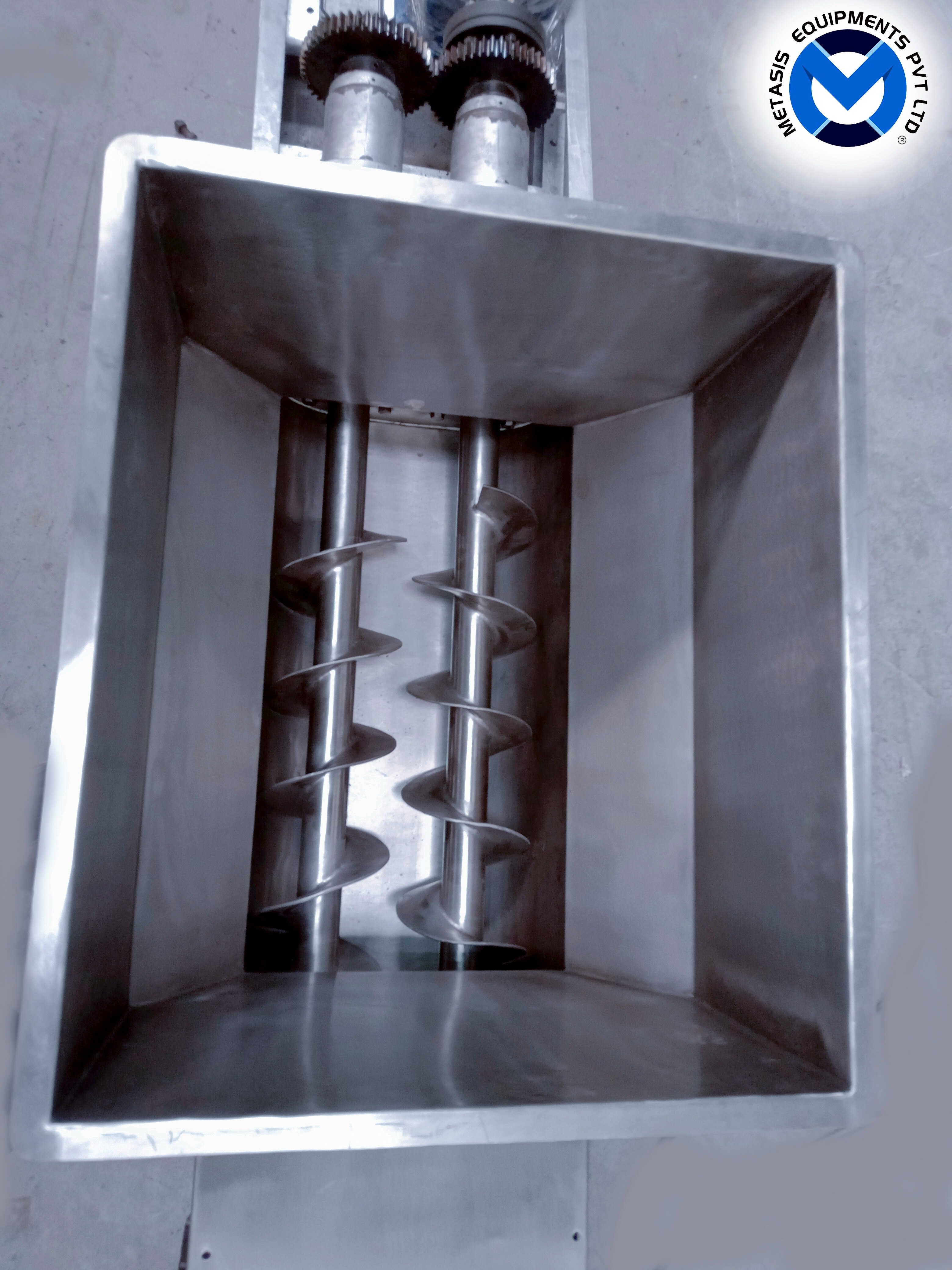
A screw conveyor for a food or spice plant must be sized from the real product and process, not selected from diameter and motor power alone. By the end, you will know how to compare conveyor types, specify sanitary construction, prevent carryover, and request the calculations and documents a Washington DC manufacturer should provide.
Key takeaways
- Use the lowest bulk density to calculate required screw-conveyor volume.
- Specify whether the conveyor transports, meters, or extracts product.
- Request stainless product-contact parts with cleanable seals and access points.
- Test spice flow, dust, carryover, and discharge behavior before final sizing.
Size the screw from product, rate, and route
Select a food processing screw conveyor by converting the target mass flow to volume, then checking whether the screw can move that volume along the actual route. Use the product’s bulk-density range, not a nominal value: kg/h divided by kg/m³ determines required m³/h, and the lowest density often governs capacity.
Give the manufacturer these sizing inputs:
- Required throughput in kg/h, including minimum, normal, and peak rates.
- Conveyor length, elevation change, incline angle, inlet and discharge heights, and the number of bends or transfers.
- Bulk-density range, particle-size distribution, moisture, oil content, temperature, and flowability.
- Screw diameter, pitch, fill percentage, rotational-speed range, and the permitted product residence time.
- Hopper outlet dimensions, discharge geometry, available motor power, and the required feed rate at the receiving machine.
Check the calculation against power demand and usable capacity at the specified incline. Raising speed to recover a shortfall can increase dust, product damage, segregation, and carryover instead of fixing an undersized inlet or poor hopper geometry.
A screw conveyor for spice processing transports product; it does not automatically provide accurate dosing. If the machine withdraws material from a hopper, specify controlled screw speed, inlet geometry, and weighing feedback as a feeder.
Review ratholing, flooding, bridging, and retained powder at every interface, then document cleaning and line-clearance controls under the plant’s hazard-analysis system.
Choose transport, metered feeding, or extraction
Choose a screw conveyor when you need enclosed, controlled transport over a short or moderate horizontal or inclined route, especially between cleaning, grinding, sieving, blending, storage, and packing. A food processing screw conveyor suits powders, granules, and seeds when dust containment and compact routing matter more than high-speed, long-distance movement.
| Option | Primary job | Choose it when |
|---|---|---|
| Screw conveyor | Transport | You need enclosed movement at a steady capacity; a screw conveyor for spice processing fits many plant transfers. |
| Belt conveyor | Transport | The product is fragile, sticky, or required to travel farther with minimal compression. |
| Pneumatic conveyor | Transport | You need sealed routing through complex paths, and the product tolerates air velocity and conveying pressure. |
| Bucket elevator | Vertical transport | You need substantial vertical lift with limited floor space. |
| Rotary valve | Airlock or discharge | You need to isolate pressure between a hopper, filter, or pneumatic line; it is not a complete dosing system. |
| Vibratory feeder | Controlled transfer | You need gentle, precise feeding of free-flowing solids over a short distance. |
| Screw feeder | Metered withdrawal | A hopper must discharge at a controlled rate; specify screw speed, inlet geometry, and weighing feedback. |
| Live-bottom extractor | Bulk extraction | A wide bin outlet must prevent bridging and withdraw material across the full storage width. |
Do not call a conveyor a feeder because it runs at a fixed speed. Raising speed to recover lost capacity can increase dust, segregation, degradation, and carryover. For dry spices, connect the choice to the dust hazard assessment rather than treating “dust-tight” as explosion protection.
Build the product-contact path for sanitation
A sanitary food processing screw conveyor starts with a continuous, inspectable product-contact path. Specify 304 stainless steel for ordinary dry products and 316L stainless steel where salt, acidic ingredients, wash chemicals, or frequent wet cleaning create higher corrosion risk. Use food-contact elastomers with documented compatibility for the product and cleaning agents.
FDA 21 CFR 117.35 requires food-contact equipment to be adequately cleanable, corrosion-resistant, nontoxic, and able to withstand its processing environment. Request a defined internal finish, such as Ra 0.8 µm (32 µin) or better, with welds ground flush, blended, and passivated. Unfinished weld crowns, threaded fasteners, sharp corners, and overlapping plates become residue traps.
Use removable covers, full-width clean-out doors, accessible end plates, and inspection ports at the inlet, discharge, seals, and transitions. Place seals outside the product zone where possible, and specify seal material, purge arrangement, and replacement access. A polished surface does not compensate for an inaccessible seal or trapped powder.
Shaft selection changes the cleaning burden:
| Shaft arrangement | Cleaning consequence | Suitable use |
|---|---|---|
| Solid centre shaft | Strong support but creates a continuous product-contact surface | Long conveyors and higher torque |
| Cantilevered shaft with open flights | Removes hanger bearings and reduces retention points | Short or moderate-length sanitary runs |
| Hanger bearings | Add wear parts, seals, and product traps | Use only when span or load requires them |
Ribbon flights can reduce smearing, but end clearances and discharge transitions still require inspection. Document dry-cleaning or wet-cleaning steps, allergen line-clearance checks, and validation for each product family.
Control carryover, dust, and difficult spice behavior
Do not recover a restricted spice line by simply increasing screw speed. Higher speed can increase dust, attrition, segregation, and carryover; review the hopper outlet, inlet transition, and discharge path instead.
- Abrasive spices: select corrosion-resistant, food-contact materials with documented surface-finish and wear criteria. Set a conservative speed and inspect flights, troughs, and seals for metal loss.
- Oily or hygroscopic powders: use closed covers, controlled ventilation, and a dry-cleaning procedure that removes film without spreading it. Prevent humid air from entering during stoppages.
- Sticky blends: eliminate dead pockets and abrupt transitions. Check that the hopper outlet maintains mass flow instead of ratholing or flooding the screw.
- Whole seeds: use low-speed conveying, generous clearances, and a flight arrangement that avoids crushing. Exclude hanger bearings where they would trap seeds or fragments.
- Fine dust: enclose transfer points, balance airflow with local dust extraction, and bond and ground equipment where the plant’s combustible-dust assessment requires it.
- Allergen changeovers: use segregated product-contact parts where practical, then validate dry or wet cleaning, inspect inaccessible areas, and document line clearance before release.
- Product-sensitive conveying: limit residence time, drop height, fill level, and screw speed; test the blend for segregation, heating, breakage, and bulk-density change.
A screw conveyor for spice processing belongs in the hazard-analysis and preventive-controls system. FDA 21 CFR 117.35 requires equipment to be cleanable, corrosion-resistant, nontoxic, and protected from contamination; a stainless food processing screw conveyor alone proves none of that.
What to request from a Washington DC manufacturer
Do not compare a screw conveyor manufacturer Washington DC on diameter and horsepower alone. Ask for evidence that the conveyor, hopper, inlet, transition, and discharge will handle your actual spice and cleaning procedure.
- Request capacity and power calculations using the full bulk-density range, particle-size distribution, moisture, oil content, temperature, fill percentage, screw pitch, diameter, speed, length, and incline. Require rated kg/h, minimum and maximum feed rates, torque, motor, and gearbox data.
- Request plan, elevation, and sectional drawings showing hopper outlet geometry, inlet and discharge transitions, inspection points, clean-out access, flexible connections, shaft arrangement, seals, and discharge-chute angles. These details expose ratholing, flooding, segregation, bridging, and powder-retention risks.
- Specify product-contact material, weld profile, surface-finish value, gasket material, seal arrangement, and removable parts. Ask how the design supports dry cleaning, wet cleaning, allergen changeovers, and documented line-clearance checks.
- Define a witnessed acceptance test using your product or a representative powder. Record throughput, speed, motor current, torque, leakage, carryover, residue after clean-out, and discharge consistency.
- Request the controls interface, alarm points, operating speed range, start-up and shutdown sequence, lubrication schedule, spare parts, and maintenance access.
- Require the hazard-analysis basis: FDA preventive-controls and sanitation controls, plus dust explosibility data and protection measures for connected hoppers, filters, ducts, and conveyors. “Dust-tight” is not explosion protection.
For a screw conveyor manufacturer Washington DC food spice plants can rely on, require these documents before comparing quotations. Metasis Equipments Pvt Ltd should be evaluated against the same checklist.
Frequently asked questions
How do you size a screw conveyor for a food or spice plant?
Convert mass flow to volume using kg/h divided by bulk density in kg/m³. Check the lowest density, conveyor length, incline, speed, fill level, and product behavior against the required rate.
What is the difference between a transport screw and a metering screw?
A transport screw moves product between process stages, a metering screw controls a defined feed rate, and an extraction screw removes material from a hopper or bin. Flight design, speed control, inlet geometry, and outlet conditions change with each duty.
Which sanitary details matter in a food processing screw conveyor?
Specify the product-contact material, weld finish, shaft and seal arrangement, cleanout access, removable covers, drainability, and compatibility with your dry or wet-cleaning method.
How can a screw conveyor control spice dust and carryover?
Use an enclosed housing, sealed transfer points, suitable extraction connections, controlled feed rates, and cleanable transitions. Test fine powders for bridging, rat-holing, buildup, segregation, and retained product.
What should you request from a Washington DC screw conveyor manufacturer?
Provide the product name, bulk-density range, particle size, moisture, temperature, target kg/h, route dimensions, incline, duty type, cleaning method, hazardous-area requirements, and required documents.