
Inconsistent batches, product loss during manual transfers, allergen carryover, long changeovers, and crowded production floors usually reflect weak process integration rather than one faulty machine. By the end, you will be able to define what belongs on a food-processing skid, test whether your product and plant suit one, and specify the hygienic, utility, automation, and commissioning requirements that prevent costly failures.
Key takeaways
- Move assembly and testing off the production floor with a framed skid.
- Match materials, cleanability, and containment to the product’s hygiene risk.
- Define utility, control, data, and connection points before installation.
- Use factory testing to find process skid problems before commissioning.
What a food-processing skid changes in the production layout
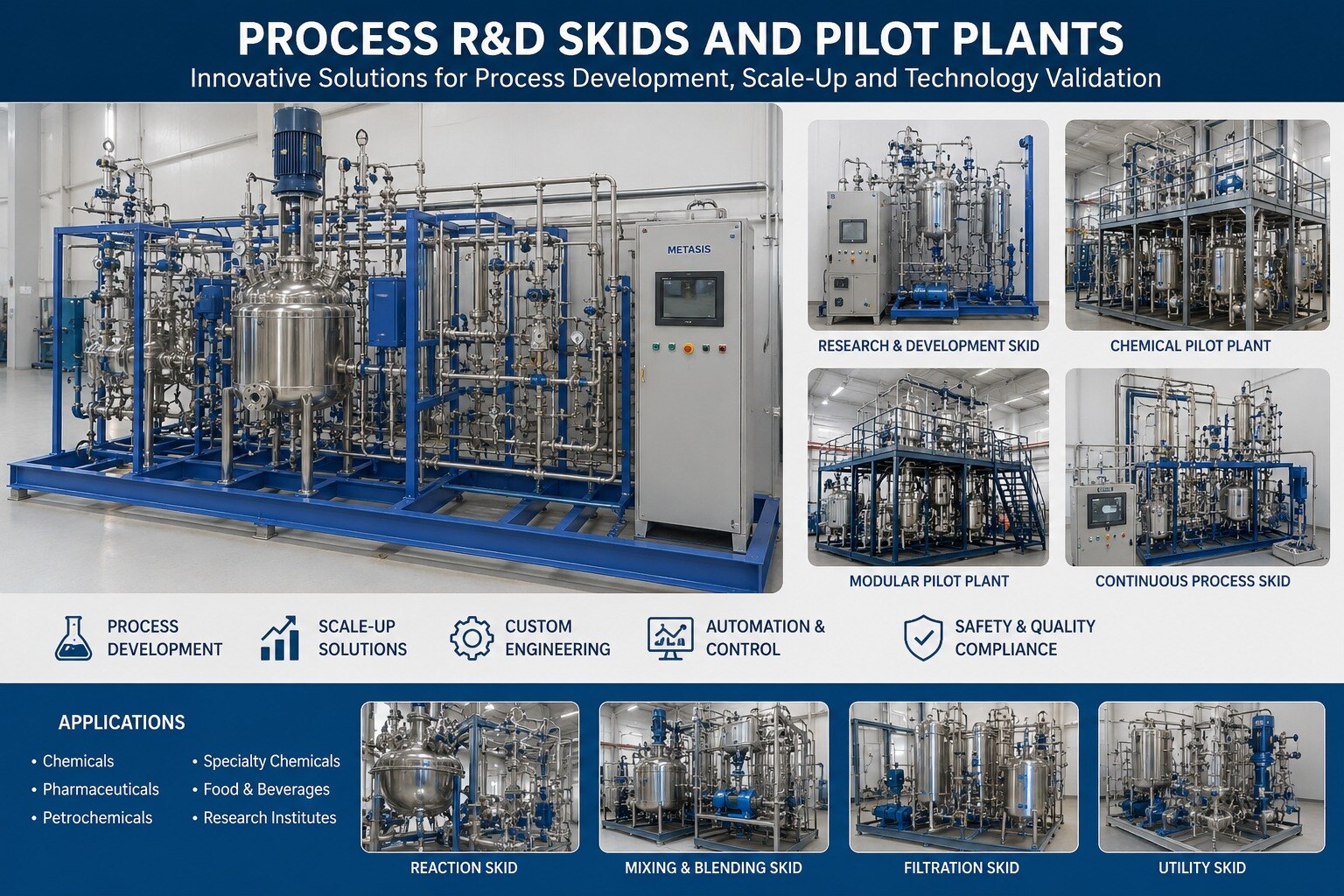
Moving pumps, valves, instruments, sanitary piping, controls, and sometimes tanks or heat exchangers onto one structural frame shifts assembly and testing away from a congested production floor.
That is the core of how process skids for solve food processing production problems: build a coordinated process module before it reaches the plant, then connect it at defined boundaries.
For process skids for food processing, the layout benefit is practical. A preassembled dosing or mixing circuit reduces manual transfers, limits hose connections, improves batch repeatability, and releases floor space for operators and storage.
Standardized routing also makes later scale-up easier, provided the skid can pass through doors, withstand floor loading, drain fully, and leave room for maintenance.
Use this procedure before fabrication:
1. Map each operation from ingredient receipt through dosing, mixing, transfer, cleaning, and discharge. Mark where inconsistent batches, product hold-up, allergen carryover, or changeover delays occur.
2. Define the skid boundary. Specify which pumps, valves, piping, instruments, controls, tanks, and utilities sit on the frame, and which electrical supply, process water, compressed air, drains, network, and exhaust systems remain plant-side.
3. Freeze a utility and interface matrix covering voltage, air pressure and flow, water capacity, sanitary connection standard, drain capacity, control-network addressing, lifting route, and floor loading.
4. Test the assembled module before delivery, then commission the boundary connections on site. A skid shortens installation only when those interfaces fit the plant.
Match the skid design to the product and hygiene risk
Viscosity, particle size, moisture, temperature, batch size, and allergen profile determine the skid layout. A pump that handles a thin sauce can shear a particulate filling, while an undersized line creates excessive pressure drop and inconsistent dosing. Match every wetted component to the product before selecting pumps, valves, heat exchangers, and instruments.
Use these product questions in process skid engineering:
- Does the product contain fibres, seeds, powders, or fragile particles? Specify pipe diameter, pump type, bend radius, and valve geometry to prevent blockage or breakage.
- Does it foul, crystallise, or harden at a temperature boundary? Provide heat tracing, jacketed lines, flush points, and accessible inspection areas.
- Does the recipe contain allergens? Use dedicated paths, validated flush volumes, controlled sequencing, or dismantling where microbial CIP alone cannot prove allergen removal.
- Does the circuit drain completely? Slope product and rinse lines, valve bodies, instrument branches, hoses, and low points so residual water cannot dilute the next batch or support growth.
- Will future expansion require extra branches? Add only modules that preserve hygienic zoning; unused valves and oversized piping increase hold-up, cleaning demand, and process skid problems.
| Risk | Hygienic design response | Consequence of mismatch |
|---|---|---|
| High-viscosity product | Positive-displacement pump and short, drainable product path | Incomplete transfer and batch variation |
| Allergen changeover | Segregated circuit or documented flush and verification | Carryover despite visibly clean equipment |
| Microbial fouling | Smooth food-contact finish, sound welds, no crevices or dead legs | Failed cleaning and recurring contamination |
Orient instruments for drainage, eliminate horizontal ledges and uncleanable valve cavities, and make every food-contact surface inspectable. A skid is cleanable only when its geometry supports the cleaning method you intend to verify.
Connect utilities, controls, and production data at the boundary
A utility and interface matrix must be frozen before fabrication. Process skids for food processing shorten commissioning by moving assembly and testing off the plant floor, but every unresolved boundary detail becomes an installation failure.
The plant must provide:
- Electrical supply with the specified voltage, phase, short-circuit rating, and network addressing
- Instrument air at the required pressure and flow, plus process water, steam, chilled water, or hot water at confirmed capacities
- Sanitary connections that match the skid’s clamp size, gasket material, orbital-welded pipework, and hygienic standards
- Drains sized for CIP return flow, with enough slope and elevation for complete discharge
- Floor loading, lifting access, maintenance clearance, and safe routes for the assembled frame
Process skid engineering should place flowmeters, load cells, temperature probes, valve feedback, and pump controls where the PLC can enforce recipe limits and permissives. Automate ingredient dosing by weight or metered volume, then control mixer speed, time, temperature, and viscosity-related conditions before opening the transfer path. Interlock pumps against closed valves and empty vessels.
Program CIP with verified flow velocity, temperature, chemical concentration, contact time, spray coverage, return drainage, and product-cleaning circuit separation; automation cannot repair poor piping. Record operator, recipe version, lot numbers, actual doses, alarms, transfers, and CIP results in the batch record, then exchange that data with the plant control or manufacturing system.
Ensure low points, valve bodies, branches, hoses, and instruments drain without disassembly.
Prove the skid works before operators depend on it
A skid is ready only when testing proves repeatable production, safe recovery from faults, and cleanability—not merely that pumps run. Use a signed acceptance plan with measurable pass/fail limits.
1. Factory acceptance testing must prove sequence logic, permissives, interlocks, alarm response, recipe limits, instrument scaling, valve feedback, loss-of-signal actions, CIP transitions, batch records, and data exchange with the plant control system. Test simulated I/O and representative recipes; a powered-up frame without either can hide process skid problems.
2. Site commissioning must prove every boundary connection: voltage, plant air pressure and flow, process-water capacity, sanitary fittings, network addressing, drain capacity, floor loading, lifting access, and maintenance clearances. Run dry and water tests before introducing product.
3. Product trials must prove batch consistency at the specified rate, fill level, viscosity, particle load, temperature, and minimum flow. For thermal service, verify residence-time distribution, cold-spot temperature, sensor response, heat-exchanger fouling, flow diversion, and upset recovery with the actual product or a justified surrogate.
4. Cleaning verification must prove that product and rinse circuits drain without dismantling and that the defined CIP cycle removes soil, allergens, and microorganisms to documented limits. Use visual inspection plus the selected rinse, swab, conductivity, pH, protein, allergen, or microbiological checks.
5. Handover must include as-built P&IDs, electrical drawings, software backups, calibration records, recipes, maintenance instructions, spare-parts lists, training records, open deviations, and signed acceptance results. This evidence turns process skids for food processing from installed hardware into an accountable production system.
Decide when a skid is better than another process architecture
Choose a skid when integration, repeatability, and controlled factory testing matter more than maximum permanent capacity. The practical question behind “how process skids for solve food processing production problems” is whether moving assembly off the plant floor offsets the skid’s limits on access, lifting, drainage, and future expansion.
| Option | What it means | When it applies |
|---|---|---|
| Fixed process line | Permanently installed vessels, piping, utilities, and controls | High, stable throughput with ample space and few recipe changes |
| Process skid | Pumps, valves, instruments, piping, controls, and selected vessels mounted on a tested frame | Multiple products, constrained construction time, repeatable batches, or a credible relocation or expansion need |
| Containerized modular system | A skid enclosed in a transportable room or container | Remote sites, rapid deployment, or severe weather and site-control requirements |
| Standalone equipment | One mixer, pump, filler, or heat exchanger integrated by plant staff | A defined bottleneck where existing utilities and controls already work |
Choose standalone equipment for a single constraint; choose a fixed line when expansion and hygiene zoning justify permanent installation. Choose a container only when enclosure and transport solve a real site problem, because access, ventilation, fire protection, and cleaning space become design issues.
Proportion the skid around batch size, viscosity, particle load, allergen changeover, CIP flow, and maintenance clearance. Unused branches add hold-up volume and dead-leg risk. That is core process skid engineering.
For pilot or scale-up decisions, Metasis Equipments Pvt Ltd can be assessed against the required trial data, not simply frame size or equipment count.
Related products
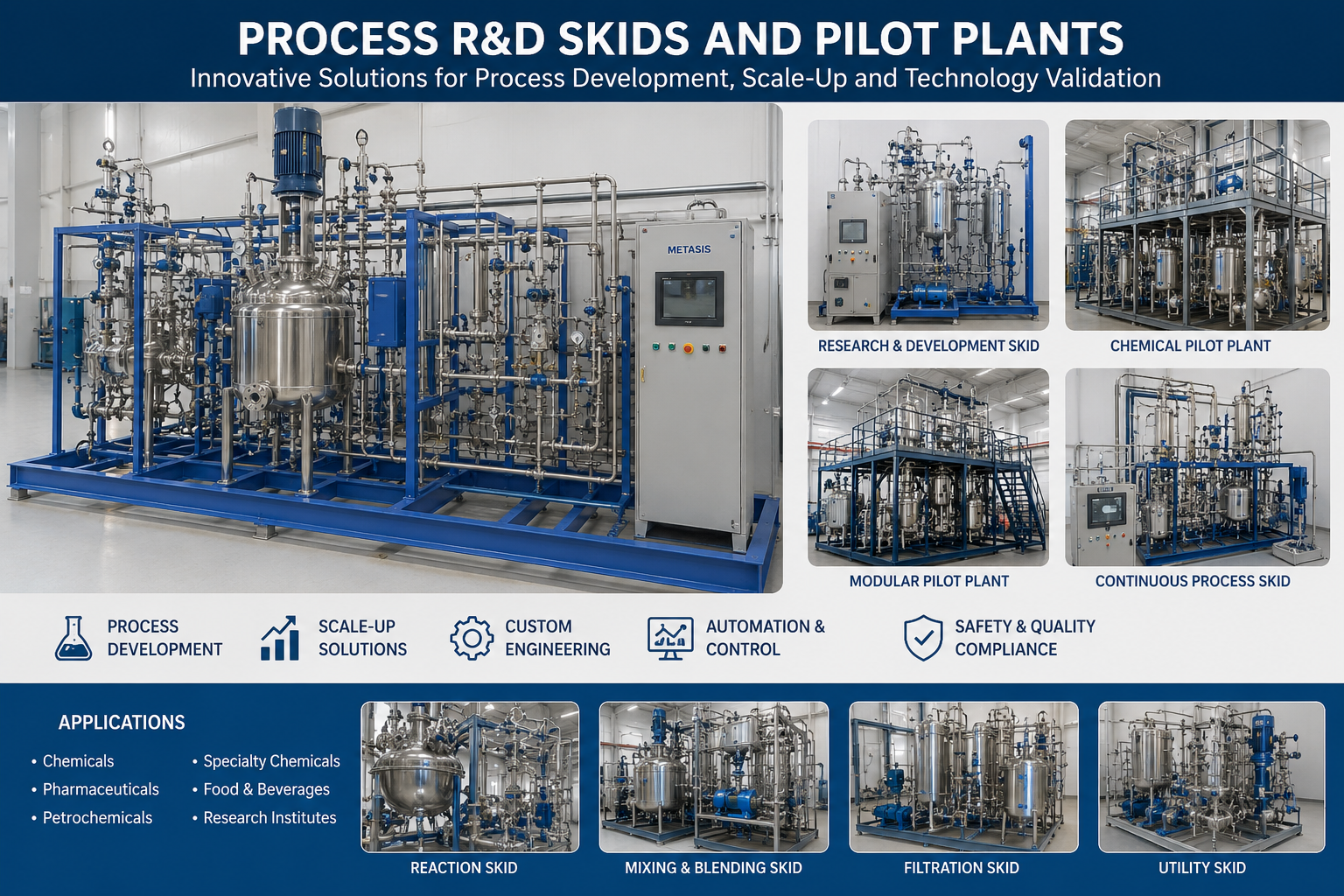 | Engineering Process System Process R&D Skids and Pilot Plants Innovative Process Development Solutions At Metasis Equipments Pvt. View product → |
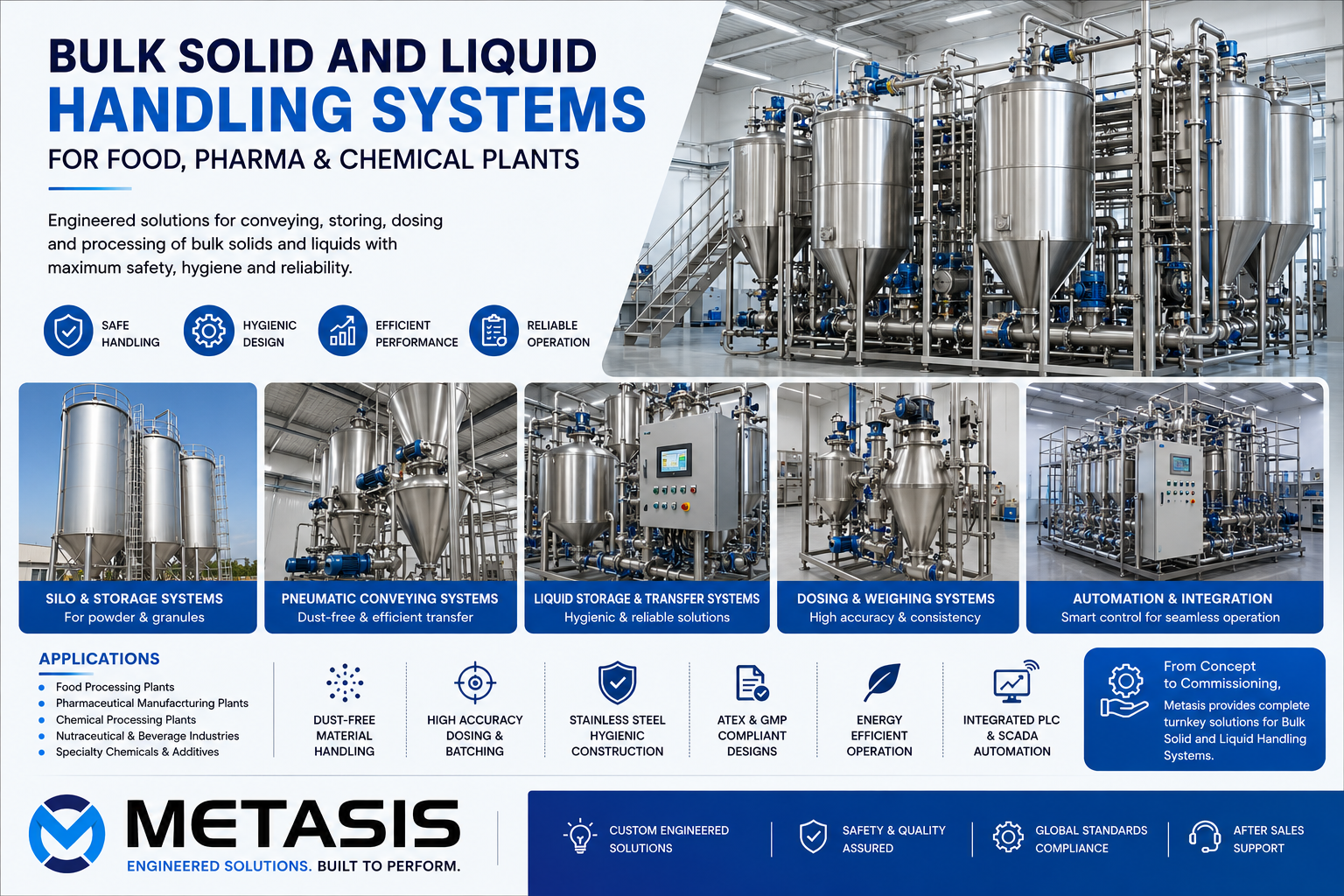 | Engineering Process System Bulk Solid and Liquid Handling Systems Bulk Solid and Liquid Handling Systems For Food, Pharma & Chemical Plants At Metasis Equipments Pvt. View product → |
Frequently asked questions
How do process skids change a food-processing production layout?
They place pumps, valves, instruments, sanitary piping, and selected tanks or heat exchangers on one structural frame, reducing field assembly in congested production areas.
How should you match a process skid to the product and hygiene risk?
Specify materials, surface finish, drainability, clean-in-place coverage, seals, and containment according to the product’s ingredients, temperature, viscosity, allergen risk, and microbial exposure.
What must you define at the skid boundary?
Define utility connections, product inlet and outlet points, electrical supply, control signals, network links, instrument data, drainage, and operator responsibilities.
How do you prove a food-processing skid works before production use?
Use documented factory acceptance testing, including leak checks, instrument verification, control-sequence tests, clean-in-place checks, alarm tests, and performance trials against agreed specifications.
When is a process skid better than another process architecture?
Choose a skid when repeatable assembly, factory testing, limited installation time, or a compact footprint outweighs the transport, lifting, access, and customization constraints of a framed system.
Related products
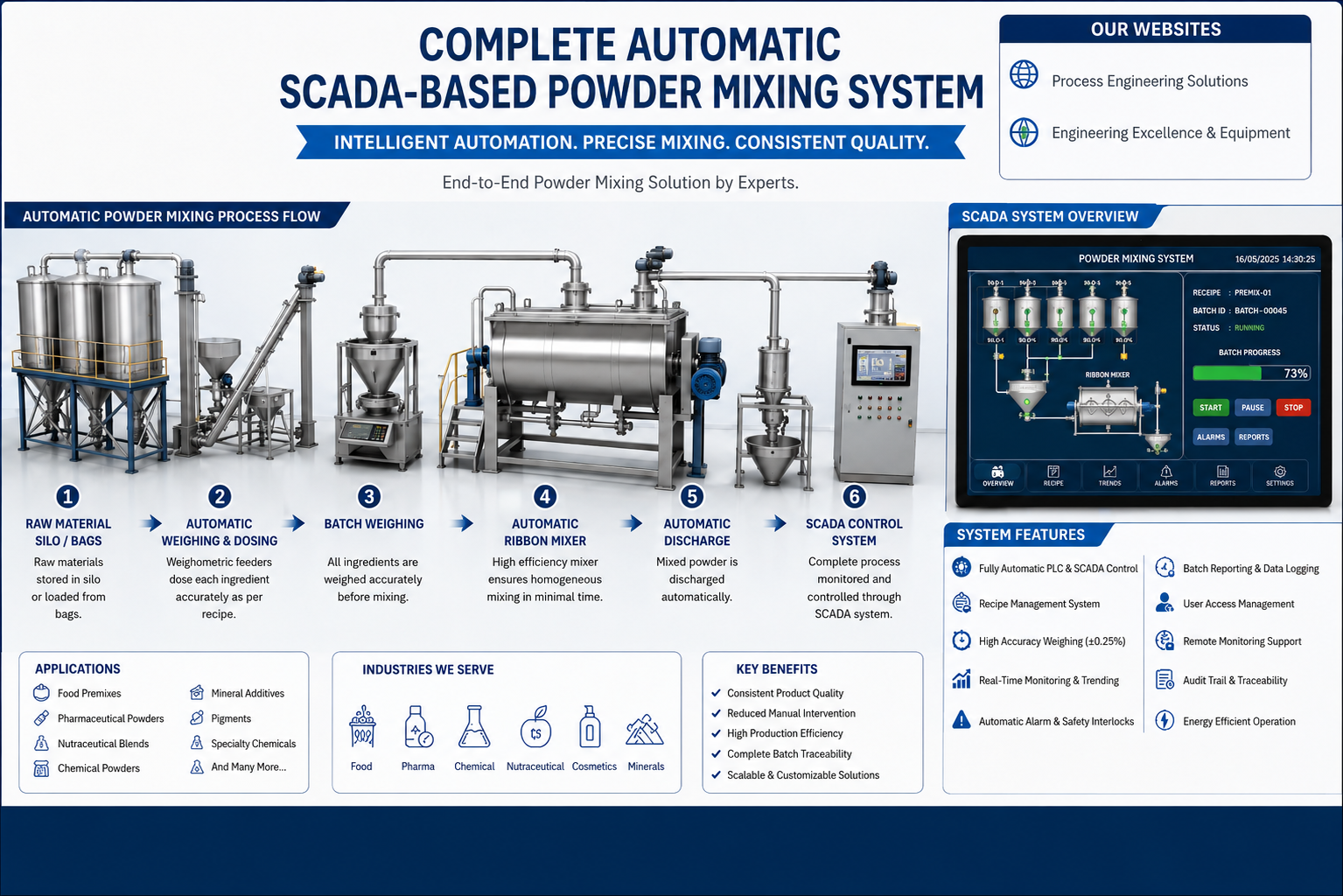 | Engineering Process System Complete Automatic SCADA - Based Powder Mixing System Intelligent Automation. Precise Mixing. Consistent Quality. At Metasis Equipment’s Pvt. View product → |
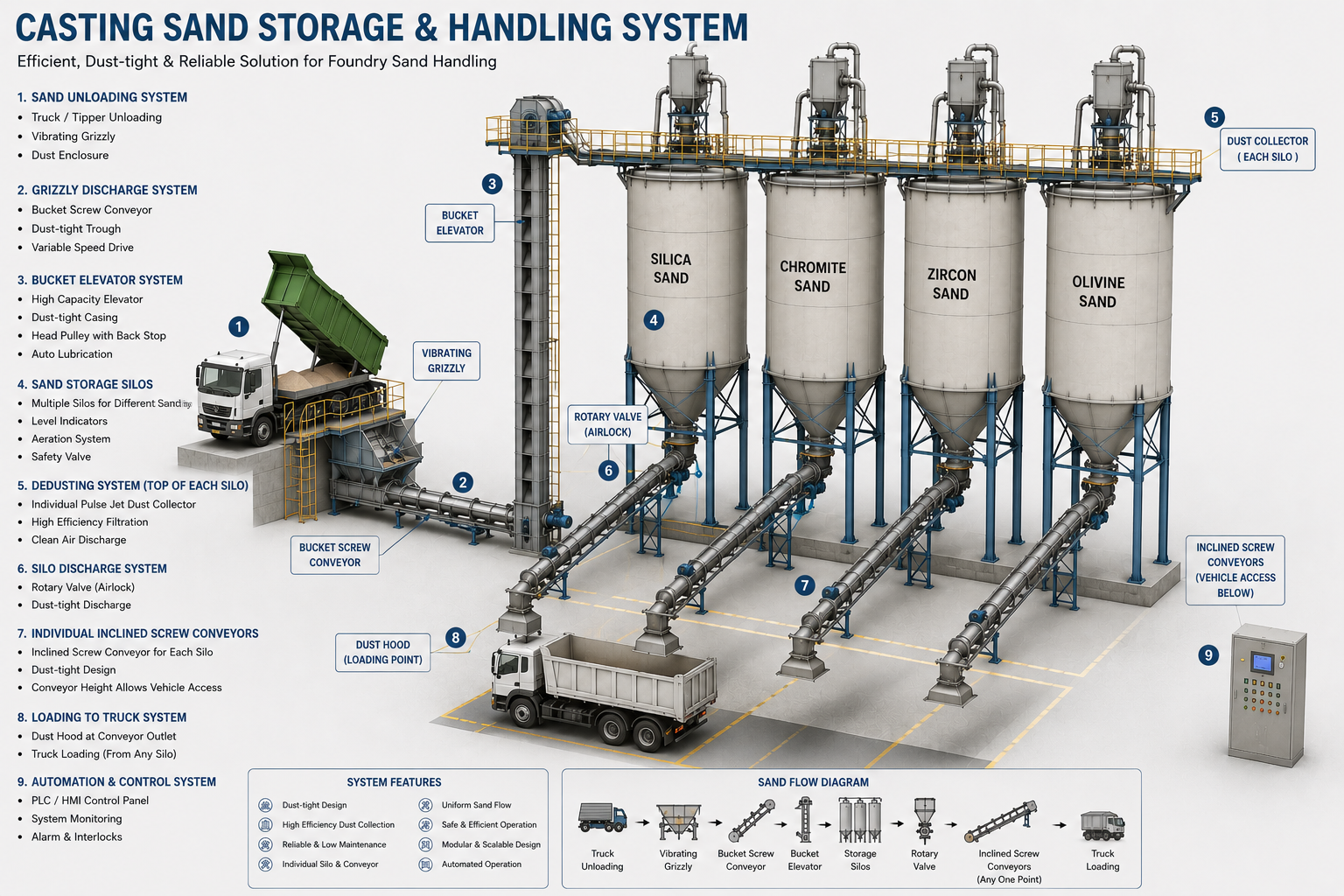 | Material Handling System Automatic Powder Handling, Weighing, Mixing & Bagging System Fully Automated Solution for Powder Unloading, Conveying, Dosing, Mixing & Packaging Metasis Equipments Pvt. Ltd. View product → |