
Stop the feed before you open a boot, head section, or inspection door, then determine whether the machine has stopped, slowed, slipped, or is running empty. By following the symptom, energy-isolation, mechanical-inspection, and controlled-restart sequence below, you can find the likely fault without turning a blockage into a larger failure.
Key takeaways
- Stop every upstream feeder before opening an inspection door.
- Classify the symptom before checking the drive, boot, or discharge.
- Inspect motor, coupling, gearbox, belt, chain, pulleys, and take-up.
- Restart empty in stages and stop if the fault returns.
Make the elevator safe before you inspect it
After a bucket elevator stops, stop feeding it before you touch an inspection door. Shut down the upstream conveyor, rotary valve, screw feeder, pump, or other feed source so material cannot keep loading a blocked boot.
1. Prevent automatic and remote startup. Notify affected operators, stop the control sequence, and isolate electrical, pneumatic, hydraulic, and mechanical energy to the motor, gearbox, and connected equipment.
2. Apply your site lockout/tagout procedure to every isolation point. Do not rely on a stopped motor, a control-panel indication, or a tripped overload; stored energy can still move the belt, chain, buckets, pulley, or gearbox.
3. Release take-up tension only as the equipment procedure directs. A loaded take-up can move suddenly and cause serious injury when a fastener, belt splice, chain, or bearing releases.
4. Verify zero belt or chain movement before opening the boot, head, casing, or inspection doors. Check the isolation, test the start control, and confirm that the drive cannot turn.
5. Treat combustible dust as both fuel and an ignition or explosion hazard. Do not use uncontrolled compressed-air blowdown, which can suspend dust; remove deposits with the site-approved method.
For a bucket elevator breakdown in France, check the ATEX risk assessment, zoning documents, and protective devices against Directive 1999/92/EC and Directive 2014/34/EU. Never bypass a speed switch, belt-alignment switch, temperature switch, guard interlock, or emergency stop to regain production.
Classify the failure by what the machine is doing
A complete stoppage means the head shaft, belt, or chain is not moving; a bucket elevator material flow problem can leave the drive running while little material reaches the discharge.
1. Confirm motor status and movement. Check whether the motor is energized, then verify shaft, belt, or chain movement from a safe observation point. Do not rely on motor current alone.
2. If the drive has stopped, record any overload relay, motor-protection device, or variable-frequency-drive trip before inspection. Look for a jam, seized bearing, gearbox fault, excessive feed, or electrical failure. Inspect before resetting, and never reset repeatedly without finding the cause.
3. If the drive runs but discharge is low, check feed starvation, wrong rotation, empty buckets, a slipped coupling, boot buildup, and material falling back before the head. A full bucket does not prove correct discharge: centrifugal elevators need sufficient speed, while continuous elevators depend on overlapping buckets and controlled geometry.
4. Treat low speed, belt dust, a polished or hot pulley, abnormal noise, or rising bearing temperature as evidence of slip or increasing resistance. A cool bearing does not rule out a feed, bucket, or discharge fault.
5. Intermittent lifting points to a loose splice, stretched chain, damaged sprocket, loose head-shaft key, or inlet bridging. For reduced capacity, time both feed and discharge and compare them with the commissioning baseline, recording bulk density, moisture, particle size, and operating speed.
Inspect the drive train from motor to take-up
For bucket elevator troubleshooting in France, start at the motor and record the trip code, running current, rotation, and shaft movement. Do not repeatedly jog a plugged machine; each attempt can worsen a jam, shear a key, or damage a splice.
- Inspect the coupling, gearbox output, drive pulley or sprocket, head shaft, and shaft keys for looseness, shearing, wear, and incorrect alignment.
- Check head and boot bearings for rising temperature, contamination, poor lubrication, noise, and turning resistance. Compare temperatures over time; one reading cannot prove a bearing is healthy.
- Examine the belt or chain for stretch, edge fraying, broken fasteners, splice separation, missing links, bucket deformation, and casing contact. Inspect every nearby bucket mounting point, not only the visibly damaged bucket.
- Check the take-up for a seized screw, unequal travel, broken spring, hydraulic failure, or a position that leaves the belt or chain slack.
Separate belt slip from misalignment before adjusting anything.
| Condition | Inspect | Clue |
|---|---|---|
| Belt slip | Take-up travel, lagging, oil or water, tension, boot overload, seized bearings | Reduced speed, heat, polished or burned pulley |
| Belt misalignment | Pulley squareness, shaft alignment, tracking, buildup, casing contact | Edge wear, leakage, damaged fasteners |
| Chain slip | Elongation, tooth wear, sprocket alignment, chain tension | Jumping, uneven motion, incomplete discharge |
Tightening a slipping belt alone can conceal an overloaded boot or seized bearing.
Find the blockage, feed fault, or discharge restriction
A running drive does not prove that a bucket elevator is conveying material. Trace the flow from inlet to discharge; an empty bucket, misplaced feed stream, or blocked chute can leave the belt or chain moving while production falls to zero.
1. Inspect the inlet for a closed slide gate, bridged material, foreign objects, wet or compacted feed, and a rotary valve or feeder that delivers inconsistently. Confirm that material enters the bucket loading zone, not the casing or the space behind the buckets. Increasing speed will not repair badly directed feed.
2. Check the boot for overfeeding, inadequate clearance, carryback, and material returning from the head. Never clear a plug by jogging the motor.
3. Inspect every bucket near the failure zone for broken, loose, worn, or deformed steel or polymer, missing bolts, and distorted mounting holes. One loose bucket can strike the casing and create further damage.
4. At the head, check the discharge chute for plugging, the downstream gate for closure, venting for restriction, and the pulley for buildup. Confirm rotation and verify that the discharge trajectory matches the bucket design and operating speed.
A centrifugal elevator needs enough speed to throw material clear; a continuous or slow-speed design depends on controlled overlapping discharge.
Isolate the equipment, remove the cause, clean the boot and head, and inspect for impact damage before restarting. This sequence exposes bucket elevator material flow problems without turning a blockage into a larger failure.
Restart in stages and decide when to involve an engineer
Restart only after the elevator is mechanically complete, protected, and proven safe to run. A full-rate restart can recreate the original plug before you know whether the fault is cleared.
1. Refit every guard and inspection cover, remove tools and personnel, and test the emergency stop, interlocks, speed switch, alignment switch, and temperature switch. Start empty when the elevator design permits it.
2. Check rotation, belt tracking or chain alignment, operating speed, bearing-temperature trend, and abnormal noise. Stop immediately if the belt rubs the casing, the chain wanders, or a bearing temperature rises.
3. Introduce material gradually while watching boot loading, head discharge, motor current, belt or chain speed, and discharge mass. Increase feed in steps; do not return directly to the former full rate.
4. If alignment trips recur, inspect pulley squareness, shaft alignment, take-up position, belt centering, pulley buildup, uneven loading, and casing contact. Never bypass the switch: repeated resets can turn detectable rubbing into belt failure or fire.
5. Escalate a bucket elevator breakdown in France when inspection finds a damaged splice, head shaft, gearbox, sprocket, casing, structural alignment, or ATEX protection issue. Confirm the equipment remains consistent with Directive 1999/92/EC and Directive 2014/34/EU.
For bucket elevator troubleshooting France, Metasis Equipments Pvt Ltd needs the fault history, material properties, measured feed rate, speed, trip codes, photographs, and inspection findings when the failure points to feed control, dosing, conveying integration, or a redesigned arrangement.
Related product
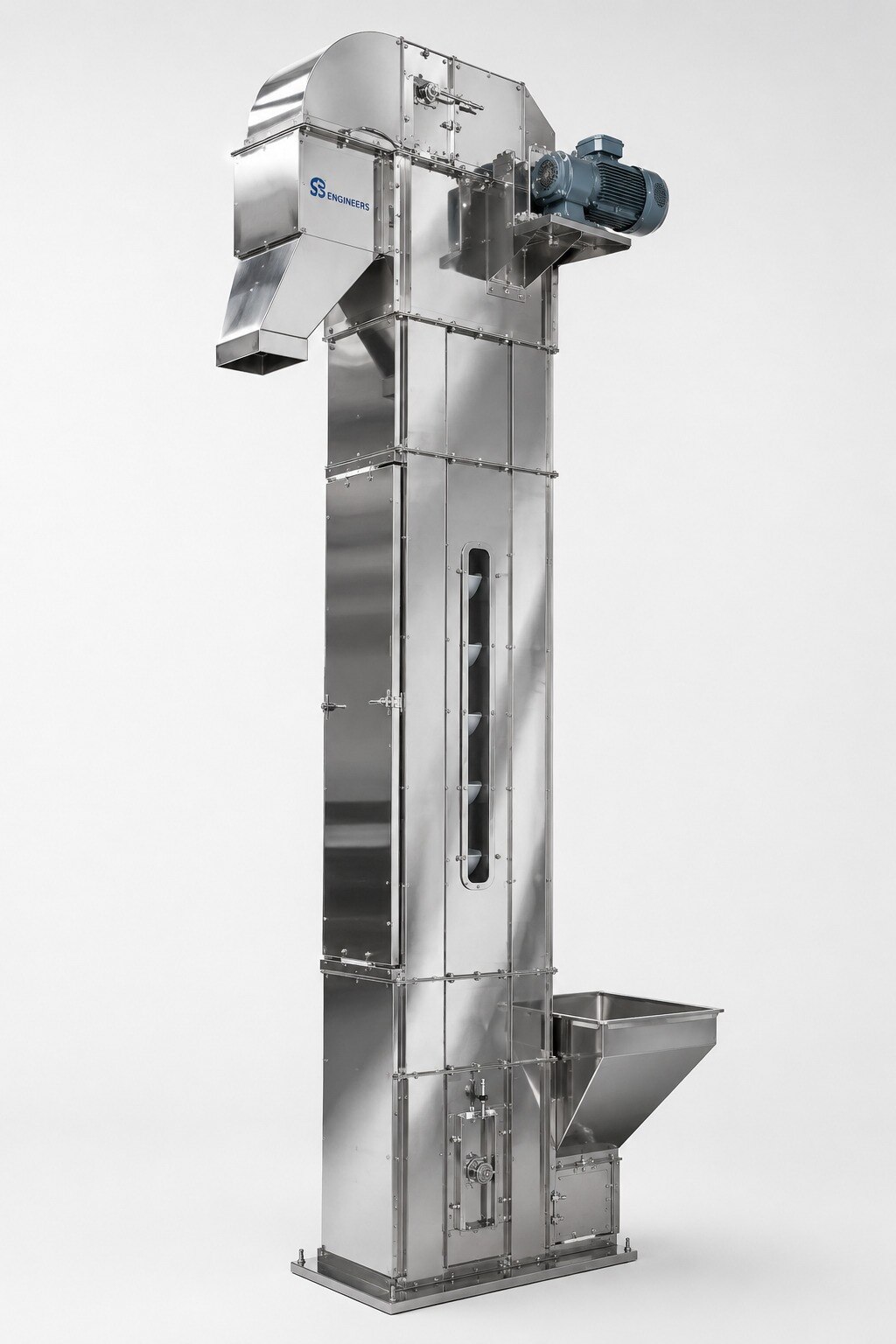
 | Bucket Elevator Efficient Vertical Material Handling Solutions A Bucket Elevator is a highly efficient conveying system designed for the vertical transportation of... View product → |
Frequently asked questions
What should you do before inspecting a stopped bucket elevator?
Stop the upstream conveyor, rotary valve, screw feeder, pump, or other feed source. Isolate and lock out the elevator and connected equipment before opening an inspection door.
How can you classify a bucket elevator failure?
Identify whether the elevator is not starting, running without lifting material, tripping under load, making unusual noise, slipping, or returning material through the boot. Each symptom points to a different inspection path.
What parts of the drive train should you inspect?
Check the motor, electrical protection, coupling, gearbox, drive shaft, pulley or sprocket, belt or chain, bearings, and take-up. Look for looseness, damage, misalignment, abnormal heat, and inadequate tension.
Where should you look for a material-flow blockage?
Inspect the boot for compacted material, the feed inlet for overloading or poor entry, the buckets for buildup or damage, and the head discharge for a blocked chute or restricted outlet.
When should you involve an engineer?
Call an engineer when the elevator trips again after an empty restart, the belt or chain is damaged, the drive overheats, the casing is misaligned, buckets are contacting the casing, or the blockage cannot be cleared safely.