
A pharmaceutical blend can fail after the mixer appears to run normally: cohesive API can remain agglomerated, low-dose material can distribute unevenly, and a uniform blend can segregate during discharge or packaging. By matching mixer type, powder properties, usable capacity, operating sequence, cleaning strategy, and validation evidence, you can identify equipment that controls the actual failure risks.
Key takeaways
- Reject ribbon blenders for cohesive powders with hard, persistent agglomerates.
- Size capacity from usable working volume, not the vessel’s gross volume.
- Control charging order, fill level, mixing time, discharge, and packaging transfer.
- Demand documented blend-uniformity, cleanability, containment, and French installation evidence.
Match the mixer to the powder and the failure risk
A ribbon blender suits free-flowing powders and granules that need gentle convective blending, not every pharmaceutical batch. Inner and outer ribbons move material in opposing axial directions while the rotating assembly circulates it radially; low shear protects fragile particles but leaves hard agglomerates intact.
| Option | Main strength | Failure risk or best fit |
|---|---|---|
| Single-ribbon blender | Simple axial circulation | Free-flowing powders with modest cohesion |
| Double-ribbon blender | Opposing axial movement and stronger exchange | Free-flowing powders and granules needing more even circulation |
| Paddle mixer | Gentle handling and flexible movement | Fragile or segregation-sensitive materials |
| Ploughshare mixer | Intensive circulation; optional choppers | Cohesive powders requiring stronger exchange |
| High-shear mixer | Agglomerate breaking, wetting, coating, or granulation | Hard lumps or processes needing controlled shear |
Screen the powder before choosing ribbon blenders for pharmaceutical powders. Check particle-size distribution, bulk-density range, cohesion, flowability, moisture sensitivity, electrostatic charge, abrasiveness, potency, and segregation risk. A wide density difference or large fine fraction can separate during discharge even after a uniform blend.
For a low-dose API, use a controlled premix or geometric dilution. Extending ribbon-blender time is less dependable and can increase segregation, charging, attrition, or temperature without correcting poor initial distribution.
The answer to which ribbon blenders for prevent pharmaceutical mixing problems is conditional: select a ribbon blender for free-flowing, gently blended material, then specify a lump breaker, sieve, mill, or separate high-shear step when deagglomeration is required.
Size the blender from working volume, not vessel volume
Calculate ribbon blender capacity from working volume: divide batch mass by the lowest credible bulk density, including the low-density condition created by a fine API or aerated powder. Do not use tapped density alone; compaction can make the equipment look large enough while the loose batch overloads it.
Check that this calculated volume sits between the validated minimum and maximum usable fills. A 30–70% gross-volume range is a preliminary design reference, not a pharmaceutical standard.
| Design variable | Uniform-circulation effect | Failure risk to test |
|---|---|---|
| Inner and outer ribbon orientation | Opposing axial paths exchange powder between the centre and ends | Reversed or mismatched pitch creates stagnant end zones |
| Speed and fill height | Speed must move the bed without excessive segregation; fill must cover the working flight | Low fill loses circulation; overfill raises torque and traps poorly exchanged material |
| Trough geometry and clearances | Shaft-to-wall, ribbon-to-wall, and end-plate clearances control scraping and axial exchange | Excess clearance leaves residues; tight clearance increases rubbing and power demand |
For pharmaceutical ribbon blender selection, test the smallest and largest batches with high-moisture, highly cohesive, and low-bulk-density powder, not only a free-flowing placebo. Verify torque, motor power, shaft strength, discharge recovery, and circulation at both ends.
Overfilling can overload the drive and leave material near the end plates; poor discharge geometry can retain powder beneath the shaft and around the valve. A defensible ribbon blender capacity therefore comes from working-volume trials, not vessel volume alone.
Control the batch from charging through packaging
A good blend can fail after the mixer if charging creates concentration pockets or transfer separates the particles. For ribbon blenders for pharmaceutical powders, operating discipline matters as much as ribbon geometry.
- Load the compatible carrier fraction first.
- Add the pre-diluted API premix made by geometric dilution.
- Add the remaining excipients while the agitator establishes circulation.
- Run a defined short premixing stage before adding liquid. When liquid is required, use a controlled spray or injection point; never pour onto one stationary location.
- Set mixing time from development trials, then confirm uniformity with samples. Longer mixing is not automatically safer: it can increase segregation, electrostatic charging, attrition, or temperature.
Discharge in a controlled sequence that prevents surging and reduces residual powder beneath the shaft, at the end plates, and around the valve. Specify bottom-discharge geometry, short product paths, and a validated drain-down or clean-out method.
For potent or sensitizing powders, review contained charging, dust extraction, pressure control, split-valve discharge, filter-change procedures, and occupational-exposure verification. Uniformity does not prove operator protection.
Follow the blend through vibration, pneumatic transfer, hopper filling, and packaging. Size, density, shape, and electrostatic differences can segregate particles after a successful mixer sample. Use short transfer routes, controlled feed rates, suitable hopper geometry, and line clearance between products.
Prove uniformity and cleanability with documented tests
A defensible qualification proves both blend uniformity and repeatable cleaning; an agitator that rotates without binding is not evidence of either.
1. Define the sampling plan before the trial. Use a specified thief-sampling technique, sample mass, number of samples, labelled containers, hold time, and handling method. Sample near each end plate, the centre, beneath the shaft where accessible, early and late discharge fractions, and the first and last material entering the receiving container.
Do not let one outlet sample or a composite conceal stratification.
2. Test each sample for assay or content uniformity against acceptance criteria established in the product process. Account for assay variability and sampling error, because a passing result can reflect poor sampling rather than a uniform blend.
3. Execute design review, installation checks, operational tests, and performance tests with representative or worst-case material at minimum, nominal, and maximum fills. Record blend time, torque, alarms, discharge recovery, containment, and cleaning results. Inspect hygienic welds, surface finish, drainability, shaft seals, bearings, ports, valve seats, jacket connections, and dead zones.
4. Link the equipment user-requirement specification and cleaning-validation protocol to EU GMP Volume 4, FDA 21 CFR Part 211, ICH Q8(R2), ICH Q9, and ICH Q10. Set residue limits and verify dry, wet, or clean-in-place procedures prevent carryover. Blender qualification does not replace validation of the complete blending, transfer, and packaging process.
Specify the French installation, containment, and supplier evidence
Demand a user-requirement specification before comparing quotations. It must state batch size, lowest and highest bulk density, powder explosibility, containment target, cleaning method, surface finish, access method, discharge recovery, sampling points, alarms, and acceptable residual limits.
For a ribbon blender France installation, require CE conformity documentation and identify the applicable European machinery-safety requirements. Address ATEX only after dust-explosibility testing and hazardous-area classification; a pharmaceutical label alone does not establish ATEX obligations.
Specify grounding and bonding, ignition-source controls, compatible drives and sensors, dust extraction, and pressure-equipment requirements for any pressure-bearing jacket or vessel.
Ask each supplier to support pharmaceutical ribbon blender selection with evidence in this order:
- Submit general-arrangement drawings showing maintenance clearances, shaft-to-wall and ribbon-to-wall clearances, access ports, discharge geometry, and dead-zone controls.
- Provide torque, motor-power, shaft-strength, and start-up calculations for the smallest and largest batches and the worst-case powder.
- Provide material certificates, weld maps, weld-inspection records, surface-finish readings, seal details, and cleanability evidence.
- Define FAT protocols covering alarms, containment, fill range, discharge recovery, cleaning, and sampling locations.
- Run documented trials with representative or worst-case powder, including low-density, cohesive, moist, or high-fines conditions.
- Link design review, installation checks, operational tests, and performance tests to the qualification plan.
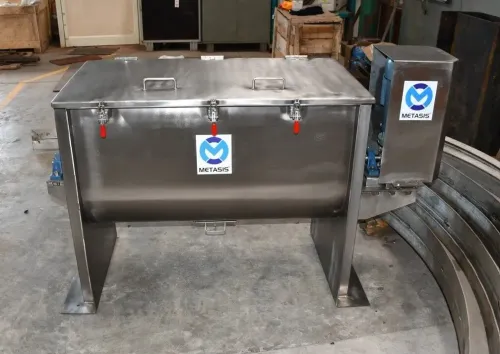
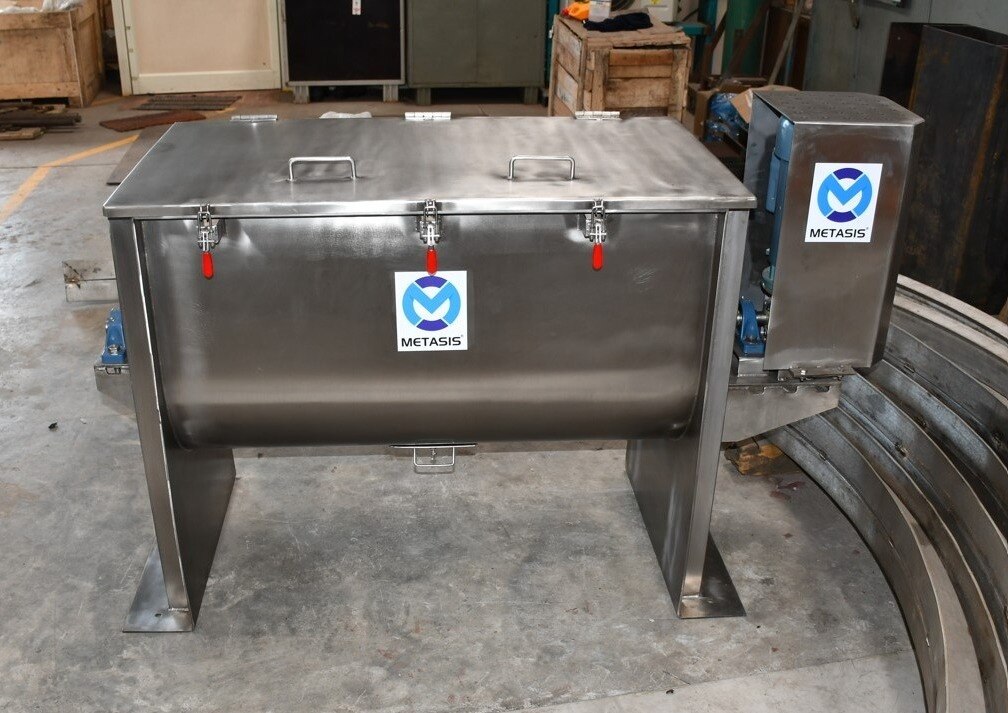
Metasis Equipments Pvt Ltd belongs on the comparison list only when it supplies this evidence for the proposed configuration. Choose on powder-trial results, containment performance, qualification records, and validated cleaning—not a generic uniform-mixing claim.
Related product
 | Ribbon Blender Efficient Powder Mixing Solutions Since 2012, Metasis Equipments Pvt Ltd has been manufacturing high-performance Ribbon Blenders for various... View product → |
Frequently asked questions
Which powders suit a pharmaceutical ribbon blender?
Ribbon blenders suit free-flowing powders and granules needing gentle convective mixing. They are a poor choice for cohesive powders or hard agglomerates that low shear cannot break.
How do you calculate pharmaceutical ribbon blender capacity?
Calculate from the required working volume and the powder’s bulk density, then keep the batch within the manufacturer’s validated fill range. Do not size from gross vessel volume.
How can you prevent mixing problems during production?
Control ingredient charging order, fill level, mixing time, discharge sequence, segregation during transfer, and the handoff to packaging.
What evidence should you request for a ribbon blender installation in France?
Request documented blend-uniformity and cleanability tests, equipment and containment specifications, installation records, operating instructions, and evidence covering the French site’s safety and utility requirements.