
A biomass bucket elevator can lose capacity, slip, track sideways, overheat or plug when feedstock properties change faster than the equipment settings. By matching each symptom to its inspection signs, you can separate a feed problem from a mechanical fault, shut down safely and restart without repeating the failure.
Key takeaways
- Match noise, spillage and capacity loss to inspection evidence before repairing.
- Check boot loading, buildup and belt tracking before changing elevator tension.
- Lock out, isolate and verify zero movement before clearing a biomass blockage.
- Prevent repeat failures with controlled feed, cleanouts and documented inspections.
How do you identify the fault from the elevator symptom?
Start with the symptom, then confirm it with inspection evidence; do not retension a belt or replace buckets until the fault is identified. For bucket elevator troubleshooting in a bucket elevator biomass plant, use this sequence:
1. Check bucket fill and feed conditions. Empty or uneven buckets with a normal boot level indicate low feed, off-centre loading, low bulk density, long fibres or wet biomass—not a plugged boot. A rising boot level, packed material around the inlet and stalled buckets indicate plugging.
2. Inspect the discharge throat and casing. Material falling back down while buckets appear full points to a blocked discharge, restricted throat or insufficient belt speed. Recirculation raises motor current and can develop into a plug.
3. Mark the belt or chain and observe one full revolution. A stationary mark, polished pulley and slipping splice indicate belt slip; check take-up tension, pulley buildup and overload before increasing tension. Movement toward one casing side indicates tracking error from misaligned pulleys, an uneven splice or off-centre loading.
4. Match the noise and measurement. Repeating knocks, casing rub or rhythmic shaking indicate vibration from a damaged bucket, loose fastener, pulley runout or bearing defect. A hot bearing with rising temperature confirms lubrication, alignment or bearing trouble.
5. Read the drive current and inspect the buckets. High current with a rising boot level indicates overload or plugging; high current with full discharge indicates excessive feed or mechanical drag. A missing, cracked or distorted bucket, with loose fragments below, identifies bucket breakage.
Record belt speed, bearing temperature, motor current, alarm history and photographs before changing settings or parts.
How do you correct bucket elevator material-flow problems at the boot?
Start with measured tonnes per hour, not the elevator nameplate. Compare the actual feed rate with normal and peak demand, then check whether the inlet loads the bucket centre or sends biomass against one side of the boot. Off-centre loading causes uneven fill, belt tracking and buildup.
- Measure the inlet-chute angle and inspect for a restriction, sharp transition or ledge that catches fibres. Correct the geometry before increasing drive speed.
- Check boot level during stopped, low-feed and normal operation. A high level indicates flooding or a restricted discharge; a low level points to underfeeding or poor bucket pickup.
- Remove compacted biomass from the boot pulley, buckets and casing access points. Wet, sticky or long-fibre feedstock bridges more readily than dry, uniform chips.
- Record moisture, particle size, fines, bulk density and tramp material. Check upstream screening or drying if seasonal or wet feedstock is creating repeated buildup.
After correcting the feed path, verify the operating settings for that specific biomass. Confirm belt or chain speed, bucket spacing and measured bucket fill; low-density fibres can leave buckets underfilled even when the mass rate appears adequate. Increasing speed before fixing flooding or buildup can worsen slip, dust and wear.
Watch the discharge trajectory at operating speed. Centrifugal discharge needs enough velocity and a clear, correctly positioned throat; biomass falling back into the casing signals inadequate speed, poor throat geometry or a restriction. Recommission empty, then at low feed and full rate while checking boot level, motor current and recirculation.
Which belt, chain, pulley and bucket checks find recurring mechanical faults?
Start with belt or chain tension, but do not retension immediately. Measure take-up position and compare both sides; wet, overloaded biomass often causes slip and stretch, while excessive tension can damage shafts and bearings.
- Check belt or chain alignment and pulley-to-pulley squareness. One-sided tracking, polished casing marks or uneven bucket loading points to misalignment rather than feed moisture.
- Measure bucket-to-casing clearance at the boot, trunk and discharge. Bent buckets, loose fasteners or biomass packed behind buckets create contact marks and recurring plugging.
- Examine the splice for lifted edges, pulled rivets, damaged bolts or chain-pin wear. A failed splice after a wet overload may be the consequence, not the original fault.
- Check every bucket fastener, then inspect bucket projection and spacing. Missing bolts, elongated holes and cracked mounting plates identify independent mechanical damage.
- Inspect pulley lagging for smooth patches, buildup and separation. Wet biomass on lagging causes slip; damaged or eccentric lagging causes slip under empty load too.
- Check bearings for temperature, noise, shaft play and contaminated grease. Heat that remains during an empty run indicates a bearing, shaft or alignment defect.
- Inspect the motor, gearbox, coupling, backstop and torque limiter. Verify backstop direction, mounting, lubrication and rated torque; confirm guards, overload trip and motion switch operation.
Use this bucket elevator troubleshooting comparison before replacing parts:
| Evidence | Likely initiating condition | Confirmation |
|---|---|---|
| Slip only at full feed | Wet or overloaded biomass | Empty run tracks and drives normally |
| Slip empty and loaded | Pulley, lagging, tension or splice defect | Current and speed remain abnormal |
| Repeated bucket contact | Alignment, clearance or bent hardware | Casing marks persist after cleanout |
How can you isolate, inspect and recommission a plugged biomass elevator safely?
A plugged bucket elevator biomass plant demands isolation before inspection. Stop upstream feed, shut down the elevator, and prevent automatic restart; opening the casing while material hangs above the boot exposes you to falling biomass, stored belt or chain tension, and sudden bucket movement.
1. Open the electrical disconnect, apply personal locks and tags, and verify zero energy at the motor and controls. Isolate connected feeders, backstops and hydraulic or pneumatic equipment.
2. Allow bearings, drive parts and recently conveyed biomass to cool. Block the belt or chain and secure counterweights or suspended components before removing covers or cleanout doors.
3. Control combustible dust: stop dusty transfers, remove ignition sources, avoid hot work, and use a suitable vacuum rather than compressed air. Test the atmosphere before entry.
4. Treat the casing and boot as a confined space. Do not enter for clearing unless a permit, isolation, attendant, atmospheric monitoring and a retrieval plan are in place; clear from outside with tools designed for the hazard.
5. Inspect the boot, buckets, belt or chain, pulley, bearings, casing clearance and discharge throat. Remove the plug, replace damaged parts, close guards, and confirm that no tools or biomass remain inside.
Recommission in stages. Run empty and check motion, rotation, tracking, vibration, bearing temperature and motion-switch operation. Feed a small controlled quantity next, watching boot level and discharge. Increase to full rate only after stable flow, then record motor current, temperature, tracking and discharge trajectory; stop if load rises or material falls back.
How do you prevent repeat blockages and choose effective repair support?
Choose protection and cleanout around the feedstock, not the elevator nameplate. Wet, fibrous biomass needs an accessible boot cleanout, moisture control and chute access; tramp metal needs magnetic separation; variable feed needs level, motion and overload monitoring.
A backstop prevents rollback after a trip, but it does not replace guarding, a motion switch or controlled restart.
| Control choice | Use it when | Failure it prevents |
|---|---|---|
| Boot cleanout doors and inspection access | Moisture causes adhesion or bridging | A compacted plug that cannot be removed safely |
| Screening, magnet and moisture control upstream | Feed contains tramp metal, long fibres or wet lumps | Bucket damage, bridging and inconsistent fill |
| Boot-level, motion, bearing-temperature and motor-current monitoring | Feed rate and biomass properties change | Undetected plugging, slip or overload |
| Backstop, overload protection and restart interlock | A loaded elevator can roll backward after a trip | Reverse movement and a second blockage |
Give repair support enough evidence to match parts and diagnose capacity rather than dispatching a generic bucket or belt. Include:
- Elevator height, belt or chain size, bucket type, projection and spacing, drive rating, speed, shaft dimensions and original duty
- Bulk density, moisture, particle size, fibre length, normal and peak throughput, and measured bucket fill
- Photographs of the boot, inlet chute, discharge, belt splice, buckets, pulleys and nameplate
- Alarm history plus belt speed, bearing temperature, motor current and the point where plugging starts
For a bucket elevator with problems in a biomass plant in Pimpri-Chinchwad, Metasis Equipments Pvt Ltd can use those records to separate a plugging or chute fault from an undersized design. Local bucket elevator repair support in Pimpri-Chinchwad still requires compatibility checks before fitting belts, chains, bearings, fasteners or cleanout parts.
Related product
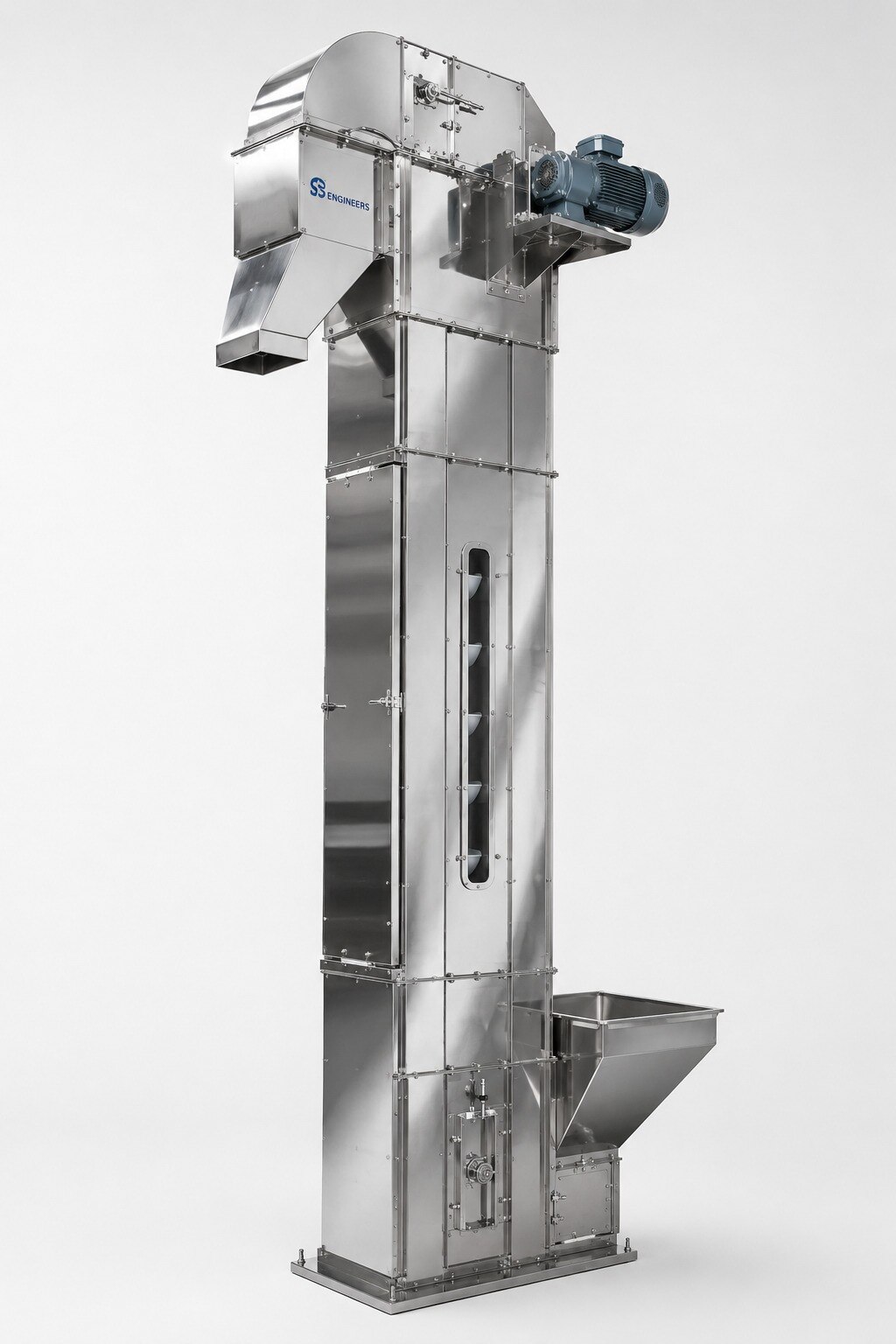
 | Bucket Elevator Efficient Vertical Material Handling Solutions A Bucket Elevator is a highly efficient conveying system designed for the vertical transportation of... View product → |
Frequently asked questions
How do you identify a bucket elevator fault from its symptoms?
Match each symptom with evidence: low capacity points to poor boot loading, belt slip or incorrect speed; spillage points to misalignment, worn buckets or overfeeding; noise points to damaged bearings, chain components or bucket contact. Inspect before replacing parts.
How do you correct bucket elevator material-flow problems at the boot?
Check that the inlet directs biomass into the bucket path without flooding it. Remove compacted material, inspect the boot pulley and cleanout doors, then correct feed rate, buildup and misalignment before restarting.
Which component checks find recurring mechanical faults?
Inspect belt joints, belt tension, tracking, chain elongation, sprockets, pulley lagging, bearings, bucket bolts and bucket spacing. Look for polished contact marks, cracked buckets, loose fasteners and uneven wear.
How can you safely recommission a plugged biomass elevator?
Stop upstream equipment, isolate electrical and stored-energy sources, apply lockout/tagout and verify zero movement. Remove material with approved tools, inspect the boot and discharge, close guards, jog the elevator, and monitor the first loaded run.
How do you prevent repeat biomass elevator blockages?
Control feed rate, keep biomass within the specified particle-size and moisture range, schedule boot cleanouts, monitor belt tracking and record recurring alarms, buildup and component wear. Use repair support that can inspect the full conveying system.