
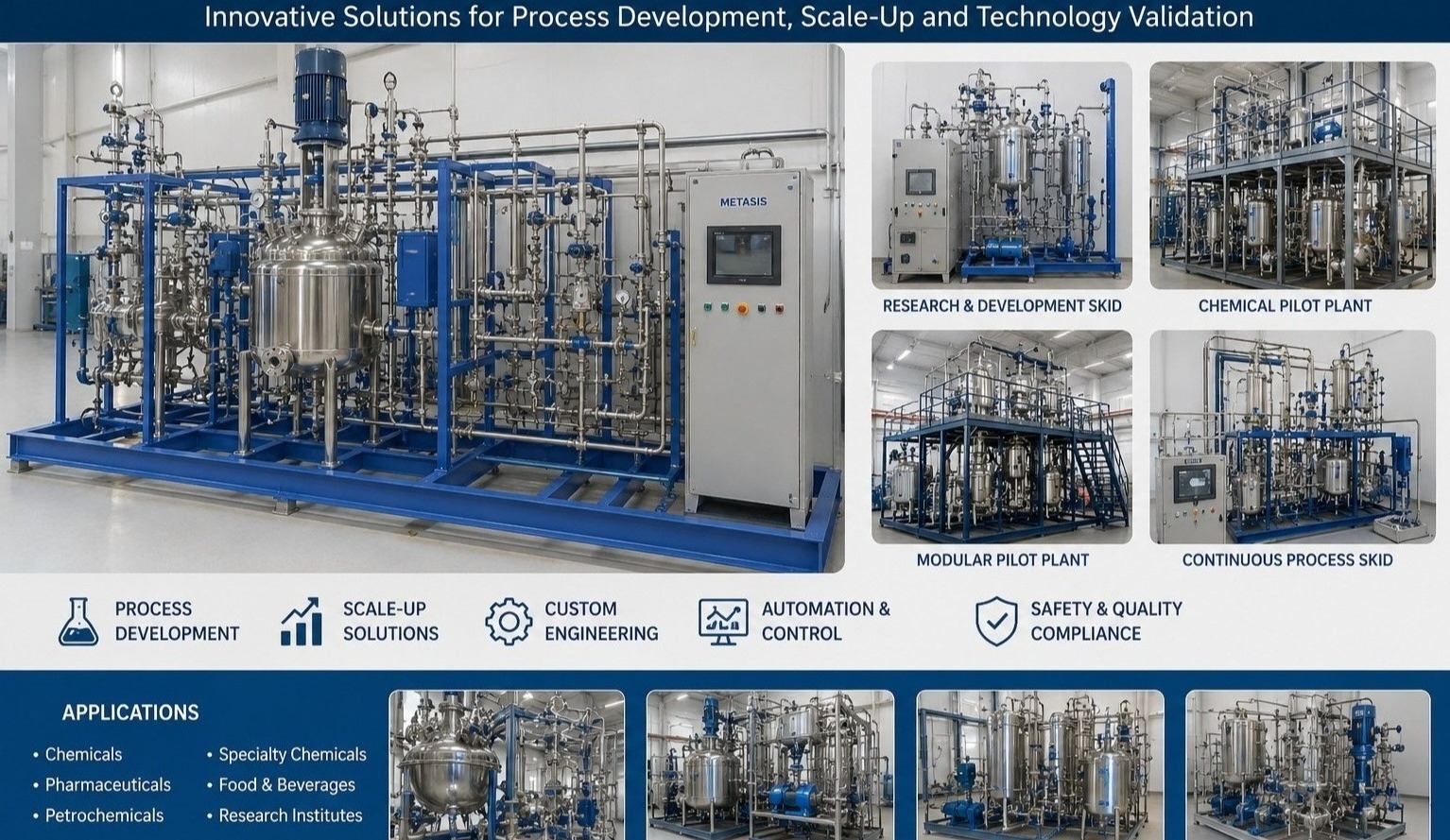
Process skids combine multiple process components into an engineered, skid-mounted package that can be fabricated and assembled before being installed at the final operating location. Depending on the application, a skid may incorporate pumps, vessels, piping, valves, instrumentation, heat exchangers, filters, and control components.
The main advantage is integration.
Instead of coordinating numerous individual pieces of equipment during site installation, businesses can develop a package around a defined process requirement. This can reduce the amount of assembly and interface work required at the plant.
Process skids are used in chemical processing, food manufacturing, pharmaceuticals, water treatment, utilities, and other industrial applications.
The design process normally begins with process requirements. Engineers need to understand operating pressure, temperature, flow rates, materials being processed, utilities, instrumentation, and required control philosophy.
Layout planning follows. Components need to fit within the available skid dimensions while remaining accessible for operation, inspection, and maintenance.
Important considerations include:
Process operating conditions
Equipment sizing
Piping arrangement
Instrument accessibility
Valve locations
Structural support
Utility connections
Maintenance clearance
Transportation limitations
Site connection points
Compactness should not come at the expense of accessibility. Placing equipment too closely together can make routine servicing unnecessarily difficult.
Businesses in Pimpri-Chinchwad and Maharashtra's wider industrial belt may use skid-mounted systems when adding a new process section, upgrading production, or installing auxiliary systems within an existing facility.
Transportation also needs to be considered during design. A skid that works on a drawing still needs to be fabricated, lifted, transported, positioned, and connected safely.
Process skids can therefore simplify industrial projects when mechanical, process, structural, piping, and instrumentation requirements are coordinated from the beginning.
Rather than viewing the skid as a collection of equipment mounted on a frame, it is more useful to treat it as an integrated process package. That approach helps ensure individual components work together effectively after installation.