
Choosing a blender by vessel capacity or a supplier’s claim of uniform mixing can leave you with segregation, difficult cleaning, damaged inclusions or an outlet that never fully clears. You will be able to match the mixer to your powder, calculate a usable batch size, compare alternative mixer types and define tests that prove performance before purchase.
Key takeaways
- Test your powder’s flow, cohesion and segregation before comparing ribbon blender models.
- Calculate batch mass from working volume, bulk density and required headspace.
- Specify discharge design alongside mixing performance to protect blend uniformity.
- Demand cleaning details, factory trials and acceptance criteria before placing an order.
Start with the powder, not the machine catalogue
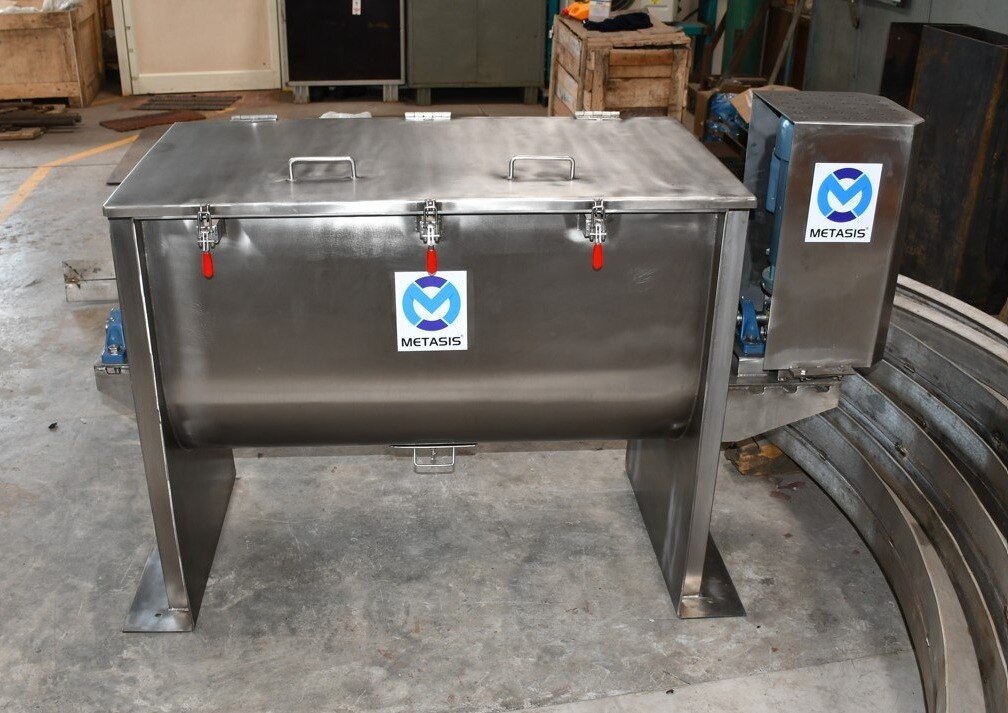
A ribbon blender earns consideration only after you test the powder, before comparing models. In a horizontal trough, a rotating drive assembly turns inner and outer helical ribbons; they move material in opposing axial directions while the assembly also circulates it radially. Ingredients enter through the inlet, undergo convective turnover, and leave through the outlet.
This action suits free-flowing powders and granules, not every recipe.
Assess the ingredient for:
- Bulk density and particle-size distribution
- Moisture, fat content and stickiness
- Friability and segregation risk
Liquid-rich pastes, highly cohesive products, fragile particles and recipes requiring particle-size reduction are warning signs. A ribbon blender is a convective mixer, not a high-shear mill; hard agglomerates need a separate lump breaker or high-shear stage.
| Option | What it does | When it applies |
|---|---|---|
| Paddle mixer | Gentler handling or specialised movement | Fragile ingredients and controlled movement |
| Ploughshare mixer | More intensive action | Cohesive powders and stronger dispersion |
| Conical screw mixer | Difficult powders with controlled turnover | Poor-flowing products needing careful circulation |
| Tumbling mixer | Low-impact blending | Fragile, free-flowing ingredients |
| High-shear mixer or lump breaker | Deagglomeration and liquid incorporation | Hard lumps, rapid wetting or particle-size reduction |
A food powder blender is suitable only when its mixing action matches the recipe. If the product must remain intact, flow freely and resist separation, confirm that behaviour with trials rather than choosing from catalogue capacity alone.
Size by working volume, batch mass and usable headspace
Geometric vessel volume is the shell’s internal capacity; working volume is the product volume you can mix without starving the ribbons of headspace. Size an industrial ribbon blender from batch mass and bulk density, not the catalogue volume alone.
1. Provide the target batch mass, loose bulk density, minimum and maximum batch loads, required fill range and minimum headspace. Calculate powder volume as mass ÷ loose bulk density, then check that every load sits inside the tested working-volume range. Filling to shell capacity can restrict axial turnover and produce poor uniformity.
2. Test minimum, normal and maximum loads. Record tip speed, batch depth, ribbon clearance, residence time, torque and specific power input; rpm alone cannot establish equivalent scale-up. A larger machine at the same rpm has greater ribbon diameter, peripheral speed and power demand.
Excessive speed or time can increase heat, particle damage and segregation, while insufficient time reduces uniformity and throughput.
3. Treat liquid addition as a separate process-sizing question. Test nozzle position, droplet size, liquid viscosity, addition rate, powder load and post-addition time together. Wall deposits, wet balls or a required lump breaker indicate poor incorporation; binders, oils, syrups and concentrated flavours can demand separate deagglomeration equipment.
4. Document the trial recipe and acceptance result for each load. Include temperature rise, uniformity assay and batch time, then compare the actual ribbon blenders on torque margin and usable capacity rather than nominal volume.
Treat discharge and segregation as part of the blend
A uniform sample drawn inside the vessel does not prove a uniform delivered batch. Ingredients with different particle size, density, shape or surface properties can segregate during discharge and transfer.
Percolation lets small particles fall through larger ones; trajectory sends particles different distances from the outlet; fluidization carries fine, light material with moving air. The blender can pass an internal sample while the first and last portions fail.
Require discharge data for the actual recipe:
- Bottom-outlet opening pattern and discharge time
- Central heel, residue mass and batch-to-batch recovery
- Downstream hold-vessel or transfer-line losses
- Ribbon rotation speed during emptying
Keep the ribbons rotating during discharge only when trials show it improves evacuation. Prolonged rotation can remix poorly while separation continues, generate heat and damage fragile inclusions.
Validate with replicate samples from multiple points in the blender, then early, middle and late discharge increments, followed by samples from the downstream hold vessel or transfer line. Define the laboratory assay for the critical ingredient, acceptance limit, method repeatability and batch-to-batch comparison before testing.
For spice mixing equipment, measure temperature and residence time as well as uniformity. Heat and long residence can strip volatile aroma compounds; residual chilli, allergens or strongly coloured spices can contaminate the next batch.
| Test evidence | Genuine performance test | Weak claim |
|---|---|---|
| Sampling | Named internal, discharge and downstream locations | “Uniform in X minutes” |
| Measurement | Defined assay, acceptance limit and replicates | Unspecified visual check |
| Recovery | Discharge time, residue and repeat batches | Mixer-only sample |
A real food powder blender test follows the material to delivery, not just to the end of mixing.
Specify hygienic construction and the cleaning regime
Specify the cleaning regime before approving spice mixing equipment: dry cleaning and wet cleaning demand different construction. Ask for stainless-steel grade, product-contact finish, weld treatment, continuous weld locations, crevice control, sealed or open hollow sections, gasket material, inspection access, drainability, and bearing and drive protection.
- For dry cleaning, require low-residue geometry, vacuum access, inspection ports and controlled disassembly without hidden product traps.
- For wet cleaning, require seal compatibility, full wash coverage, drainage, drying, water exclusion from bearings, and evidence that hollow components cannot retain water.
- State how operators will inspect contact surfaces, remove gaskets, open covers and verify cleanliness between allergen or strong-colour batches.
- Treat “washdown” as a housing claim, not proof of suitability for validated hygienic cleaning.
- For sugar, flour, starch, milk powder and spices, ask for dust classification, containment, extraction, ignition control, bonding and earthing, guarding and explosion protection.
- For ribbon blenders for food processing in London, confirm door and floor access, lifting routes, extraction connections, noise, utilities, service clearance and documentation.
Do not accept stainless steel alone as a hygiene specification. Require drawings, material schedules, seal details, cleaning instructions and evidence that the selected regime reaches every product-contact area without leaving water in bearings or hollow components. The same food-safety requirements apply in London as elsewhere.
Buy evidence through trials, acceptance tests and service support
Turn supplier comparison into a documented factory or site acceptance test using the intended recipe and representative powder blend, not water, sand or generic test powder. Record fill level, ingredient order, ribbon speed, mixing time, temperature rise and liquid-addition conditions.
The protocol must define sampling locations, laboratory assay, uniformity acceptance limit, replicate testing for repeatability, discharge time, residue, recovery, cleanability observations and dust-emission controls. “Uniform in 10 minutes” proves nothing without these details.
Compare quoted machines on the evidence that affects production:
| Feature | Compare | Why it matters |
|---|---|---|
| Outlet | Geometry, opening pattern and heel | Uneven discharge biases composition |
| Access | Inspection points and tool-free reach | Faster cleaning and fault finding |
| Changeover | Demonstrated time and residue | Sets allergen and spice carryover risk |
| Drive | Torque margin and controls | Prevents trips during dense batches |
| Protection | Guarding and extraction interfaces | Controls contact and combustible dust |
| Installation | Method, clearances and service response | Limits London-site disruption |
For ribbon blenders for food processing in London, check door and floor access, noise, extraction connection and utility requirements. Metasis Equipments Pvt Ltd belongs in the same evidence-based comparison, with no performance conclusion until its proposed industrial ribbon blender passes the agreed trial.
Before purchase, collect:
- Product data sheet
- Layout
- Utility schedule
- Risk assessment
- Cleaning procedure
- Test report
- Manuals
- Spare-parts list
- Operator training record
Related product
 | Ribbon Blender Efficient Powder Mixing Solutions Since 2012, Metasis Equipments Pvt Ltd has been manufacturing high-performance Ribbon Blenders for various... View product → |
Frequently asked questions
How do you choose a ribbon blender for food or spice powders?
Start by testing the powder’s flow, cohesion, bulk density and segregation behaviour, then compare blender geometry, capacity, discharge and cleanability.
How should you size a ribbon blender?
Size it from the required batch mass, measured bulk density, working volume and headspace needed for effective ribbon movement without overfilling.
Why do discharge and segregation matter in ribbon blending?
A poor outlet or unsuitable discharge sequence can leave residues, split particle sizes and deliver a non-uniform blend even when mixing is complete.
What hygiene details should you specify?
Specify product-contact materials, weld and surface finishes, access for inspection, seals, dead-leg control and whether the equipment must support dry cleaning, wet cleaning or validated washdown.
What evidence should you request before buying an industrial ribbon blender?
Request powder trials, documented acceptance criteria, blend-uniformity results, discharge tests, cleaning information, drawings, manuals and a defined service-support plan.