
A pilot installation must generate trustworthy process data without creating a permanent asset around an unproven recipe. By the end, you will be able to distinguish a true process skid from a fixed installation, select the better format for your trial, and compare quotations without overlooking interfaces, validation, or scale-up risk.
Key takeaways
- Build a skid around the evidence your pilot must produce, not production scale.
- Choose fixed equipment for long campaigns, high throughput or permanent plant integration.
- Price utilities, commissioning, relocation, downtime and operator training—not equipment alone.
- Document every interface, acceptance test and operating responsibility before fabrication.
What a pilot skid is—and what it is not
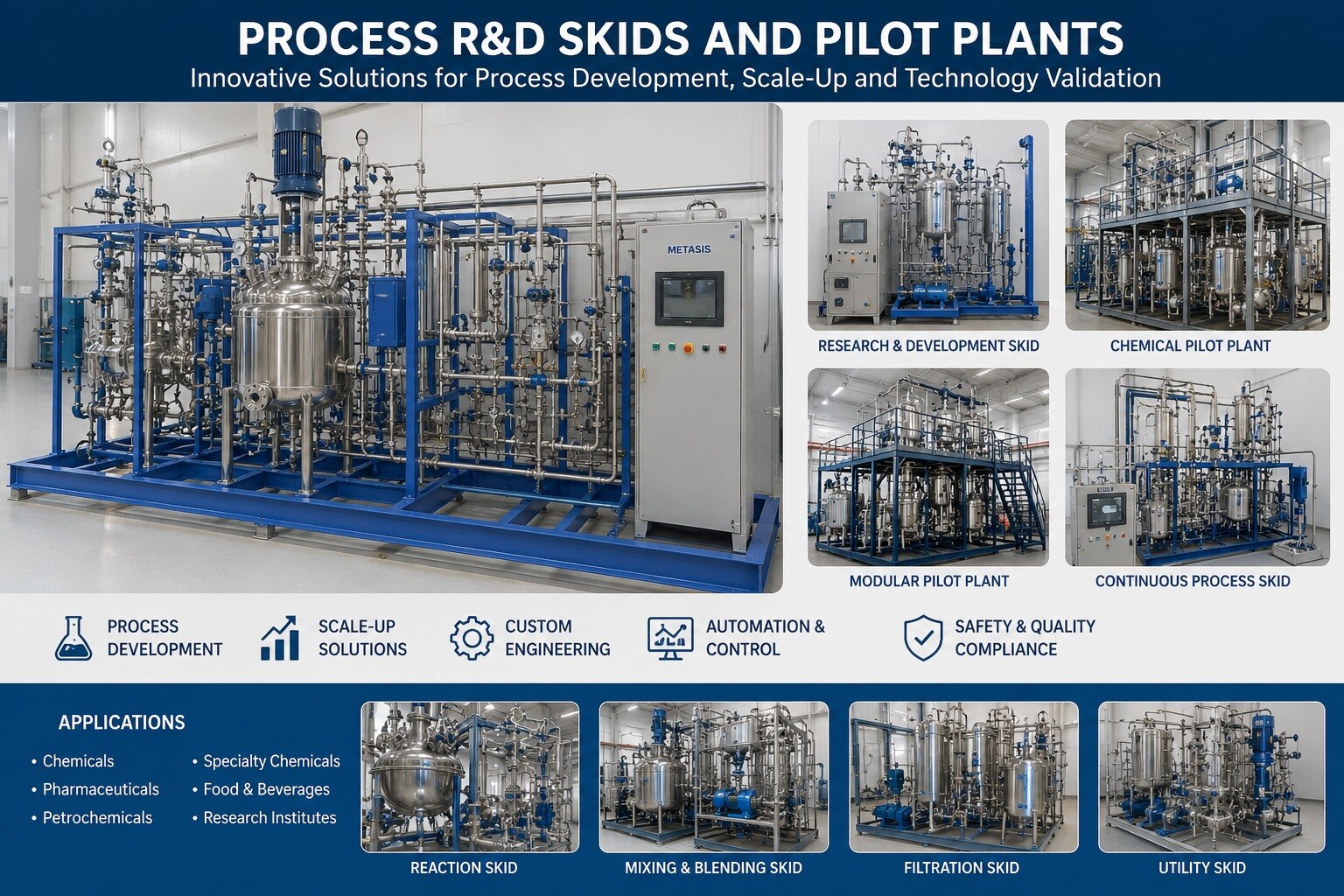
A process skid is a packaged process unit built on a frame. It combines equipment such as feeders, pumps, mixers, heat exchangers, vessels, piping, valves, instruments and controls so you can connect it to plant utilities and operate it as one assembly. It is not automatically small, temporary, mobile or exempt from process-piping requirements.
Pilot plant equipment is the broader term. It includes the skid, fixed vessels, utility systems, storage, ventilation, safety systems and building services needed to run pilot trials. A skid can be one part of a pilot plant, not the whole plant.
Modular process equipment describes the design approach rather than the application. Swappable feeders, mixer modules, spare nozzles and extra instrument capacity let you change formulations or residence times without rebuilding the entire unit. That flexibility adds valves, connections, dead legs and configuration work.
Process research skids are pilot skids designed for repeated experimentation. They prioritise measurement, rapid changeover, cleanability and access to sampling points over the simplicity of a one-recipe installation.
Classify a proposed package in this order:
1. Ask what is physically included: a framed package, a complete pilot installation, or separate modules.
2. Identify the intended work: production support, one long campaign, or changing experiments.
3. Check what the label does not settle: pressure classification, hazardous-area suitability, cleaning design and applicable codes such as ASME B31.3 or the Pressure Equipment Directive.
4. Treat utilities, extraction, waste handling and operator access as separate scope unless the quotation explicitly includes them.
Design the pilot around evidence, not a smaller production plant
A pilot earns its scale-up value by reproducing the governing process behaviour, not by resembling the production vessel. A mixer scaled by volume alone can miss blending time, solids suspension and gas dispersion because Reynolds number, Froude number, power per unit volume, impeller tip speed and gas superficial velocity cannot all remain constant.
1. Define the similarity criterion that controls each result. For mixing, record the selected relationship and its permitted range; for heat transfer, match duty, temperature difference and fouling behaviour; for conveying or dosing, reproduce feed properties, residence time and feeder response.
2. Instrument the process research skids to explain every mass and energy balance. Specify calibrated temperature, pressure, flow, torque or power, feeder-rate, moisture, level and composition measurements, then record sampling frequency and data quality. Removing an instrument can leave a failed run impossible to diagnose.
3. Reproduce the operating envelope, not just the nominal recipe. Test the planned pressure, temperature, solids loading, viscosity, moisture, gas rate, batch size and control actions, including start-up, shut-down and credible upset conditions. Product quality and residence-time distributions must link to those conditions.
4. Set acceptance evidence before fabrication: stable material balances, repeatable residence time, demonstrated heat-transfer duty, mixing performance and product specifications. State the piping code, including whether ASME B31.3 applies, and complete hazardous-area and process-safety screening; low throughput does not automatically remove those obligations.
5. Reject results that lack traceable calibration, raw data, sample identity and uncertainty. Scale-up decisions need a defensible correlation, not a single successful batch.
Choose the format using throughput, risk, and campaign duration
Choose process skids or fixed plant equipment for pilot work by matching throughput, process risk, and campaign duration—not by assuming modularity is always safer. A skid suits changing formulations, short campaigns, and evidence-gathering across several operating points. Fixed equipment suits a narrow process window, steady production-like operation, and long campaigns at one recipe.
| Decision basis | Process skids | Fixed plant equipment |
|---|---|---|
| Throughput | Low or moderate flow, frequent recipe changes, and multiple residence times | Higher sustained flow or production-representative loading |
| Risk | Fast reconfiguration matters, provided flexible hoses, valves, and interfaces are controlled | Fewer connections, dead legs, movement points, and control permutations reduce failure opportunities |
| Campaign duration | Days or weeks, with relocation or future reuse | Months or years, where commissioning effort is recovered over extended operation |
Modular process equipment earns its cost when swappable feeders, mixers, nozzles, and spare instrument capacity prevent a new build. It becomes the wrong choice when unused branches, flexible connections, and configuration control create more validation work than the experiment requires.
Specify cleaning and changeover with throughput. Small units retain disproportionate material in hoses, valve cavities, screw flights, instrument tees, and mixer seals; require drainability, removable contact parts, and a defined clean-out method. Test bulk solids at pilot fill levels and refill frequencies, because a production hopper’s flow pattern does not prove pilot performance.
For either format, state the piping code, pressure and temperature limits, hazardous-area needs, and battery limits. Assign utilities, dust extraction, relief routing, guarding, controls, and commissioning labor before purchase; an apparently complete skid can still arrive as an unusable pilot plant.
Compare the total cost and practical penalties of each format
A skid’s purchase price is only one line in the comparison. Price the complete operating asset, including interfaces, engineering hours, testing, data quality and the cost of removing it after the campaign.
| Cost area | Process skids | Fixed plant equipment | Practical penalty to price |
|---|---|---|---|
| Capital | Frame, vessels, pumps, controls, flexible connections, spare nozzles and extra instruments | Foundations, structural steel, installed vessels, piping, electrical distribution and permanent services | Modularity adds valves, dead legs, unused branches and connection hardware; fixed equipment adds site construction |
| Engineering | Package design, transport restraints, hazardous-area review, utilities, battery limits and ASME B31.3 piping records | Detailed plant layout, foundations, permanent piping, ventilation, dust extraction and tie-ins | A skid reduces site design but shifts work into configuration management and interface definition |
| Commissioning | Factory testing plus site hookup, loop checks, utility verification and control integration | Construction inspection, pressure testing, electrical checks and plant commissioning | A “turnkey” skid still fails if foundations, relief discharge, network links or exhaust treatment are excluded |
| Maintenance | More seals, hoses, valves, instruments and flexible joints to inspect or replace | Fewer movable connections, but permanent access and isolation systems cost more | Frequent reconfiguration increases leak checks and spares |
| Validation | Instrument calibration, cleaning studies, change control, recipe configuration and data reconciliation | Fewer configurations when one recipe runs for long periods | Swappable modules increase validation scope; removing instruments can destroy scale-up evidence |
| Decommissioning | Disconnect, drain, clean, lift and redeploy or store the package | Remove plant services, demolish supports and dispose of fixed equipment | Skids recover faster, while contaminated internals and residual utilities still require controlled clearance |
For a narrow process window and long campaign, fixed pilot plant equipment can cost less overall. For changing formulations, modular process equipment can avoid repeated builds, provided you budget the extra validation and maintenance. Include pilot plant equipment’s lost production time during changeovers, cleaning, fault finding and operator retraining.
Lock down interfaces, acceptance tests, and operating responsibility
A technically complete quote becomes an incomplete pilot plant when battery limits stop at the skid frame. Compare every quotation against the same interface schedule, naming the supplier, site owner, required utility, connection point and acceptance evidence.
| Quotation line | Supplier scope | Site scope | Acceptance evidence |
|---|---|---|---|
| Utilities and services | Connection points, consumption and inlet conditions | Distribution, isolation valves and final hookups | SAT flow, pressure and electrical checks |
| Site infrastructure | Loads, anchor pattern and lifting points | Foundations, ventilation and dust extraction | Installed survey and inspection |
| Safety and exhaust | Relief outlet size, guarding and exhaust-treatment connection | Relief discharge routing, emergency systems and field guarding | Interlock, alarm and emergency-stop tests |
| Electrical and controls | Panel, instruments, software and network protocol | Classified-area wiring, network connection and electrical distribution | I/O, loop, alarm and communications tests |
| Commissioning | Mechanical completion support and commissioning labour | Transport inspection, field assembly and operating labour | Signed commissioning and training records |
Separate FAT from SAT. FAT can prove assembly, instrument ranges, sequences, alarms and selected performance tests; SAT must prove site utilities, area classification, field piping stress, transport condition and plant emergency functions.
Specify the hazardous gas, vapour or dust zone and required equipment protection level before freezing process skids. Ask process research skids suppliers to price drainability, removable contact parts, hose and valve clean-out, spare nozzles, changeover time and residual-material checks.
Metasis Equipments Pvt Ltd should be asked to identify these boundaries explicitly when quoting modular process equipment, rather than leaving integration to the pilot operator.
Assign one named owner for each operating task:
- Startup, recipe changes, cleaning, sampling, calibration, maintenance and deviation approval
- FAT punch-list closure, SAT sign-off, training and operating-procedure ownership
- Configuration control for interchangeable feeders, mixers, valves, instruments and unused branches
Require the quotation to include the P&ID, I/O list, cause-and-effect matrix, utility schedule, spares list, manuals and as-built drawings. Without those documents, modularity creates options but not a reproducible experiment.
Related products
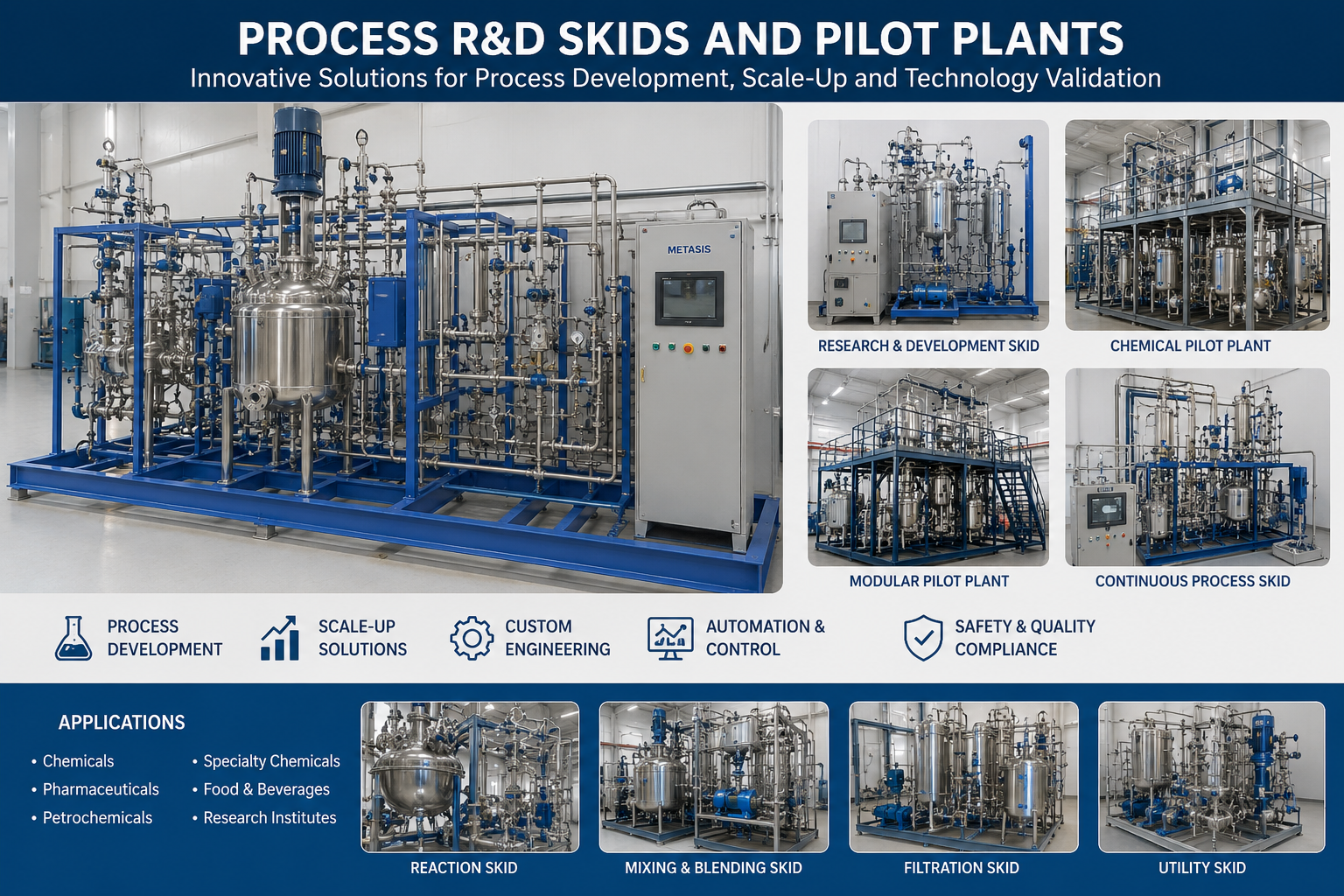 | Engineering Process System Process R&D Skids and Pilot Plants Innovative Process Development Solutions At Metasis Equipments Pvt. View product → |
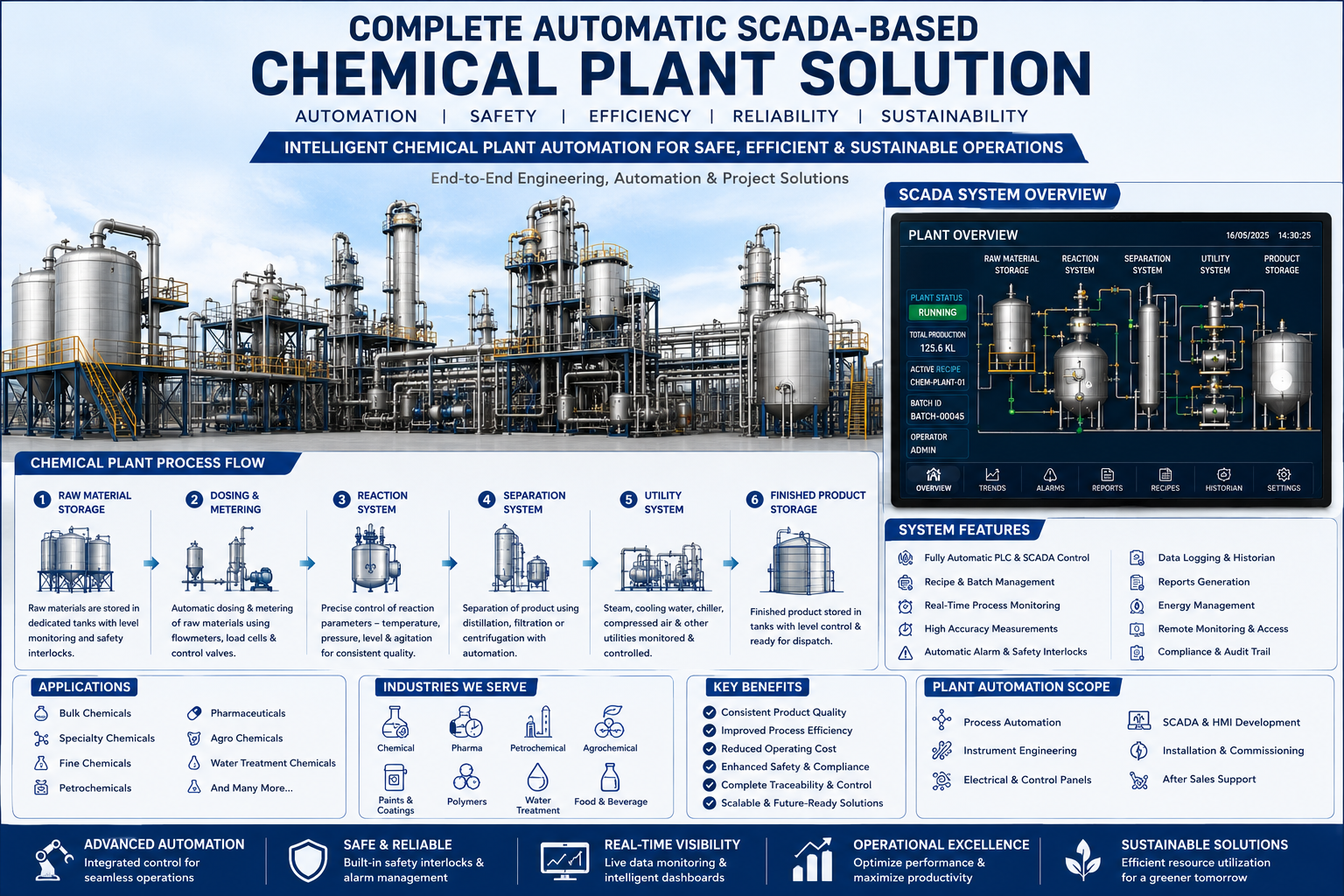 | Engineering Process System Metasis Equipments Pvt. Ltd. – Engineering Excellence in Process Solutions Metasis Equipments Pvt. Ltd. View product → |
Frequently asked questions
What is a pilot process skid?
A pilot process skid is a framed, packaged process unit combining equipment, piping, valves, instruments and controls for connection to plant utilities. It is not automatically small, temporary, mobile or exempt from process-piping requirements.
When should you choose process skids over fixed plant equipment for pilot work?
Choose process skids when packaged integration, relocation or faster installation supports the pilot campaign. Choose fixed equipment when throughput, campaign duration, permanent services or plant integration outweigh modularity.
Why should a pilot skid not simply be a smaller production plant?
A pilot must generate specific evidence, such as mixing performance, dosing accuracy, heat-transfer behaviour or material compatibility. Scaling down every production component can add cost without improving the measurements you need.
What costs should you compare between a skid and fixed pilot equipment?
Compare purchase and fabrication costs with utilities, foundations, structural supports, transport, installation, commissioning, relocation, downtime, operator training, maintenance and eventual removal.
What must be defined before accepting pilot process equipment?
Define mechanical and utility interfaces, control signals, operating limits, documentation, factory and site acceptance tests, commissioning steps and who owns operation, maintenance and safety decisions.