
A bucket elevator earns its place when a chemical plant needs enclosed, space-efficient movement of a compatible bulk solid to a higher process stage. By weighing lift height, usable capacity, material behavior, containment, safety, cleaning, and lifecycle cost, you can decide whether it beats a pneumatic, screw, belt, drag-chain, or vertical screw alternative.
Key takeaways
- Choose a bucket elevator when vertical lift and enclosed routing outweigh simple equipment cost.
- Match buckets and belt materials to particle size, moisture, temperature, abrasiveness, and reactivity.
- Specify discharge, traction, dust containment, cleaning access, and explosion protection as one system.
- Compare elevators with pneumatic, screw, belt, and chain conveyors before approving the layout.
When a bucket elevator makes economic and process sense
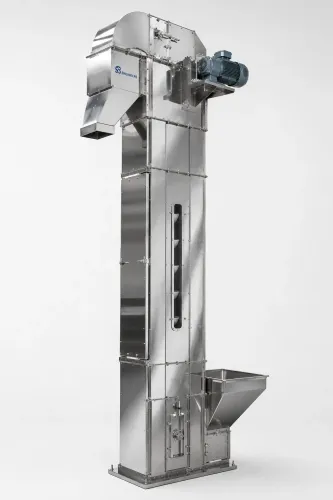
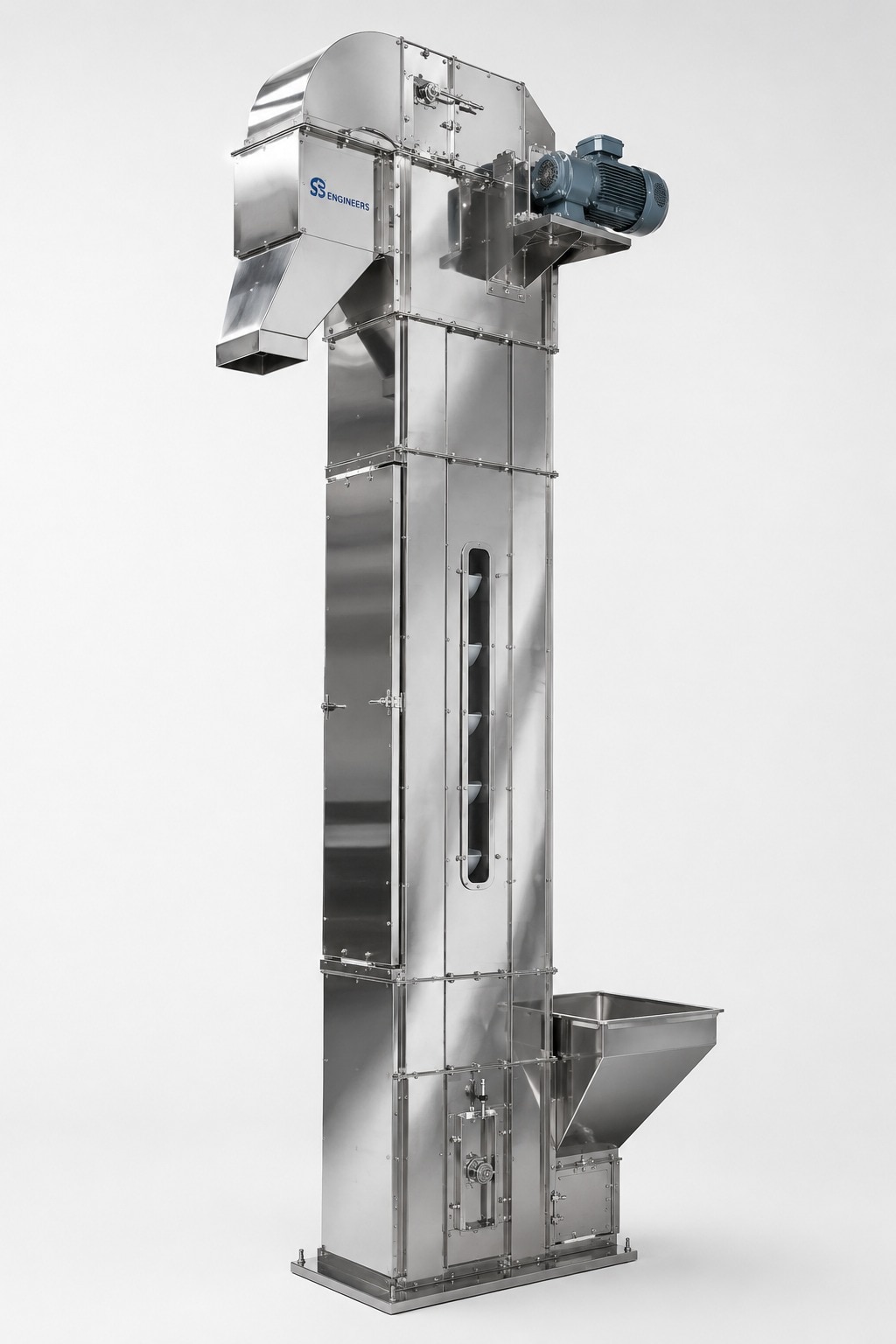
A bucket elevator for chemical plants earns its place when a large vertical lift, limited floor space, or enclosed routing matters more than simple equipment cost. This chemical plant vertical conveyor can replace several horizontal conveyors and transfer points, reducing building footprint, dust-release opportunities, and product accumulation between storage, processing, and packaging.
Use this decision procedure:
1. Confirm the lift and throughput. Specify elevation, tonnes per hour, bulk density, bucket volume, spacing, speed, and fill level. Elevator speed alone is not a dosing control; use a controlled feeder when the process needs stable flow.
2. Check the material against the duty. Dry, free-flowing powders, granules, crystals, pellets, salts, catalysts, and fertilizers are stronger candidates than sticky, wet, stringy, strongly bridging, or continuously mixed materials.
3. Price the complete installation. Include the boot, head, belt or chain, buckets, liners, inspection access, discharge chute, drive, backstop, zero-speed detection, plugged-chute detection, belt-slip monitoring, and explosion-protection measures. A low equipment quote can hide expensive access and maintenance work.
4. Test containment and cleaning against the campaign schedule. An enclosed casing is not enough if bucket fasteners, belt joints, dead legs, boot liners, or the head section cannot be inspected, drained, cleaned, and validated between products.
The installation makes economic sense when its space and containment savings outweigh those maintenance points. Choose another conveyor when the material requires gentle handling, continuous mixing, or easier washdown than the elevator can provide.
Match the elevator to the material, not just the chemical name
Reliability depends on how the solid flows, breaks, heats, and wears equipment—not on its chemical name. For chemical industry plants, bucket elevator benefits include enclosed vertical transfer and fewer floor-level transfer points. Industrial bucket elevator applications include powders, granules, crystals, pellets, salts, catalysts, and fertilizers, but each requires a different specification.
| Property | Failure risk | Design implication |
|---|---|---|
| Particle size and shape | Uneven filling, segregation, or dust escape | Test the full particle-size distribution and specify bucket geometry accordingly |
| Moisture and cohesion | Bridging in the boot, sticking, overload, and erratic discharge | State moisture range, caking tendency, and angle of repose; provide access for cleaning |
| Bulk density and feed rate | Capacity claims exceed actual output | Size from minimum and maximum feed rates, stated bulk density, usable fill factor, bucket spacing, and speed—not nominal bucket volume |
| Friability and agglomeration | High-speed discharge creates fines and dust | Use slower continuous buckets, lined chutes, and controlled transfer points |
| Temperature, abrasiveness, and corrosivity | Belt, chain, bucket, liner, or fastener failure | Specify operating temperature, abrasive content, chemical compatibility, and corrosion-resistant materials |
| Explosibility and dustiness | Deflagration, static ignition, and dangerous pressure release | Define dust explosibility data, grounding, venting, isolation, and other protection measures |
High-speed centrifugal elevators suit free-flowing, durable solids. Choose continuous discharge when the material is fragile, sluggish, or cohesive; the gentler path can require greater height or lower throughput. Test representative material before purchase, including its worst-case moisture and feed condition.
Choose discharge, traction, and containment configurations together
A centrifugal-discharge, belt-driven elevator is the balanced choice for free-flowing granules, crystals, pellets, and salts when capacity matters more than gentle handling. Choose continuous discharge instead for friable, cohesive, sluggish, or agglomerating solids; its closely spaced buckets reduce impact and dust, but the same lift may require greater height or lower throughput.
| Configuration | Product handling and capacity | Maintenance and containment |
|---|---|---|
| Centrifugal, belt traction | Highest practical speed for free-flowing solids; impact can create fines | Fewer moving parts than chain systems, but the head trajectory and chute need dust control |
| Continuous, belt traction | Gentler gravity discharge for fragile or cohesive products; capacity is usually lower at equal bucket size | Smooth operation and lower impact; inspect belt joints, bucket fasteners, boot buildup, and inaccessible head areas |
| Continuous, chain traction | Suits abrasive, hot, or difficult solids where robust pulling force matters | More sprocket and chain maintenance, with added noise and potential ignition points; use sealed, cleanable casing |
Treat a bucket elevator for chemical plants as a contained transfer machine, not a dosing device. Size buckets, spacing, speed, fill level, and feeder control together; elevator speed alone will not produce stable dosing. For combustible dust, specify hazard testing, ignition-source control, explosion venting or suppression, and isolation from connected equipment.
A sealed casing alone is not explosion protection.
For campaign production, select inspection doors, drainable boots, removable liners, and cleanable fasteners. The best chemical plant vertical conveyor is the one whose discharge protects the product and whose containment you can safely inspect, clean, and validate.
Compare the elevator with competing conveying methods
A bucket elevator benefits chemical industry plants when a high lift, small footprint, enclosed routing, and steady bulk-solid flow matter more than rapid product changeover. Compare the total transfer system, including feeders, airlocks, filters, transfer points, cleaning access, and maintenance—not the conveyor alone.
| Option | Main advantage | Trade-off and best fit |
|---|---|---|
| Bucket elevator | Efficient vertical lift with low floor area and limited transfer points | Suits dry, free-flowing powders, granules, crystals, pellets, salts, catalysts, and fertilizers; boot plugging, bucket wear, belt or chain failure, and difficult cleaning raise lifecycle costs |
| Pneumatic conveyor | Flexible routing and sealed transfer through pipes | Uses more power and can increase particle breakage, heat, dust loading, and filter demand; useful for fine powders and hygienic isolation |
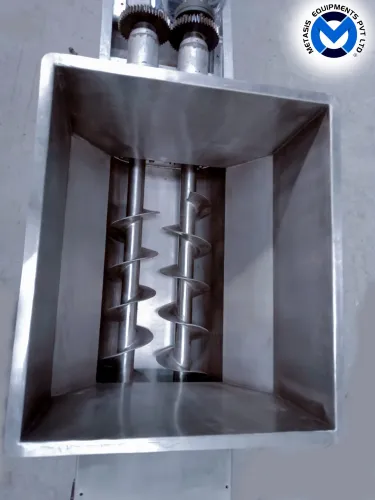
| Screw conveyor | Controlled, compact horizontal or mildly inclined movement | Handles cohesive material better than an elevator but adds shear, residence time, shaft wear, and cleaning effort |
| Belt conveyor | Low-energy horizontal transport with gentle handling | Needs more floor space and transfer points; unsuitable for a steep vertical lift unless specialized equipment is used |
| Drag-chain conveyor | Enclosed movement with strong containment and flexible routing | Consumes more power than a belt and can damage friable solids; useful for heavier, dusty, or less free-flowing material |
| Vertical screw conveyor | Compact lift with continuous conveying and some metering ability | Higher shear, slower capacity, and greater plugging risk; choose it for short lifts or controlled feeding |
For industrial bucket elevator applications, confirm whether the material remains free-flowing at its actual moisture and temperature. A feeder still controls dosing; elevator speed alone does not. For campaign production, compare inspection, drainage, validation, and changeover time against the alternatives.
Specify safety, compatibility, cleaning, and lifecycle support before buying
Price the installation as a risk-controlled system, not as a casing, belt, and buckets. Vertical lift delivers bucket elevator benefits chemical industry plants value: enclosed routing, reduced floor space, and fewer transfer points—provided you price every added failure and cleaning point.
1. Define the duty: lift height, tonnes per hour, bulk density, particle size, temperature, moisture, abrasiveness, friability, duty cycle, and required residence time. Add a controlled feeder if you need stable dosing; elevator speed alone is not a precision-metering control.
2. Specify chemical compatibility for every exposed part: buckets, belt or chain, boot liner, gaskets, fasteners, shaft coating, and seals. Name chemical concentration, chlorides, operating temperature, abrasion, and wet-dry cycling rather than approving “stainless steel” generally.
3. Document the safety package: dust classification, grounding and bonding, bearing-temperature monitoring, belt-slip and misalignment switches, emergency stops, explosion venting or isolation, and the required dust collector. Price inspection access and safe platforms.
4. Require a cleanability drawing showing removable buckets, drainable boots, accessible head sections, smooth liners, and sealed fasteners. If campaigns change products, price validated cleaning, swab access, washdown limits, drying, and lost production during changeover.
5. Compare total installed cost and lifecycle risk, including supports, platforms, feeders, receiving chutes, spare belts or chains and buckets, inspection labor, plugged-boot recovery, drive replacement, and outage cost. When reviewing a proposal from Metasis Equipments Pvt Ltd, use this same boundary-of-supply checklist.
Related product
 | Bucket Elevator Efficient Vertical Material Handling Solutions A Bucket Elevator is a highly efficient conveying system designed for the vertical transportation of... View product → |
Frequently asked questions
When does a bucket elevator make economic and process sense in a chemical plant?
It makes sense when you need a substantial vertical lift, limited floor space, enclosed material routing, or fewer transfer points between storage, processing, and packaging.
How should you match a bucket elevator to the conveyed material?
Evaluate particle size, bulk density, moisture, temperature, abrasiveness, flowability, chemical compatibility, and contamination risk rather than selecting equipment from the chemical name alone.
Which bucket elevator configurations should you specify together?
Select the discharge method, belt or chain traction, bucket geometry, enclosure, dust extraction points, and containment features as one coordinated design.
What should you compare before choosing a bucket elevator?
Compare it with pneumatic, screw, belt, and chain conveyors using required lift, capacity, footprint, degradation, cleaning effort, energy use, safety controls, and lifecycle support.