
The right vertical conveyor depends less on lift height than on the chemical’s flow behavior, hazard profile, required capacity and cleaning regime. By the end, you can compare a bucket elevator with screw, pneumatic, belt, drag and vertical screw systems, then write a purchase specification that exposes capacity, compatibility and safety gaps.
Key takeaways
- Map the boot, head, casing, supports and maintenance clearances before approving the layout.
- Test capacity with actual bulk density, moisture, particle size and flow behavior.
- Specify buckets and materials for degradation, abrasion, corrosion and cleaning requirements.
- Compare elevator failure consequences with alternative conveyors before accepting shutdown risk.
Start with the material and the plant layout, not the lift height
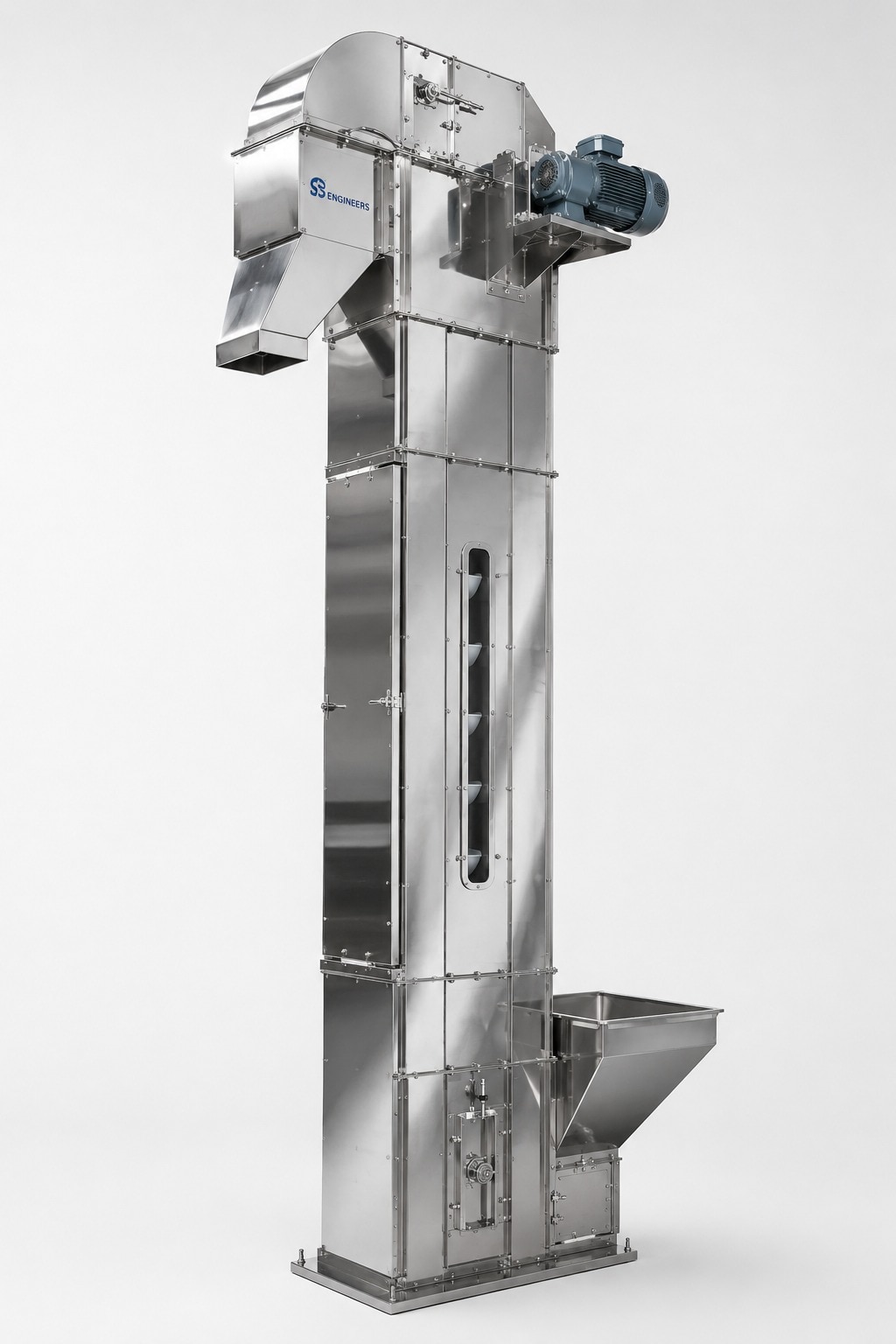
A bucket elevator for chemical plants makes sense when a dry, free-flowing solid must move vertically between process levels while horizontal floor space is scarce. Its footprint is smaller than an inclined belt or screw conveyor, but the layout still needs a boot, head, casing, structural supports, access platforms and maintenance clearance.
A narrow footprint does not remove the need for safe access.
Choose it when the material feeds consistently and discharges cleanly. Reject it as a default for wet, sticky, cohesive or slurry-like chemicals: they can cake on buckets, collect in the boot, obstruct discharge and cause belt tracking problems.
Check these conditions before comparing equipment:
- Select an elevator for dry granules, crystals, pellets or powders that do not bridge or smear.
- Choose a screw, drag conveyor or dewatering step when moisture creates buildup or backflow.
- Compare pneumatic conveying when routing flexibility, sealed transfer or difficult containment outweighs air-system energy and filtration costs.
- Check the building for casing height, transfer points, inspection access, cleaning space and a safe maintenance route.
| Option | Layout advantage | Main reason to choose it |
|---|---|---|
| Bucket elevator | Compact vertical bulk material handling | Dry, free-flowing solids and limited floor area |
| Inclined belt conveyor | Flexible routing and easier visual access | Long runs or gentle handling |
| Pneumatic conveying | Enclosed, flexible routing | Toxic powders or complex paths, with air and filtration costs |
| Vertical screw lift | Compact installation | Shorter lifts and controlled, lower-throughput feeding |
Prove capacity with the actual bulk material condition
An industrial bucket elevator proves its capacity only with your material at its operating condition, not with the motor rating or a catalogue tonnes-per-hour figure. Ask the supplier to calculate tonnes per hour from usable bucket volume, bucket spacing, belt or chain speed, fill percentage, bulk density, and discharge efficiency.
Use this calculation:
- Capacity = bucket volume × fill fraction × buckets per second × bulk density × discharge efficiency.
- Convert the result to tonnes per hour and state the test density, moisture, temperature and particle-size distribution.
- Check capacity at the lowest operating bulk density; a higher density can overload the drive and structure.
- Run a material trial at the proposed speed and feed rate. Inspect the boot, buckets, casing and discharge for buildup, backflow, spillage and incomplete emptying.
- Measure product loss and degradation, not only elevator throughput. Friable crystals, pellets and agglomerates can break in a high-speed centrifugal discharge.
Reject the selection if the material bridges, cakes, smears or remains in the boot after discharge. Wet, sticky, cohesive or slurry-like chemicals can plug the casing, damage belt tracking and contaminate the next batch; consider a screw conveyor, drag conveyor, pneumatic system or dewatering step instead.
For a dry, free-flowing solid, compare the requested feed rate with the calculated capacity at realistic fill, not 100 percent bucket loading. Keep operating margin for surges, density variation and reduced flowability, then confirm that the bucket elevator can sustain the rate without raising speed beyond the product’s degradation limit.
Choose the elevator design around degradation, wear and cleanability
Choose discharge method first: centrifugal discharge suits dry, free-flowing material, while continuous discharge protects fragile, sluggish or aerated solids from throwing and impact. A high-speed centrifugal bucket elevator can fracture crystals, pellets or agglomerates and increase dust.
| Option | Main advantage | Choose it when |
|---|---|---|
| Centrifugal discharge | Fast release at higher speed | The product flows freely and tolerates impact |
| Continuous discharge | Low-speed, overlapping buckets | The product is friable, cohesive or prone to aeration |
| Belt construction | Quiet running with no chain lubrication | The temperature and load suit the belt, and low contamination matters |
| Chain construction | Handles abrasive loads and higher mechanical abuse | Heavy buckets, elevated temperature or severe wear justify more maintenance |
Select the belt cover, chain, buckets, casing, fasteners and gaskets against the actual chemical, concentration, temperature, moisture, cleaning agent and contact time. Stainless steel alone proves nothing: a chemical can corrode the casing, embrittle polymer buckets, swell gaskets, degrade belt covers or cause stress cracking.
Use carbon steel only where corrosion testing supports it; specify stainless steel, a lined surface or a suitable polymer when the exposure demands it. Ask for compatibility evidence for every wetted or dust-contacting component, not just the casing.
Cleanability can decide whether an industrial bucket elevator fits campaign production. Specify removable buckets, smooth internal surfaces, drainable boots, access doors and a validated cleaning method. Reject the design if wet, sticky or slurry-like material will cake in the boot, smear the casing or block discharge; a screw, drag or pneumatic conveyor may be safer.
Treat dust, toxic chemicals and corrosion as design conditions
A sealed casing does not make a bucket elevator for chemical plants leak-free. Dust escapes through head and boot doors, inspection covers, shaft seals, belt joints and transfer points, so toxic or sensitising powders need defined containment, local extraction and negative pressure where the risk assessment requires it.
Before approving an industrial bucket elevator, demand evidence for each condition below:
- Identify every dust- or product-contacting part: casing, buckets, belt covers, chain, gaskets, bearings and seal materials. Check compatibility against the chemical’s concentration, temperature, moisture, cleaning agent and residence time; stainless steel alone does not prove suitability.
- Specify the ATEX zone, equipment category, dust group, maximum surface temperature and process conditions for an installation in the European Union. An ordinary elevator is not automatically suitable for an ATEX zone.
- Use representative test data for minimum ignition energy, minimum explosible concentration, maximum explosion pressure, rate of pressure rise, layer ignition temperature and cloud ignition temperature. Do not substitute data from a similar-looking chemical.
- Control ignition sources with bonding and grounding, belt- or chain-speed monitoring, belt-drift switches, boot-plug detection and head and boot bearing-temperature monitoring.
- Define explosion venting or suppression and isolation from connected equipment using the dust hazard analysis; casing, boot, head and transfer equipment belong in the same assessment.
- Specify interlocked startup and shutdown sequencing, and a maintenance procedure for opening contaminated equipment.
Metasis Equipments Pvt Ltd can be asked to provide a component compatibility matrix, containment boundary and instrumented shutdown schedule rather than only a casing-and-drive quotation.
Related product
 | Bucket Elevator Efficient Vertical Material Handling Solutions A Bucket Elevator is a highly efficient conveying system designed for the vertical transportation of... View product → |
Compare the shutdown risk before you approve the investment
Approve a bucket elevator for chemical plants only when its compact footprint and lower energy demand outweigh the cost of one failed vertical route stopping the process.
For vertical bulk material handling, price the complete installation: boot, head, casing, platforms, access, dust collection, transfer equipment, spare belt or chain, and cleaning provisions. Compare that total with a pneumatic system’s blower, air cooler, filter, and degradation costs, not with the elevator motor alone.
| Option | Main advantage | Shutdown and cleaning exposure |
|---|---|---|
| Bucket elevator | Small floor footprint; efficient lift | One belt, chain, drive, or boot failure can stop flow; ledges and boot corners retain product |
| Pneumatic conveying | Flexible routing and enclosed transfer | Blower or filter failure stops transport; higher air-handling and filtration load |
| Screw or drag conveyor | Accessible conveying path; controlled discharge | More floor space or route length; trough residue and wear still require cleaning |
Before approval, calculate the cost per hour of a stopped batch, then test whether a bypass, parallel elevator, surge hopper, or stored intermediate inventory limits that loss. Require inspection access, removable buckets where changeover demands it, drainable surfaces, documented cleaning time, and critical spares on site.
Reject the investment if cleaning needs exceed the campaign window, the material cakes in the boot, or operators cannot verify clean surfaces safely. A cheaper elevator becomes expensive when one plugged boot, corroded casing, or broken drive shuts down the entire line.
Frequently asked questions
When is a bucket elevator suitable for a chemical plant?
Use one when a dry, free-flowing solid must move vertically and floor space limits an inclined belt or screw conveyor. Confirm that the layout accommodates the boot, head, casing, supports, access platforms and maintenance clearance.
How do you verify a bucket elevator’s capacity?
Use the actual bulk material condition, including bulk density, moisture, particle-size distribution, flow behavior and feed rate. Do not size the elevator from a material name or theoretical maximum alone.
What design features matter for chemical powders and granules?
Choose the elevator around degradation, wear, cleanability, dust control, chemical toxicity and corrosion. Match bucket shape, belt or chain construction, casing materials, seals and access points to the material and cleaning method.
How should you assess bucket elevator shutdown risk?
Compare the consequences of an elevator failure with alternative conveying routes. Include access for inspection, spare parts, isolation, maintenance time and the effect of a stoppage on upstream and downstream processes.