
A ribbon blender can produce a uniform pharmaceutical powder blend, but only when the formulation flows and circulates rather than clumps, charges, or segregates. By assessing powder properties, comparing alternative mixers, and defining evidence-based operating and acceptance criteria, you can decide whether a ribbon blender fits the process before you buy one.
Key takeaways
- Check powder flow, cohesion, density and particle size before choosing mixer volume.
- Choose ribbon mixing for bulk movement, not hard agglomerate breaking or high-shear dispersion.
- Control fill level, clearance, discharge and charging order to reduce dead zones and segregation.
- Validate uniformity with representative samples, defined endpoints and scale-up evidence.
Start with the powder, not the mixer volume
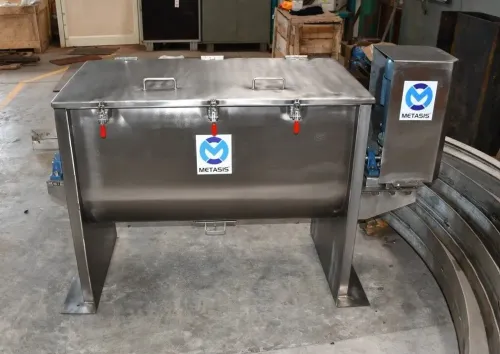
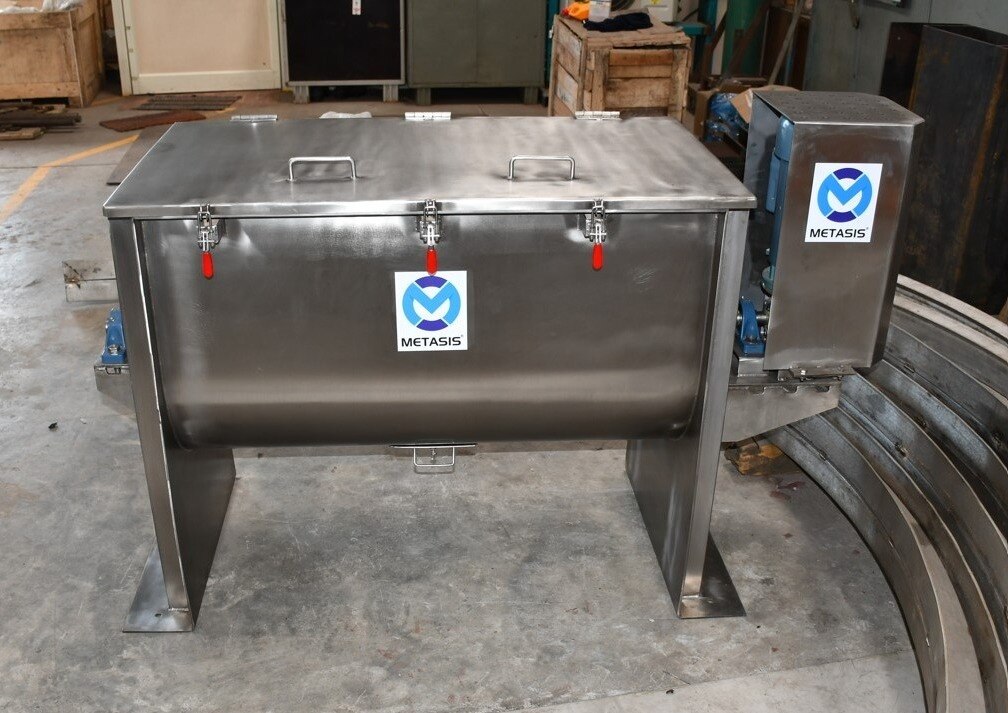
A ribbon blender is a sensible starting point when the formulation is free-flowing, blends by repeated bulk movement, and does not require intense shear. Its opposing inner and outer helical ribbons move powder axially and fold the bed, making ribbon blenders for pharmaceuticals better suited to uniform powders and granules than to breaking hard agglomerates.
Check these properties before selecting a pharmaceutical powder mixer:
- Particle-size distribution: a wide size range increases segregation after mixing, especially during discharge.
- Bulk density: large density differences can cause settling and uneven withdrawal.
- Cohesiveness and flowability: cohesive, poorly flowing powder can form rat-holes, bridge over the ribbons, or leave dead zones.
- Moisture and electrostatic charge: damp or charged particles cling to surfaces and form lumps.
- Friability: fragile granules can fracture under repeated ribbon movement.
- Segregation tendency: free-flowing particles that separate during transfer may need gentler, shorter handling.
| Powder condition | Ribbon-blender suitability | Main concern |
|---|---|---|
| Free-flowing powder or granules with similar size and density | Strong starting candidate | Segregation during discharge |
| Cohesive, electrostatic or poorly flowing powder | Require formulation trials before selection | Dead zones, shaft loading or rat-holing |
| Hard agglomerates or a wet-granulation requirement | Choose a high-shear or fluid-bed system | Ribbon action will not reliably break or form granules |
| Fragile, segregation-prone material | Compare with a bin, V or double-cone blender | Convective movement can damage particles or increase separation |
Do not select by vessel volume alone. Test the real formulation through loading, mixing, discharge and cleaning; a visual blend can hide a failed powder bed.
Match the mixing mechanism to the formulation
Choose ribbon blenders for pharmaceutical powder mixing problems when the formulation is free-flowing, reasonably cohesive, and does not require hard-agglomerate breakage. Inner and outer helical ribbons move material in opposing axial directions, folding the bed through convective circulation rather than applying intense local shear.
| Option | Mixing mechanism | Choose it when |
|---|---|---|
| Ribbon blender | Convective axial transport and folding | Free-flowing powders or granules need efficient bulk blending |
| High-shear mixer | Intense impeller and chopper shear | You must break agglomerates, wet powders, or produce controlled granules |
| Tumbling blender | Gentle rotation and particle diffusion | Fragile, free-flowing powders need low-shear blending with limited attrition |
| Conical screw mixer | Orbital screw lifting and convective turnover | Cohesive, fragile, or broad-density formulations need thorough lifting |
| Bin blender | Container rotation with minimal transfer | You need closed, low-shear blending and want to avoid an intermediate discharge step |
| V or double-cone blender | Repeated splitting and recombination | Small, free-flowing batches need gentle blending and low equipment complexity |
| Fluid-bed system | Air suspension with simultaneous heat and mass transfer | You need drying, granulation, or coating rather than dry blending alone |
Do not select a ribbon blender solely because the vessel holds the batch. Diameter changes alter tip speed, circulation, wall effects, shear exposure, and power demand; holding rpm constant proves nothing. Run trials with the formulation or justified surrogate, then test start-up, discharge, cleaning, and downstream segregation.
Liquid addition also requires validated nozzle placement and spray rate, because a dry ribbon blender can create localized lumps instead of uniform granules.
Control the causes of dead zones, clumping and segregation
A ribbon blender will not fix segregation created by large differences in particle size, density or flowability. Control the movement of powder instead: choose a trough and ribbon geometry that reach the validated working fill, maintain adequate wall clearance, and eliminate internal supports, shaft ledges and seal recesses that trap material or create dead zones.
- Use variable-speed drive control and set the process by tip speed, fill level, power draw and blend uniformity—not rpm alone. A larger diameter changes circulation, shear exposure and wall effects.
- Fit a discharge valve that empties the full trough without leaving a heel. Control discharge rate and avoid long drops, narrow chutes and high-velocity pneumatic transfer, which can separate fast- and slow-moving particles.
- Add liquid only with a defined spray system. Nozzle position, spray rate, viscosity and wetting behaviour determine whether the powder forms a uniform agglomerate or localized lumps; a dry ribbon blender is not automatically a granulator.
- Trial the actual formulation through loading, blending, discharge and cleaning. Cohesive or electrostatic powders can rat-hole, load the shaft or stop circulating even when the surface looks uniform.
| Choice | Prevents | Specify or verify |
|---|---|---|
| Full-length bottom discharge | Retained heel and discharge segregation | Valve geometry, emptying test and transfer route |
| Variable-speed drive | Excessive shear or incomplete circulation | Tip speed, power trend and operating range |
| Sanitary trough and seals | Dead zones and carryover | Cleanable clearances, seals and end plates |
A passing mixer sample does not prove the downstream bin or hopper remains uniform. Include discharge samples in the trial.
Prove the endpoint with sampling and scale-up data
Establish mixing time as the earliest sampling point that meets a pre-specified blend-uniformity criterion across representative locations, then confirm that uniformity survives discharge and scale-up. Do not declare success because one thief sample matches the target.
1. Run a time-course study on the pharmaceutical powder mixer. Sample before mixing, at several intervals, and after the planned endpoint from multiple bed locations, including near the walls, shaft and discharge outlet. Record sample mass, location, timing and assay result.
2. Separate process variation from sampling error. Use a justified sample mass, replicate samples and a validated content assay with known analytical variability. A passing average with wide location-to-location variation indicates a poor blend or an inadequate sampling plan, not control.
3. Test the discharge path. Collect material from the beginning, middle and end of discharge, then from the transfer line or hopper that feeds the next operation. A blend can pass inside the vessel yet segregate through percolation, sifting or trajectory effects during emptying.
4. Define the endpoint before extending the run. After uniformity is reached, continued agitation can create fines, damage fragile granules or promote demixing during discharge. Compare the selected endpoint with a longer hold to detect overmixing rather than assuming ten minutes is safe.
Scale-up for ribbon blenders for pharmaceuticals cannot rely on constant rpm. Compare tip speed, power demand or power per volume, fill level, circulation pattern and blend time in trials using the commercial formulation or a justified surrogate. Demonstrate uniformity across the intended commercial operating range; a visually uniform small batch proves little.
Turn the decision into a pharmaceutical equipment specification
Specify evidence, not a catalogue volume. A supplier of ribbon blenders for pharmaceutical powder mixing problems must show that the proposed geometry, seals and controls work with your formulation, cleaning method and containment target.
1. Ask for a trial using the real powder or a justified surrogate. Record working fill range, batch capacity, agitator speed, tip speed, torque, power demand and blend-uniformity results at startup, steady state and discharge. Require scale-up data; constant rpm alone does not preserve tip speed or circulation.
2. Inspect the product-contact design. Require material grades, surface finish, ribbon-to-wall clearances, shaft seals, end plates, internal supports and discharge-valve details. The demonstration must measure retained product after discharge and document cleaning by the intended manual, COP or CIP method, including visual inspection and swab or rinse results.
3. Define containment as a testable limit. Request charging, sampling, discharge and filter-change results against your occupational exposure band, with gasket, seal and pressure-control details. A closed lid alone does not prove containment.
4. Treat capacity as a process range, not the vessel’s gross volume. Require minimum and maximum working fills, bulk-density assumptions, motor overload limits and discharge time, then include those values in the factory acceptance test.
5. Obtain a dust-explosion assessment for the powder: explosibility, Kst, Pmax, MIE and MEC where applicable. Specify bonding and grounding, electrical classification, venting, suppression or isolation; stainless steel alone is not protection.
Metasis Equipments Pvt Ltd can be included in the supplier comparison, but apply this same evidence checklist to every ribbon blender manufacturer france candidate.
Related products
 | Ribbon Blender Efficient Powder Mixing Solutions Since 2012, Metasis Equipments Pvt Ltd has been manufacturing high-performance Ribbon Blenders for various... View product → |
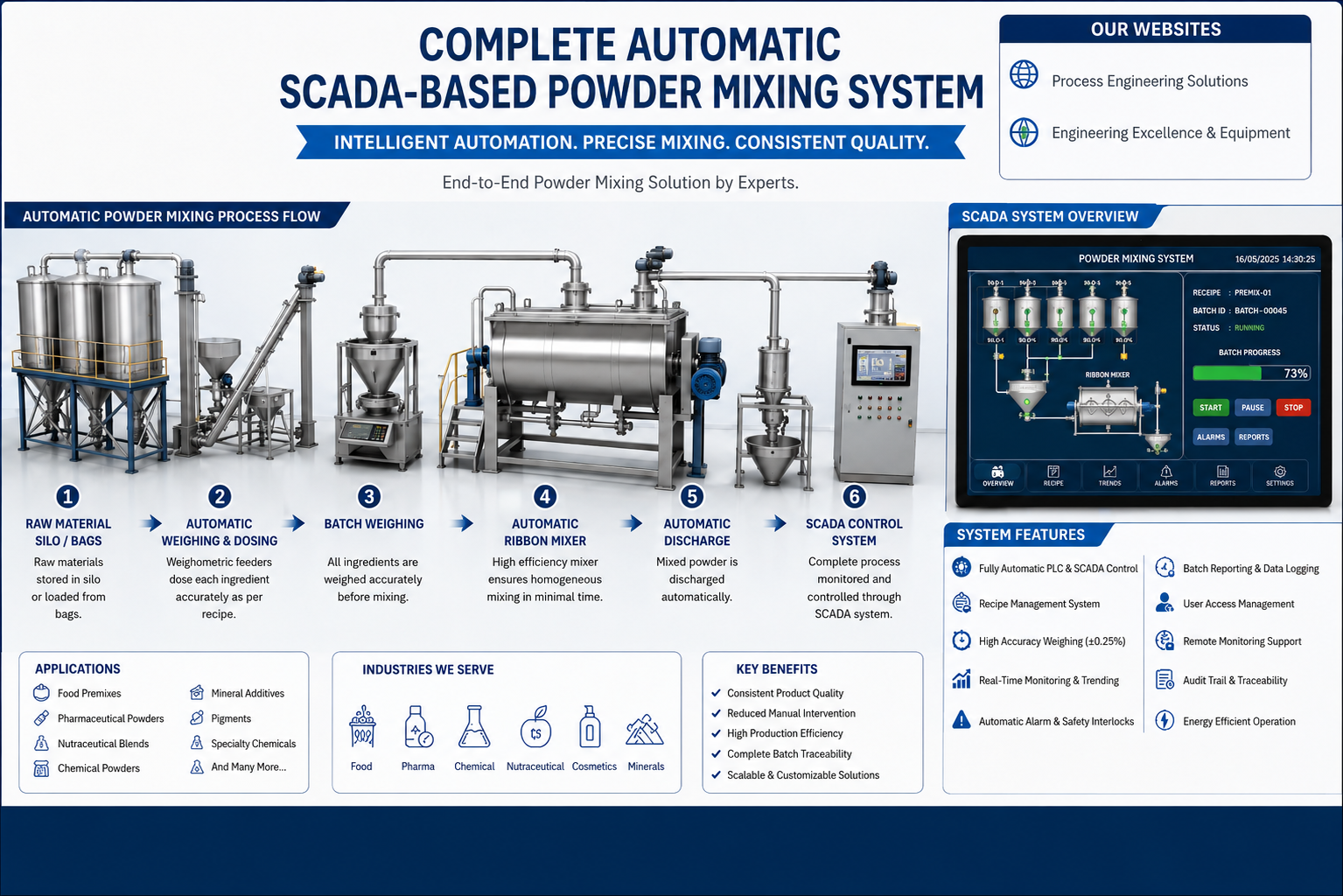 | Engineering Process System Complete Automatic SCADA - Based Powder Mixing System Intelligent Automation. Precise Mixing. Consistent Quality. At Metasis Equipment’s Pvt. View product → |
Frequently asked questions
What powders are suitable for ribbon blenders for pharmaceuticals?
Ribbon blenders suit free-flowing powders and granules that achieve uniformity through repeated bulk movement without intense shear.
How do you prevent dead zones, clumping and segregation in a ribbon blender?
Control fill level, ribbon-to-vessel clearance, charging order, discharge design and the powder’s cohesion and density differences.
How do you prove a pharmaceutical powder blend is uniform?
Define the mixing endpoint, take representative samples from multiple locations and compare results with the acceptance criteria.
What belongs in a pharmaceutical ribbon blender equipment specification?
Specify powder properties, batch size, fill range, materials, cleanability, mixing performance, sampling, discharge and scale-up requirements.
Related products
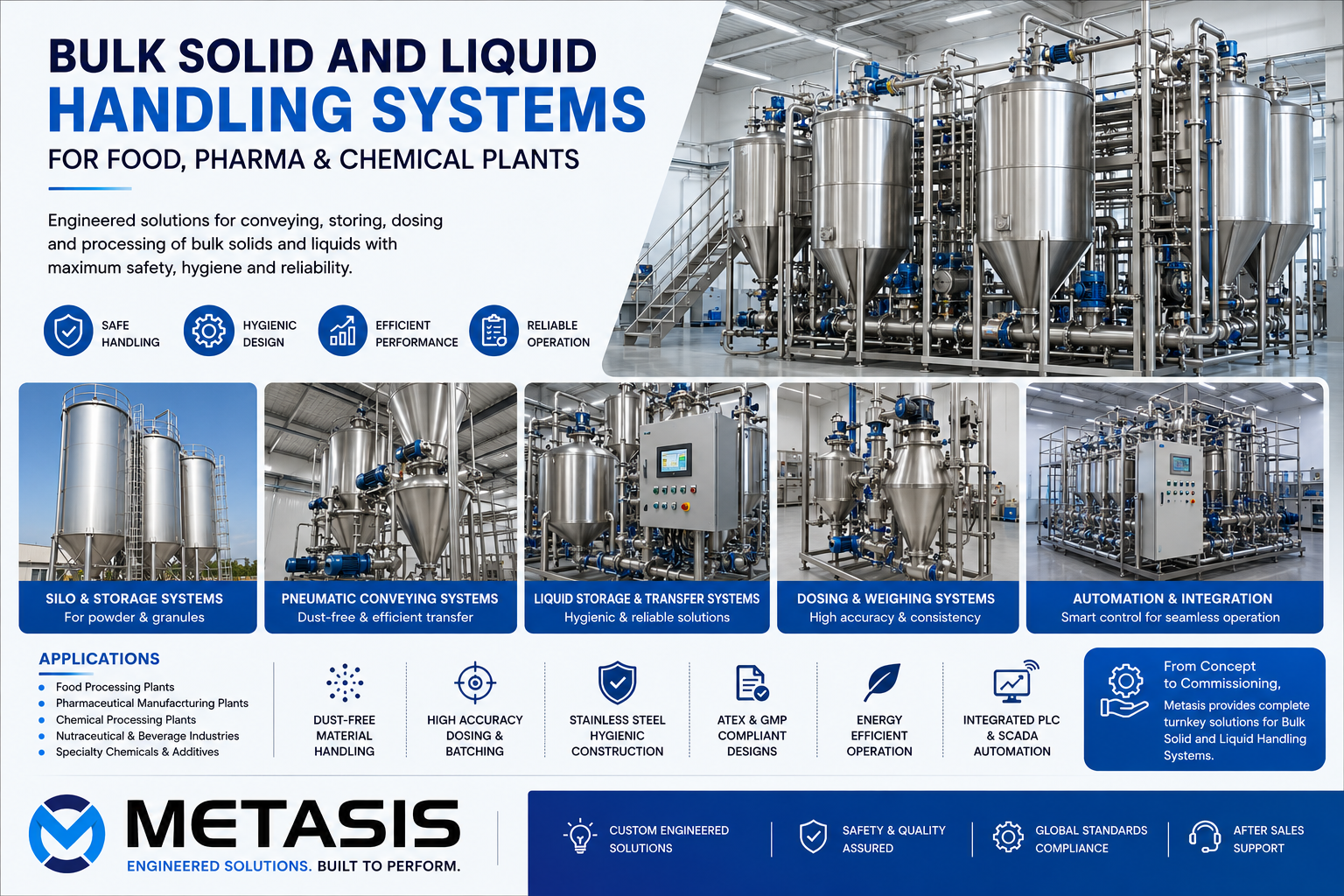 | Engineering Process System Bulk Solid and Liquid Handling Systems Bulk Solid and Liquid Handling Systems For Food, Pharma & Chemical Plants At Metasis Equipments Pvt. View product → |
 | Material Handling System Automatic Powder Handling, Weighing, Mixing & Bagging System Fully Automated Solution for Powder Unloading, Conveying, Dosing, Mixing & Packaging Metasis Equipments Pvt. Ltd. View product → |