
Ribbon blenders are commonly used for mixing dry powders, granules, and selected powder-liquid formulations. They are found across industries such as food processing, chemicals, pharmaceuticals, minerals, spices, and industrial manufacturing where ingredients need to be distributed consistently throughout a batch.
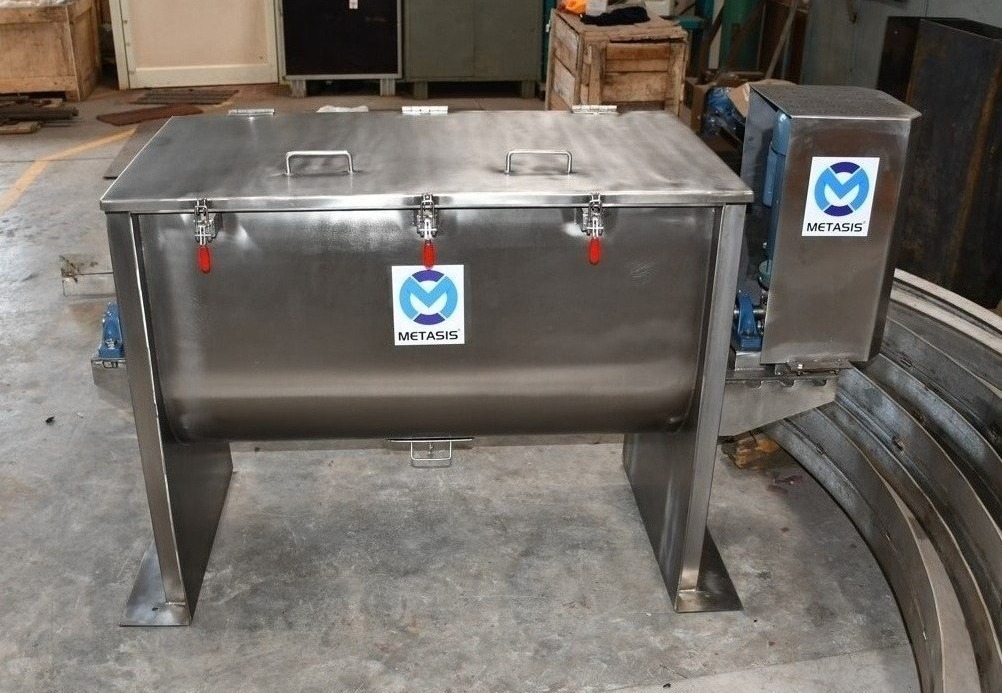
The equipment generally consists of a horizontal mixing chamber with an internal ribbon agitator. The inner and outer ribbons move material in different directions, creating continuous circulation within the vessel.
However, mixing performance depends on more than the presence of a ribbon agitator.
Material characteristics should be examined first. Differences in particle size, bulk density, flowability, moisture, and ingredient proportion can affect how materials behave during mixing. A formulation containing a small quantity of an additive may require different operating conditions from a simple mixture of similarly sized powders.
Batch capacity also needs careful consideration. Filling a blender beyond its intended working volume can reduce material movement. Operating with too little material may also prevent the ribbon geometry from working as intended.
Industrial buyers should consider factors such as:
Batch size
Material bulk density
Required mixing time
Ribbon configuration
Motor and gearbox selection
Product discharge requirements
Construction material
Cleaning accessibility
For food or spice processing applications, hygiene can become particularly important. Equipment design may need to reduce areas where product can accumulate and allow operators to clean contact surfaces efficiently.
Manufacturers operating in Pimpri-Chinchwad and other industrial regions of Maharashtra may also need the blender to connect with screw conveyors, bucket elevators, storage hoppers, feeders, or packaging equipment. Looking at the complete material flow can prevent avoidable handling between processing stages.
Safety and maintenance accessibility should also be considered during equipment design.
The right ribbon blender is therefore not simply determined by vessel capacity. Mixing requirements, material behaviour, cleaning expectations, discharge arrangements, and integration with the surrounding process all influence equipment selection.
Understanding these factors early helps businesses develop a mixing system that supports repeatable production rather than treating blending as an isolated operation.