
A belt can provide a steady, controlled route for ingredients, but its suitability depends on whether the material flows, sticks, breaks, segregates, creates dust, or requires containment. By checking the ingredient properties, route, capacity, sanitation demands, and competing conveyor types, you can decide whether a belt is the right equipment or an avoidable compromise.
Key takeaways
- Check moisture, oil, temperature, abrasiveness, friability, and dust before selecting a belt.
- Choose a belt for fixed, continuous routes when ingredients will not roll, leak, stick, or break.
- Calculate required capacity, route length, belt width, speed, loading rate, and discharge height.
- Specify cleanability, food-contact materials, guarding, emergency stops, and dust-control provisions.
Match the Conveyor to the Ingredient
A food conveyor belt for moving ingredients suits a controlled, continuous transfer along a mostly fixed route when the ingredient can ride without rolling, leaking, sticking, or breaking. Check bulk density, particle-size distribution, moisture, oil or fat content, temperature, abrasiveness, friability, and dust generation before choosing the belt.
| Ingredient form | Suitability indication | Main risk to test |
|---|---|---|
| Free-flowing granules | Good for horizontal or modest-incline transfer with contained loading | Segregation, bouncing, and spillage at transfers |
| Flakes or pieces | Good when the belt speed and drop height are low | Breakage, rolling, and size separation |
| Free-flowing powder | Suitable with sealed covers, controlled loading, and dust extraction | Dust escape, carryback, and buildup on the return side |
| Sticky or high-fat material | Suitable only with a belt surface and scraper proven against adhesion | Residue, tracking problems, and difficult allergen changeovers |
| Wet ingredient | Suitable when the belt, frame, drainage, and sanitation method tolerate moisture | Water traps, corrosion, and product sliding |
Run a product trial at minimum, normal, and peak feed rates. Watch the loading point, incline, discharge, belt return, and every transfer for buildup, dust, segregation, spillage, and damage.
Select the exact belt construction for the ingredient’s temperature, oil content, abrasion, cleaning chemicals, and sanitation temperature. “Food conveyor belt” is not a material specification; request food-contact compliance documents and confirm the belt survives the cleaning regime.
A highly cohesive powder, liquid slurry, steep vertical lift, or product requiring complete containment indicates that another conveying method may fit better.
Compare the Belt with Other Conveying Methods
Choose a belt conveyor when you need a continuous, controlled transfer along a mostly fixed route and the ingredient can travel without excessive slipping, sticking, or breakage. It suits moderate inclines, visible product flow, and gentle handling better than many alternatives.
| Option | Choose a belt conveyor instead when | Choose the other method when |
|---|---|---|
| Screw conveyor | You need lower product compression and easier inspection over a long horizontal run. | Choose a screw for compact transfers, controlled feeding, or cohesive powders that need agitation. |
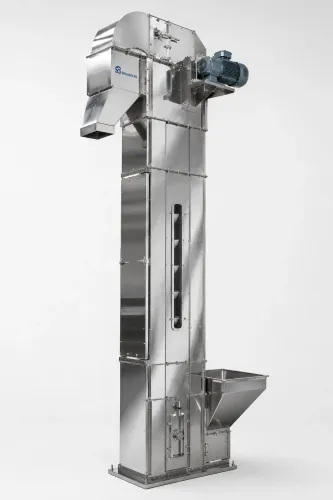
| Bucket elevator | The route is horizontal or only moderately inclined and you need gentler handling. | Choose an elevator for a steep vertical lift with limited floor space. |
| Pneumatic system | The ingredient is not highly dusty, fragile, heat-sensitive, or prone to segregation. | Choose pneumatic conveying for sealed routing, many destinations, or complete containment. |
| Vibratory conveyor | You need a defined route with steady belt loading rather than spreading, scalping, or gentle metering. | Choose vibration for short transfers, cooling, spreading, or fragile pieces that bridge on belts. |
| Drag conveyor | You need visible, accessible conveying with less scraping and product-on-product contact. | Choose a drag conveyor for enclosed movement of bulk material through horizontal or inclined paths. |
A belt is the wrong choice for a steep vertical lift, liquid slurry, very hot material, or powder requiring sealed containment and dust control. For allergen changeovers, compare cleaning access and verified residue removal, not throughput alone.
Specify the ingredient conveyor as a metering device when dosing: belt speed, loading depth, bulk-density variation, surge control, and scale feedback determine mass flow. A constant speed does not guarantee a constant dose.
Size the Route, Capacity, and Operating Speed
Use the shortest practical route, then calculate capacity from actual belt loading rather than belt width alone. Required capacity is peak ingredient demand, not average demand; convert it to mass flow with:
Capacity (kg/h) = belt loading (kg/m) × belt speed (m/h)
Measure belt loading at the ingredient’s lowest and highest bulk density, then compare the result with peak demand and your design margin. Constant belt speed does not ensure constant dosing: hopper surging, density changes, and uneven loading alter delivered mass flow.
- Specify route length, horizontal sections, elevation, incline angle, belt width, sidewalls, cleats, transfer heights, and the allowable drop into the receiving vessel.
- Obtain a product trial before fixing an incline. Friction, moisture, particle shape, belt surface, and cleat spacing determine whether material slides, rolls, segregates, or spills.
- Limit loading height and acceleration for fragile pieces, flakes, and blends. A large drop or fast transfer can break particles or separate fine and coarse fractions.
- For dosing, define target and peak kg/h, belt-speed range, hopper volume, surge control, and belt-scale or loss-in-weight feedback.
| Route feature | Sizing decision | Failure prevented |
|---|---|---|
| Horizontal run | Size belt loading for peak flow at the lowest bulk density | Starvation or overflow |
| Incline | Prove the angle with the actual ingredient and belt | Sliding and spillage |
| Transfer point | Minimise drop height and align the receiving chute | Breakage and segregation |
| Metering section | Control feed depth and verify mass flow under surges | Dosing errors |
These checks distinguish robust belt conveyor applications from a nominally wide ingredient conveyor that cannot deliver a stable, clean flow.
Verify Hygiene, Dust Control, and Machine Safety
A food processing conveyor passes a hygiene review only when every product-contact surface and adjacent space can be reached, cleaned, dried, and inspected. Specify stainless-steel frames, smooth continuous welds, sealed or hygienic fasteners, cleanable belt supports, and bearings and drives positioned outside the product zone.
Check these access details before approval:
- Lift-up or quick-release belt supports that expose the return side, pulley faces, and frame corners
- Openings large enough to inspect transfer chutes, skirts, scrapers, and the underside of the food conveyor belt
- Drainable surfaces without ledges, hollow sections, exposed threads, or water traps
- Removable guards and covers that require controlled removal, with lockout before anyone enters a guarded area
Guard every nip point, rotating pulley, take-up, shaft, and drive. A sanitary design does not remove the need for fixed or interlocked guards, emergency stops, and safe isolation during cleaning. A guard that blocks inspection without a defined removal method creates a sanitation failure and an injury risk.
For flour, starch, sugar, and other fine powders, specify dust collection at loading and discharge points, bonding and grounding for static control, and an assessment of combustible-dust ignition sources. Enclosure reduces emissions but can hide buildup and trap heat, so include inspection doors and cleaning access.
Treat each transfer as a hygiene and safety checkpoint. Use short drops, controlled feed trajectories, suitable skirts, and accessible chutes to limit spillage, dust, product damage, and residue.
Turn the Decision into a Purchase Specification
Give the supplier a process brief, not merely “a food conveyor belt for moving ingredients.” State the ingredient name, bulk-density range, particle-size distribution, moisture, fat, temperature, stickiness, abrasiveness, friability, dust generation, target and peak mass flow, and whether the conveyor transports or meters.
Include a route drawing with length, elevation, incline, transfer points, allowable drop height, belt-speed range, hopper dimensions, containment, sanitation method, washdown temperature and chemicals, cleaning frequency, allergen changeover time, guarding, controls, and available utilities. For belt conveyor applications, ask for the exact belt construction, splice method, cleat and sidewall materials, and food-contact compliance documents.
Metasis Equipments Pvt Ltd can use this information to distinguish a transport conveyor from a dosing system requiring belt-scale or loss-in-weight feedback.
Require these checks before approval:
- Run the actual ingredient at target and peak rates, recording belt speed, loading, spillage, segregation, breakage, and discharge consistency.
- Verify metering accuracy across the stated bulk-density range, including startup, stoppage, hopper refill, and upstream surge.
- Inspect every food-contact surface, return roller, cleat, sidewall, frame, and transfer point for residue traps and tool-free cleaning access.
- Time the documented allergen changeover and inspect swab or visual-cleaning results against your acceptance criteria.
- Test guards, emergency stops, interlocks, alarms, dust containment, belt tracking, and restart behavior, then record serial numbers and approved drawings.
Related products
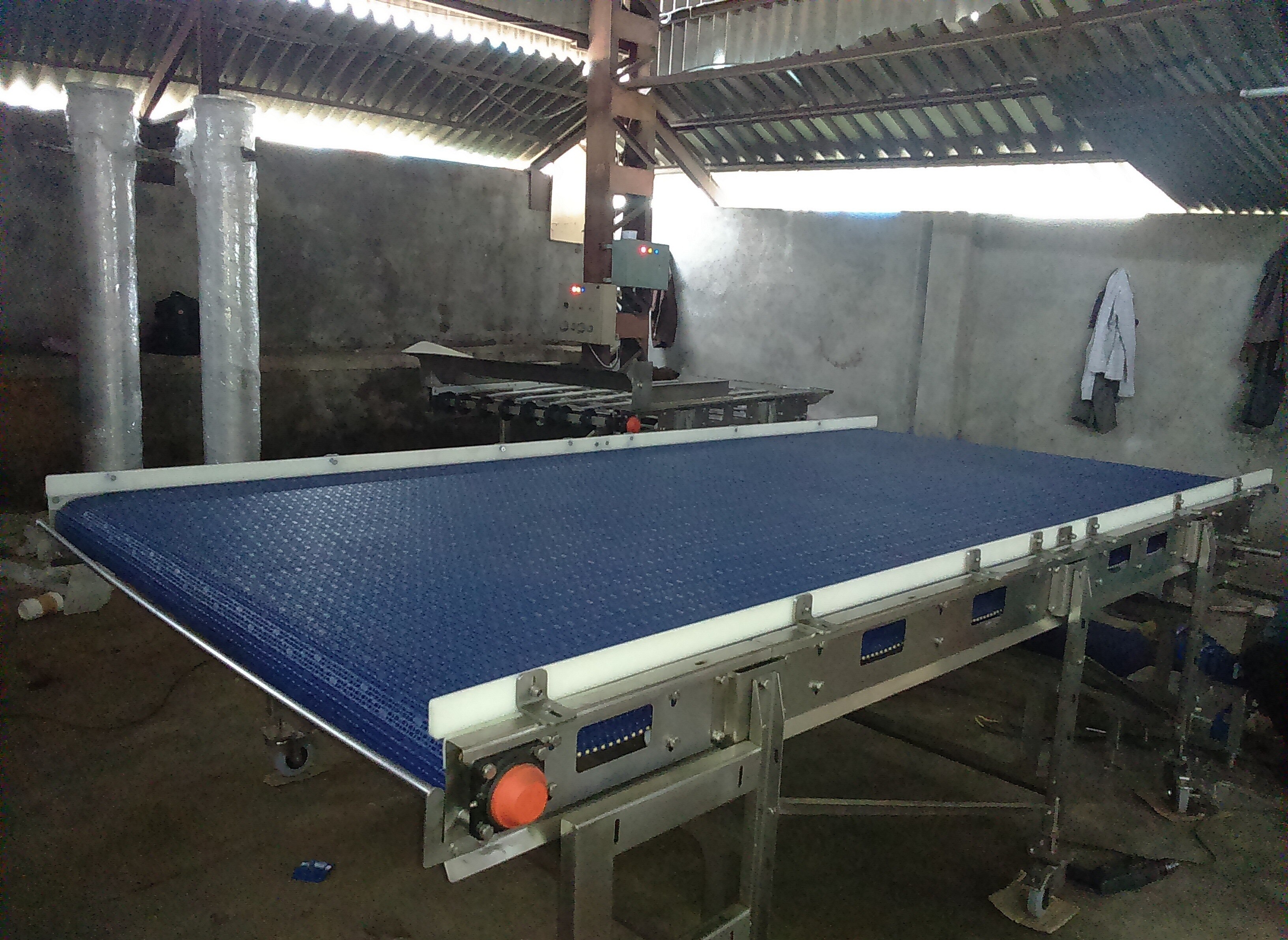
 | Belt Conveyor Metasis Equipment Pvt. Ltd. is a leading belt conveyor manufacturer in India, providing high-performance conveyor systems for efficient and reliable... View product → |
 | Bucket Elevator Efficient Vertical Material Handling Solutions A Bucket Elevator is a highly efficient conveying system designed for the vertical transportation of... View product → |
Frequently asked questions
When is a food conveyor belt suitable for moving ingredients?
Use a belt for controlled, continuous transfer along a mostly fixed route when the ingredient can ride without rolling, leaking, sticking, or breaking.
What ingredient properties determine conveyor suitability?
Check bulk density, particle-size distribution, moisture, oil or fat content, temperature, abrasiveness, friability, and dust generation.
What should you include in a food conveyor purchase specification?
Define capacity, route length, belt width and speed, loading and discharge points, construction materials, cleanability, dust control, guarding, and emergency stops.
Related products
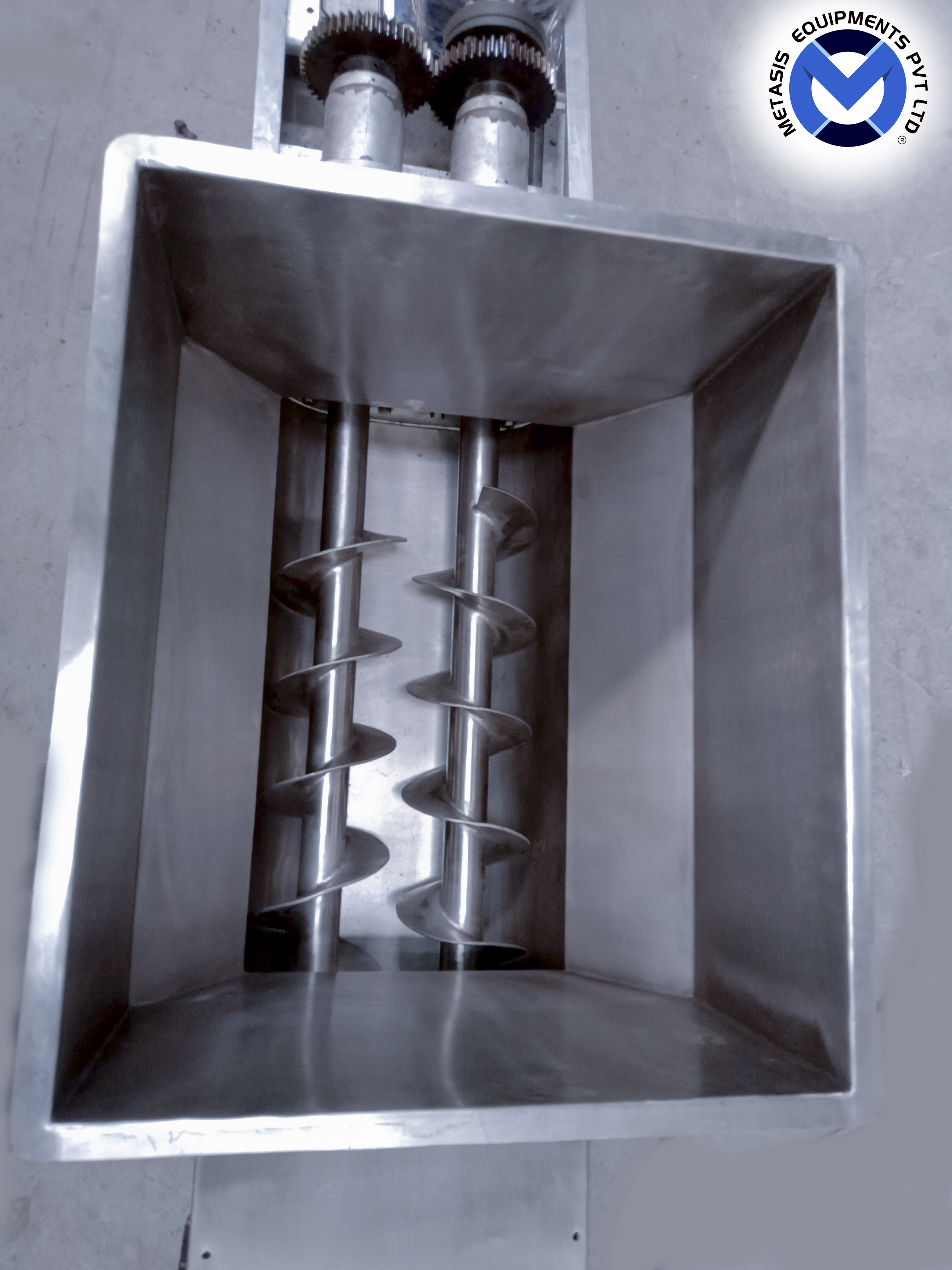 | Screw Conveyor Global Leader in Custom Screw Conveyor Solutions Metasis Equipments Pvt. Ltd. View product → |
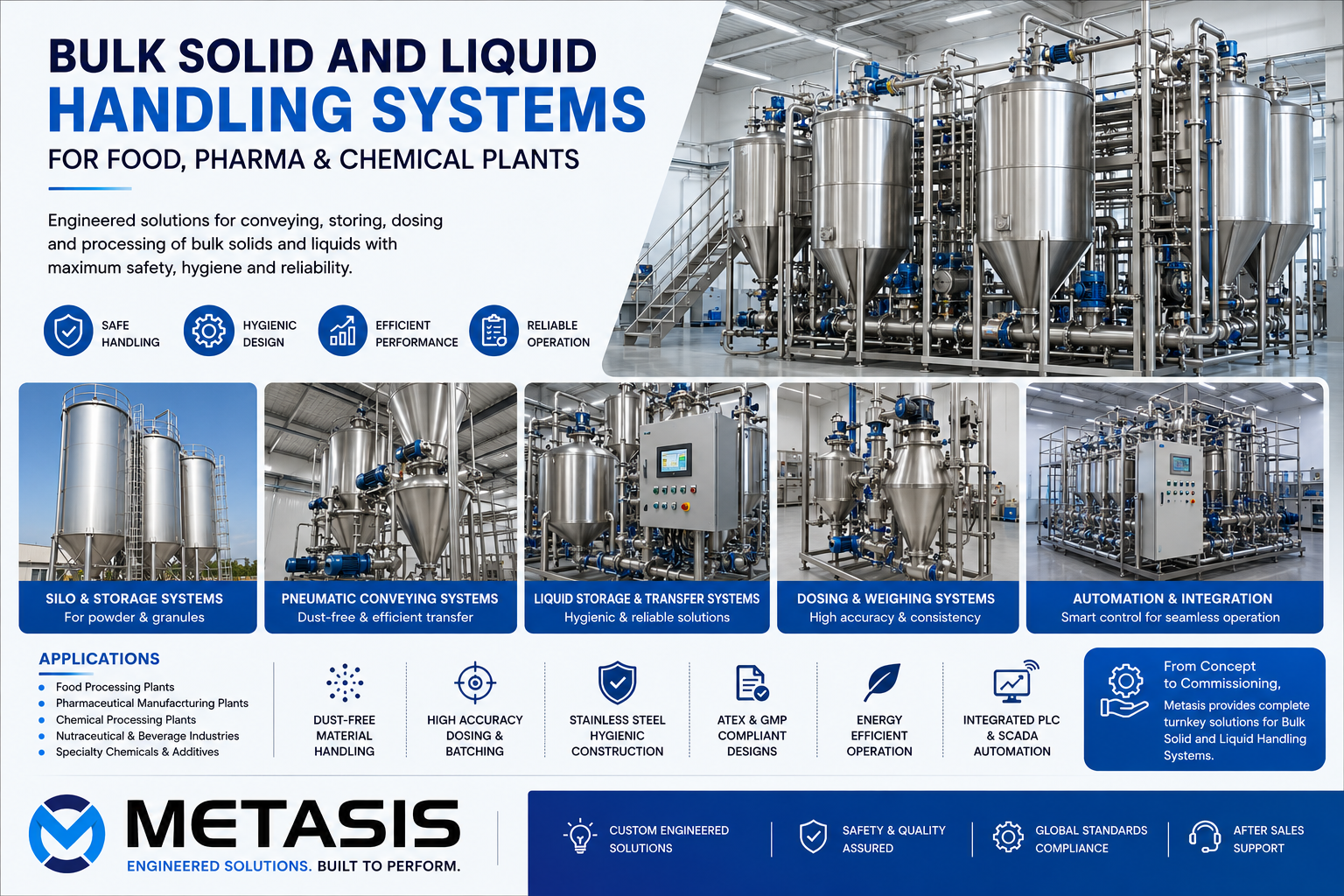 | Engineering Process System Bulk Solid and Liquid Handling Systems Bulk Solid and Liquid Handling Systems For Food, Pharma & Chemical Plants At Metasis Equipments Pvt. View product → |
 | Material Handling System Automatic Powder Handling, Weighing, Mixing & Bagging System Fully Automated Solution for Powder Unloading, Conveying, Dosing, Mixing & Packaging Metasis Equipments Pvt. Ltd. View product → |