
A pilot skid must reveal how a process behaves across recipes, feed rates and operating windows; a production skid must deliver repeatable output, safe operation and maintainable throughput. By the end, you will be able to classify the available skid types, choose the right architecture, define the data a supplier needs and plan a credible scale-up.
Key takeaways
- Classify skids by process duty, not footprint or vessel capacity.
- Match pilot service to learning needs and production service to repeatability.
- Use scale-up variables such as residence time, heat transfer and throughput.
- Write measurable acceptance criteria into the skid specification and bid documents.
Classify the skid by its job, not its physical size
Which process skids fit pilot plants depends on the evidence you need: process skids for pilot plants require breadth for learning, while production skids require repeatability.
| Option | Primary job | Defining choice |
|---|---|---|
| Laboratory or bench skid | Screen chemistry and equipment concepts | Small inventory, manual intervention, fast changes |
| Pilot skid | Establish operating windows and scale-up data | Flexible connections, interchangeable contact parts, broad turndown |
| Demonstration skid | Prove extended operation at near-commercial conditions | Longer campaigns and more representative controls |
| Modular production skid | Manufacture repeatably with packaged capacity | Narrower validated range, higher automation |
| Full-scale fixed plant | Deliver sustained commercial output | Permanent utilities, structures, storage and dedicated equipment |
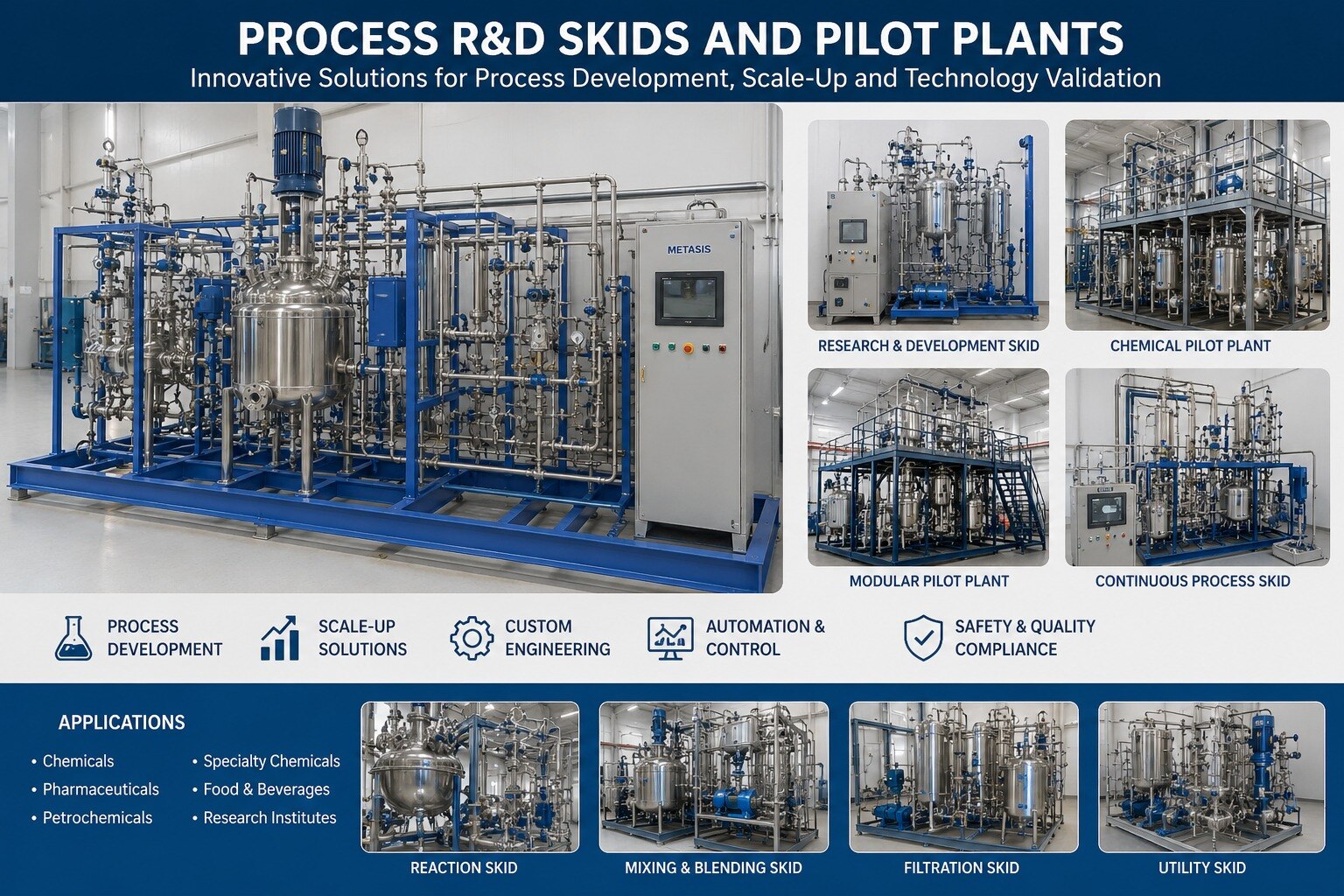
A typical train contains these equipment blocks:
- Feed hopper or tank, metering device and pump
- Mixer, reactor and heat exchanger
- Filter, separator and instrumentation
- Control panel and discharge system
Pilot equipment prioritizes recipe changes, multiple feed rates and residence times. Production equipment is optimized around a narrower validated operating range, so broad turndown can sacrifice efficiency.
Batch skids offer recipe flexibility and suit frequent campaign changes. Continuous skids support steady-state throughput and lower hold-up, but demand stable feeding, residence-time control and off-specification diversion. Semi-continuous skids combine timed batches with ongoing steps, trading some flexibility for smoother flow. Choose batch for changing recipes, continuous for consistent volume, and semi-continuous when both matter.
Choose pilot or production service from measurable process demands
Choose a pilot skid when you need evidence across multiple feed rates, residence times, recipes and operating windows, not merely a smaller production run. Choose production equipment when batch size, hourly throughput, residence time, operating hours per day and campaign frequency are stable enough to validate one defined range.
A transition skid fits when pilot data exists but scale-up objectives still require extended campaigns, higher automation or numbered-up capacity.
| Option | Measurable demand | Design priority |
|---|---|---|
| Pilot skid | Small batches, frequent recipe changes, variable feed rates and short campaigns | Flexible piping and instrumentation, interchangeable parts, broad turndown and manual access |
| Transition skid | Longer campaigns, repeated recipes and rising daily hours | Automated controls, representative cleaning, redundancy and maintenance access |
| Production skid | High throughput, fixed recipes and validated residence time | Cleanability, repeatability, fault tolerance, validation records and expansion capacity |
For process skids for pilot plants, a loss-in-weight feeder improves formulation accuracy when bulk density changes. Performance still depends on refill strategy, vibration isolation, hopper geometry, powder flowability and the minimum stable feed rate; headline accuracy does not hold across full turndown.
Use a production skid only after confirming:
- The feeder remains stable at the lowest required rate.
- Cleaning, validation and traceability match the manufacturing use.
- Spare capacity, operator access and expansion plans justify the higher fixed cost.
- Batch, continuous or semi-continuous operation has been tested through startup, shutdown and recipe changeovers.
Select one integrated skid, several modules or a fixed plant
Choose one compact train when fewer interfaces and faster installation matter more than independent access to every operation. Separate skids suit feeding, reaction, separation, drying, conveying or packing when maintenance access, fault isolation, vendor independence and numbered-up capacity matter more.
| Option | Best balance | Main compromise |
|---|---|---|
| Integrated skid | Fast installation, one control boundary, fewer product and utility interfaces | Restricted access and a single fault can stop the train |
| Separate process skids | Easier maintenance, isolation, replacement and phased expansion | More connections, controls, transfers and commissioning work |
| Fixed plant | Very high throughput, large storage and permanent utilities | Civil works, longer installation and limited relocation |
Treat powder conveying as a process choice, not a distance calculation. Dilute phase raises velocity but can increase attrition, segregation and line wear. Dense phase lowers velocity-related damage, yet demands tighter control of pressure, solids loading and powder flowability.
A skid is the wrong choice for very high flow rates, large storage volumes, heavy structural loads, difficult site access, major utility demands or extensive civil works. Define the battery limit before purchase and assign ownership for:
- Product inlets and outlets, utilities, vents, dust-extraction connections, drains, compressed-air quality, electrical supply, network interfaces, control integration and structural loads.
Ambiguous boundaries leave missing transition pieces, utility tie-ins or controls at site. A larger single train, parallel trains or a hybrid often beats one monolithic package.
Scale up the controlling variables instead of multiplying vessel volume
Do not scale a pilot vessel by volume alone. Select the production design around the variable that controls quality: Reynolds number, impeller tip speed, power per unit volume, gas dispersion, or mixing time. Holding one constant can change another, so document the trade-off rather than claiming a single universal scale factor.
| Option | Strength | Cost or risk |
|---|---|---|
| Geometric scale-up | Increases vessel and equipment dimensions while preserving proportions | Mixing, shear, heat transfer and power rarely remain proportional |
| Numbering-up | Repeats pilot modules to retain mixing or residence-time behaviour | Adds valves, instruments, control loops and failure points |
| Hybrid design | Numbers-up sensitive modules and enlarges tanks or utilities elsewhere | Requires careful interface and control integration |
Preserve heat-transfer area per batch duty, dosing accuracy, residence-time distribution, pressure drop, shear exposure and feed-rate stability. A production skid can require more area, parallel feeders or staged mixing even when the vessel volume appears adequate; process skids for production should target the validated operating window, not a theoretical volume ratio.
A useful pilot skid captures more than final product quality:
- Torque or power draw, temperature profiles and mixing time
- Pressure drop, filter loading and conveying pressure or velocity
- Feed-rate stability, residence-time distribution and material holdup
- Startup and shutdown transients, plus cleaning time
Powder trials must include representative refill points, flexible connections, vacuum receivers, filters and discharge devices. Omitting them hides bridging, ratholing, dusting, segregation and filter blinding before production scale.
Write a bid-ready specification that survives commissioning
Before requesting a quote, freeze the design basis and identify who will verify each value. State which process skids fit pilot plants and which process skids for production require fixed, validated operating limits.
1. Provide the material’s solids concentration, bulk density, viscosity, particle-size distribution, corrosiveness, temperature, pressure, flow rate, batch volume and cleaning method. Include startup, shutdown and upset conditions, not only normal operation.
2. Define the hygienic boundary: product-contact materials, internal surface finish, drainability, gasket design, dead-leg geometry, spray coverage and CIP flow rate, temperature, chemistry and return conditions. Assess combustible dust using the actual material and configuration, including moisture, ignition sensitivity, explosion severity, dust-release points and collector arrangement.
Specify bonding, isolation, venting or suppression where the assessment requires it. For pressure equipment in the European Economic Area, check the Pressure Equipment Directive using pressure, volume or nominal size, fluid group and hazard category—not a generic CE-mark request.
3. For regulated work, identify critical process parameters, critical quality attributes, material traceability, calibration records, recipe and version control, and deviation handling. Define FAT for wiring, I/O, logic, alarms, interlocks and selected checks; reserve SAT for site utilities and interfaces, and commissioning for installed performance with actual material.
Metasis Equipments Pvt Ltd can convert these inputs into a customized skid specification, battery limits and integrated handling package. A successful pilot remains scale-up evidence, not production validation.
Related products
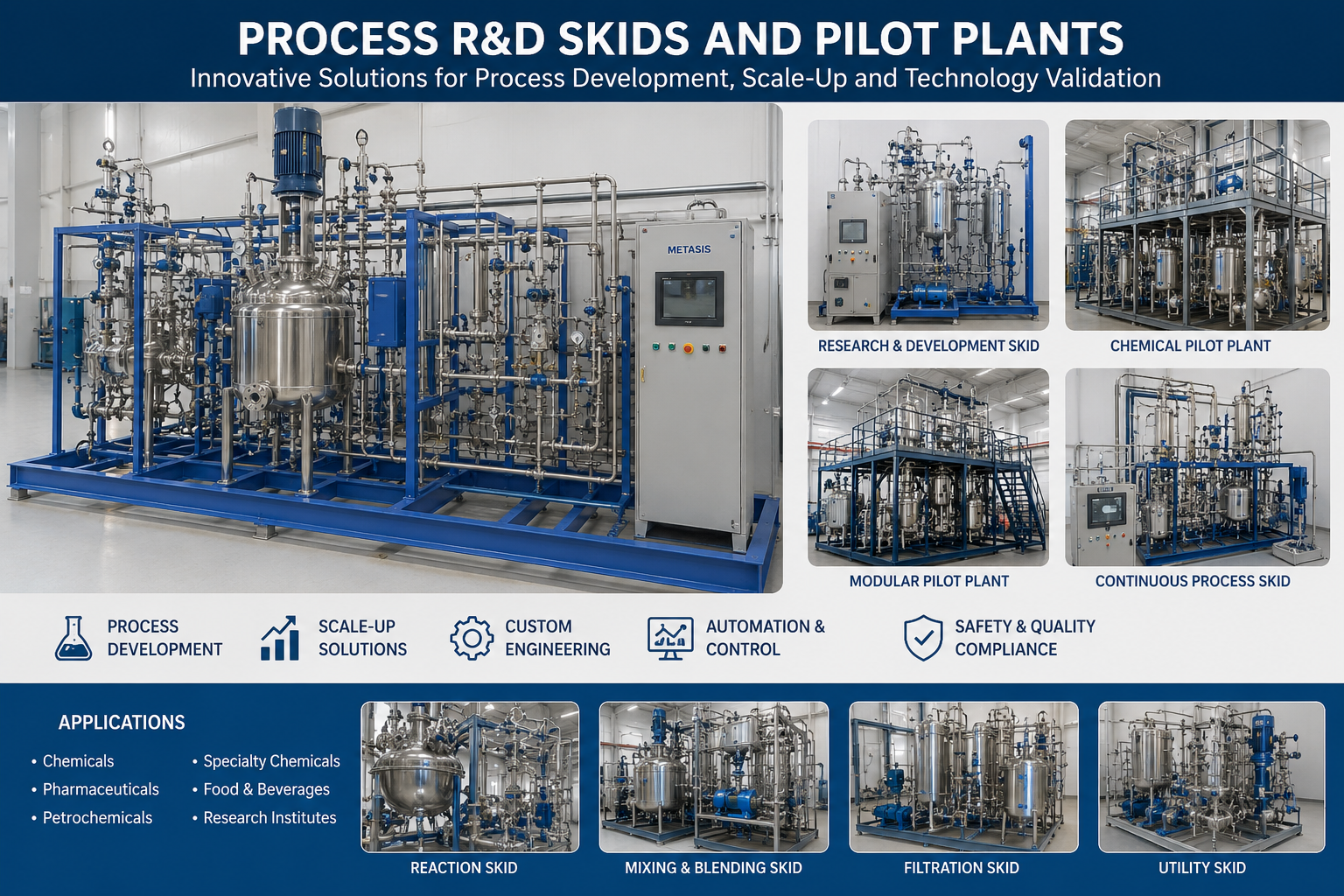 | Engineering Process System Process R&D Skids and Pilot Plants Innovative Process Development Solutions At Metasis Equipments Pvt. View product → |
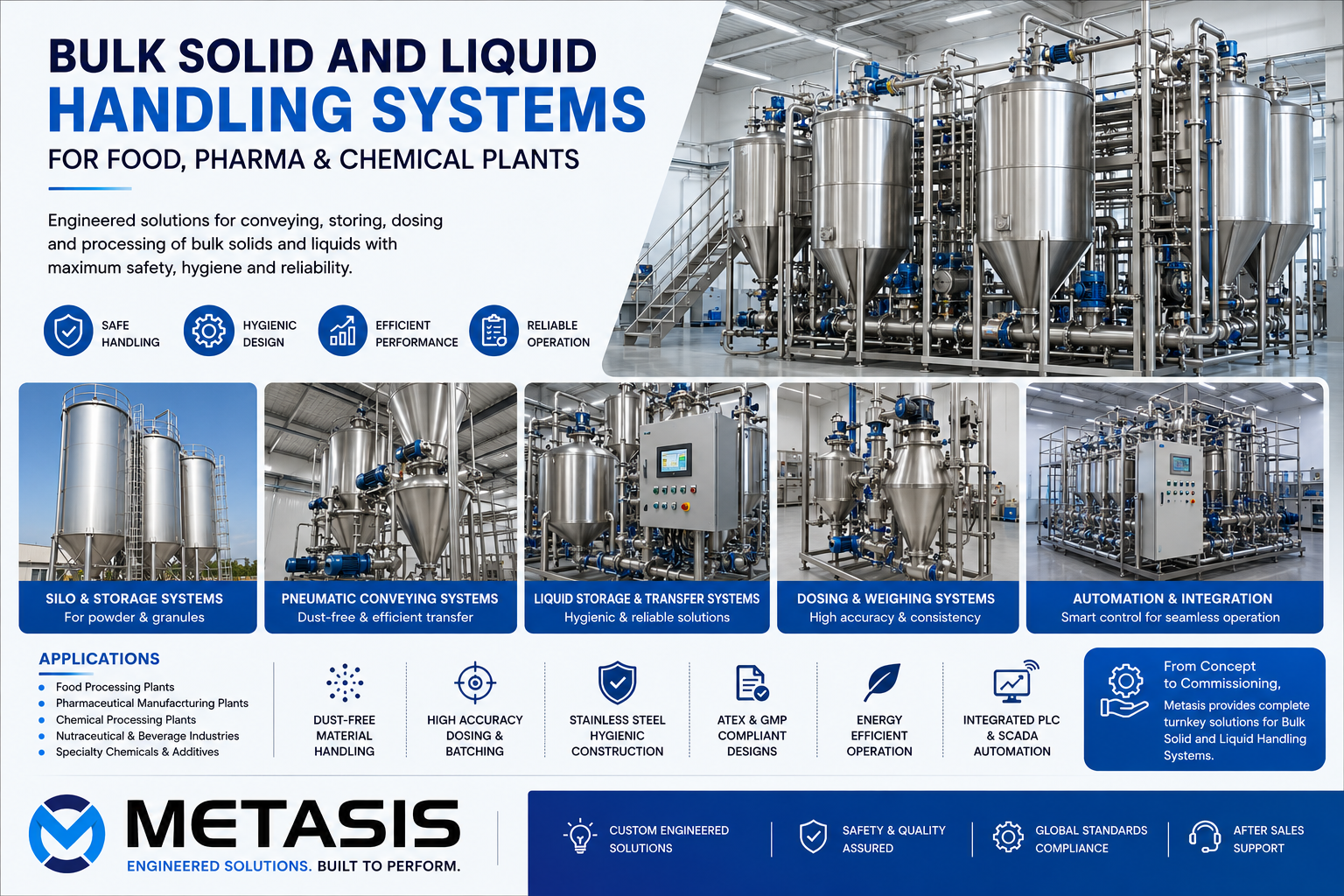 | Engineering Process System Bulk Solid and Liquid Handling Systems Bulk Solid and Liquid Handling Systems For Food, Pharma & Chemical Plants At Metasis Equipments Pvt. View product → |
Frequently asked questions
Which process skids fit pilot plants?
Pilot plants need flexible process skids that support testing, sampling, recipe changes and measurement of scale-up variables. Specify the required operating range rather than selecting equipment by physical size.
How do process skids for pilot plants differ from process skids for production?
Pilot skids prioritise flexibility, access and process learning. Production skids prioritise repeatable throughput, controlled operating conditions, maintainability and documented commissioning performance.
Should you choose one integrated skid, several modules or a fixed plant?
Choose an integrated skid when transport and rapid installation matter, several modules when process stages need independent changes, and a fixed plant when capacity, utilities and permanent infrastructure dominate.
What belongs in a bid-ready process skid specification?
State feed composition, throughput, temperature and pressure ranges, residence time, materials of construction, utilities, controls, documentation, testing requirements and measurable commissioning acceptance criteria.
Related product
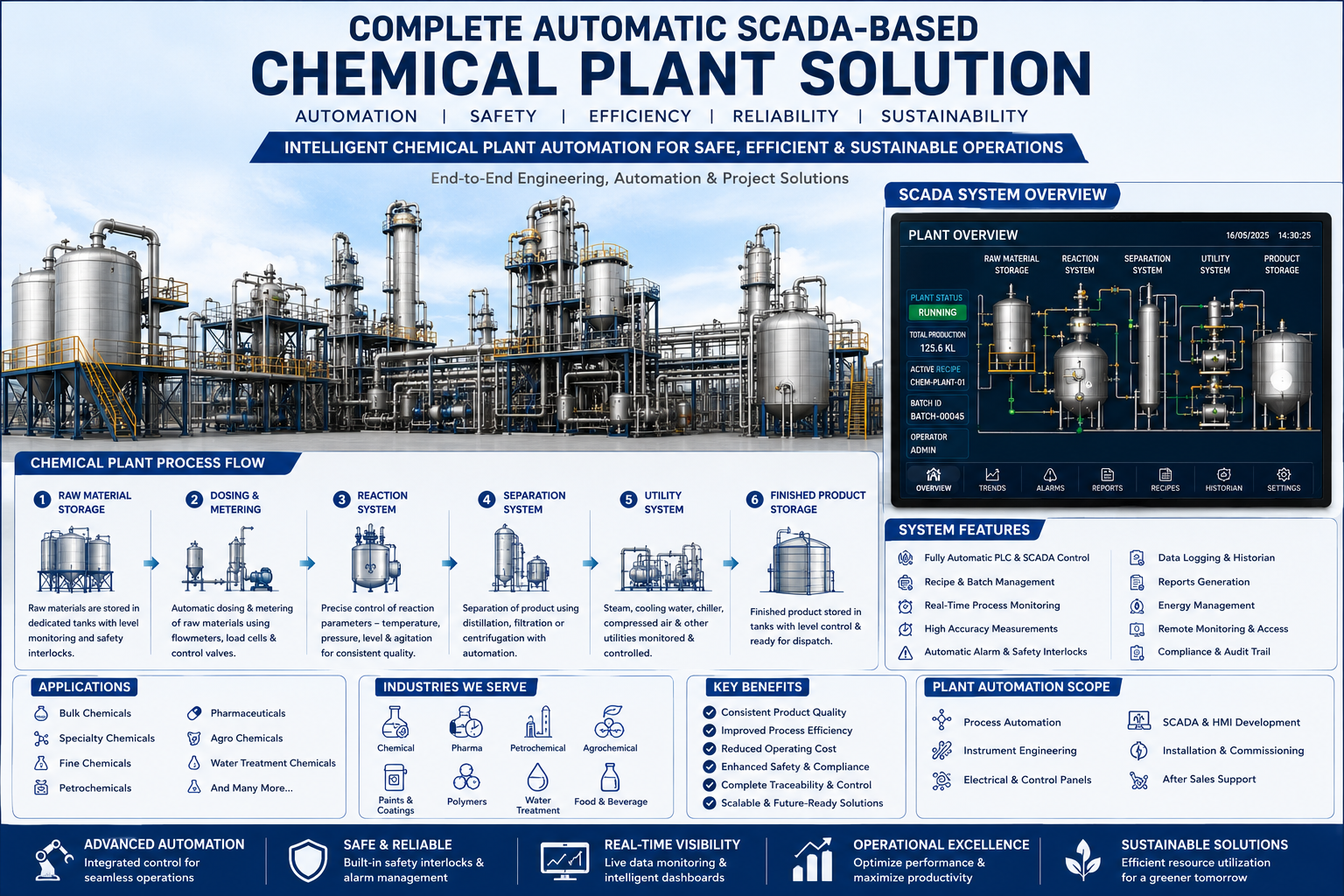 | Engineering Process System Metasis Equipments Pvt. Ltd. – Engineering Excellence in Process Solutions Metasis Equipments Pvt. Ltd. View product → |